
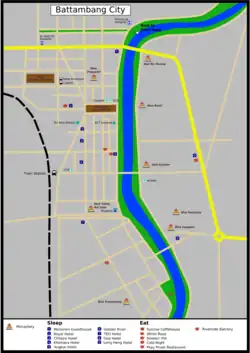
Battambang
Baat Dambang, Cambodia
Why visit Battambang?
Battambang (Khmer: ក្រុងបាត់ដំបង), Cambodia's second-largest city with around 119,000 residents, sits on the banks of the Sangker River in the country's fertile northwest. The city's name derives from a local legend about an ancient Khmer king who wielded a magical stick (dambong) to quell rebellions — a story commemorated by the Lok Ta Dambong Kra Nhoung statue on the road in from Phnom Penh. Long the rice basket of Cambodia, the surrounding province produces much of the country's grain, and the relaxed provincial capital still feels closer to its agricultural roots than to the tourist-heavy cities elsewhere. Its compact riverside core preserves one of Cambodia's best-surviving stocks of French colonial shophouses, gently weathered, often painted ochre and cream, and lining streets that remain easy to wander on foot.
Battambang is often skipped in favor of Siem Reap and Phnom Penh, and that is precisely the appeal: it is quieter, cheaper and less Westernized, with a small but lively café and arts scene anchored by the celebrated Phare Ponleu Selpak circus school. Travelers come for the bamboo train, the cliff-top "killing caves" of Phnom Sampeu, Angkor-era ruins like Wat Banan and Wat Ek Phnom, countryside cycling, and Khmer cooking classes — most of it within a 30-minute tuk-tuk ride of the centre.
The climate is tropical monsoon. The cool dry season (November–February) is the most comfortable time to visit, with daytime highs around 30°C and low humidity. March to May is uncomfortably hot, often above 35°C. The rainy season (June–October) brings short, heavy afternoon downpours, lush green countryside, and the highest river levels — also the only window when the boat from Siem Reap reliably runs all the way to town.
Planning Battambang? Tell us your dates and we’ll tailor the trip.
Ask on WhatsAppHow do you get there?
By Train
Battambang Station (☏ +855 99 457 626) sits a short walk west of the city centre. Royal Railway runs one daily train each way between Phnom Penh and Battambang, continuing on toward Poipet on certain days as the line has reopened. The southbound service departs Phnom Penh at 06:40 and arrives Battambang around 13:00 (US$8); the return leaves Battambang at 15:00. Connections en route include Pursat (2½ hr, US$4) and Maung Russey (1 hr). The carriages have no air-con but the wide-open windows and ceiling fans are usually sufficient outside of the hot-season midday. The train is slower than the bus but offers far better scenery, and is generally considered the best way to travel between Phnom Penh and Battambang. Buy tickets at the station or via the Royal Railway website a day or two ahead in peak season.
By Car / Road
National Highway 5 from Phnom Penh (≈290 km) takes around 5 hours on what is now mostly sealed and reasonable road. From Sisophon (≈70 km, 1 hr) Highway 6 branches east to Siem Reap (≈170 km, 3–4 hr), and Highway 5 continues northwest to Poipet at the Thai border (≈110 km, 2–3 hr). Highway 57 connects Battambang to Pailin (≈85 km, 2 hr).
Bus services and approximate fares:
- Phnom Penh — US$5–12, 5–6 hr. Operators include Virak Buntham (departs ~05:00, 06:30), VET Air Bus Express (07:00, 13:00), Capitol (hourly 07:00–14:45), and Phnom Penh Sorya (multiple departures from 06:30).
- Siem Reap — US$4–5, 4 hr.
- Poipet (Thai border) — US$4–5, 2–3 hr.
- Pailin — Paramount Angkor runs twice daily for US$4 (2 hr).
- Bangkok — Phnom Penh Sorya offers through services via Poipet.
A scenic but slow boat runs once daily from Siem Reap (departing 07:00, US$20). The journey threads small rivers and floating villages and takes 6–12 hours depending on water levels; in the dry season the final leg is completed by minibus or pickup truck.
Central Battambang is compact and walkable — most cafés, guesthouses, the riverside, and the colonial quarter sit within a 10–15 minute stroll of Psar Nath market. Footpaths and roads, however, have deteriorated noticeably since 2020, with potholes common; watch your step at night.
Bicycles rent for US$1–2 per day from most guesthouses and are excellent for exploring the riverside and outer neighbourhoods. Motorbikes start at US$5 per day; local driving is hazardous and police occasionally fine foreigners — if pulled over, stay calm, remove the key from the ignition, and expect to pay US$1–2 to move on.
Tuk-tuks and motodops congregate around tourist areas and the markets. Most rides within town cost US$2–4. Out-of-town trips run US$10 to Phnom Sampeu alone, or US$12–15 for a half/full-day countryside circuit combining Phnom Sampeu, Wat Banan and the bamboo train. Drivers like Sam Bo (093 255 505) and Chan (081 625 554) speak excellent English and are well regarded as guides; tip generously, especially in low season.
Small ferry boats (500 riel) cross the Sangker River from in front of the market and are useful for reaching the east bank's quieter wats and villages. PassApp and Grab are not as ubiquitous as in Phnom Penh; PassApp generally works in town but supply is thin.
What are the things to do?
Temples and ruins
- Wat Banan — the so-called "mini-Angkor Wat", an Angkor-style five-tower temple atop a long flight of stairs about 25 km south of the city. Still in use as a Buddhist shrine. Admission is included with the Phnom Sampeu ticket.
- Wat Ek Phnom — about 10 km northwest of town, an 11th-century Angkor-era temple ruin reached via a pretty rural road. A massive modern Buddha statue stands nearby and the carvings on the old temple are well preserved in places.
- Wat Samrong Knong — an extremely old pagoda on the east bank of the Sangker, used as a Khmer Rouge prison. A new pagoda is being built alongside, and a memorial just to the north uses graphic illustrations to commemorate the regime's victims.
- Wat Baydamram — a working temple where hundreds of fruit bats roost in the trees under the protection of the resident monks.
Hills and caves
- Phnom Sampeu — a limestone hill ~12 km south of town, with the infamous "killing caves" of the Khmer Rouge era, several other caves containing Buddhist statuary, and a clifftop monastery with two stupas. The climb takes about an hour; allow time at dusk for the spectacular nightly emergence of millions of bats from a cave on the lower slope. Admission US$3 (includes Wat Banan).
Museums
- Battambang Provincial Museum — corner of Rd. 1 and Street 125. Tu–Su 08:00–17:30, closed Monday. Compact but worthwhile collection of Khmer artifacts spanning Hindu, Buddhist and Angkorian periods, plus neolithic pieces from the Laang Spean site. Renovated, with bilingual Khmer-English signage. US$1.
Statues and street sights
- Lok Ta Dambong Kra Nhoung — the giant statue of the legendary club-wielding king on the highway in from Phnom Penh; the eponymous landmark of the province.
- Peace Bird Statue — riverside roundabout monument, often a meeting point.
- The whole city is dotted with whimsical statues of animals (real and mythical) and deities; spotting them as you walk is a small pleasure of Battambang.
Performance
Phare Ponleu Selpak Circus — about 10 minutes by tuk-tuk from the centre. Probably the single most interesting thing happening in Battambang: energetic, theatrical circus performances staged by students and graduates of the NGO arts school that supports disadvantaged children. Schedules are posted on flyers around town and on phareps.org. Tickets US$16. ☏ +855 77 554 413, [email protected].
Bamboo Train (Norry) — a bamboo platform on train axles powered by a small go-kart engine, now running on a purpose-built loop track since the original line was rehabilitated for the Phnom Penh–Poipet service. The trip takes about 10 minutes out to a stop with cold drinks and souvenir t-shirts, then returns the same way. Regulated by the Tourist Police at US$5 per person (minimum 2 people, or US$10 solo); group discounts apply.
Soksabike Tours (Street 1.5, near Psar Nat; ☏ +855 12 542019; [email protected]) — half- and full-day countryside bike tours led by local university students, with a strong community-tourism model that returns most of the fee to the families visited along the way. Hotel pickup, helmets and a stop at one of Battambang's best cafés included.
Green Orange Kayak (☏ +855 77 204 121) — half-day, 11 km kayak descent of the Stung Sangker River from Ksach Poy village to Battambang, past riverside farms and stilt houses. US$12.
Battambang Countryside Tuk-tuk Trips (☏ +855 77 854 044) — customised day trips taking in temples, local craft villages and rural sites; hotel pickup.
Volunteer Teaching English (BOVA) (10 min north of Battambang; ☏ +855 12 326 577) — short-stay homestay in Samroang Khnong village helping local children practise English. No experience required. US$12 per night including three meals.
Cooking classes — a Battambang specialty:
- Nary's Kitchen — opposite Holiday Guesthouse, 200 m from the central market. ☏ +855 12 763 950. The original Battambang cooking school: market tour, hotel pickup, four dishes (vegetarian available) and a free cookbook to take home. US$10.
- Smokin' Pot — corner of Street 121 and Road 1.5. ☏ +855 12 821 400. Chef Vannak takes you to a produce market for ingredients then to his home for a hands-on, very Khmer-style class. US$10.
- Ch'Ngainh Ch'Ngainh — homey, family-style class in a private home. ☏ +855 12 639 350. Daily, US$10.
For tour bookings on a budget, The Real Place Hostel is widely used as an aggregator of group day trips — comparing prices at one or two other guesthouses is still worthwhile.
Planning Battambang? Want these on a customised itinerary?
Ask on WhatsAppWhere to eat?
Battambang punches above its weight for food. The city has a strong Khmer home-cooking culture (it is one of the best places in the country to learn Khmer cuisine), a row of riverside cafés in restored colonial shophouses, and good options for vegetarians thanks to its long Buddhist tradition. Signature regional dishes worth seeking out are num banh chok (rice noodles with green fish curry, the classic breakfast), fish amok (steamed coconut fish curry), lok lak (peppered beef with lime-pepper dipping sauce), kuy teav (rice noodle soup) and freshwater fish from the Sangker.
- Psar Nath food stalls (budget) — bowls of kuy teav and num banh chok at the market for around 8,000–12,000 riel (US$2–3). Best in the morning.
- Lan Chov Khorko Miteanh (budget) — a long-running family-run Khmer noodle and rice place near the centre; mains 10,000–18,000 riel.
- Jaan Bai (mid-range) — a social-enterprise restaurant supporting the Cambodian Children's Trust, doing modern Khmer-Asian small plates with strong vegetarian options. Mains around US$5–9.
- Pomme (mid-range) — French-Khmer bistro on the riverside in a colonial-era building; well-executed pasta, salads and Khmer classics. Mains US$5–10.
- Lonely Tree Café (mid-range) — fair-trade café/restaurant supporting a local NGO, with Western and Khmer dishes and a quiet upstairs terrace. Mains US$4–8.
- Smokin' Pot (budget–mid) — beyond the cooking class, the restaurant itself does excellent amok, lok lak and curries for US$3–5.
Vegetarian food is widely available on request. Halal options are limited but a small Cham Muslim community sustains a few halal noodle stalls near Psar Nath.
Where to drink?
Cambodian beers — Angkor, Cambodia and Ganzberg — are the everyday drinks; expect US$0.75–1 for a draft and US$1–2 for a bottle. Sombai rice-wine liqueurs (infused with anise, ginger, lemongrass and other Khmer spices) are made locally and sold in souvenir bottles. Iced Khmer coffee with sweetened condensed milk is the universal afternoon pick-me-up; specialty third-wave coffee is increasingly available too, often using beans from Mondulkiri.
- Kinyei Café (Street 1.5) — small, much-loved coffee shop run as a barista training programme, generally regarded as the best espresso in town.
- Choco l'Art Café — colourful riverside café with cakes, smoothies and an arty crowd.
- Madison Corner — long-running expat-leaning bar on the river with a relaxed terrace.
- Miss Wong / "Pub Street" — the locals have rather optimistically named the main central cross-street "Pub Street" after Siem Reap's; it has a handful of low-key bars and is a fine place for a sundowner without being remotely as raucous.
- Libations — small craft cocktail bar that has become a fixture of the evening scene.
Tap water is not safe to drink. Bottled water is cheap and ubiquitous (1,500–2,000 riel for 1.5 L); ice in established cafés and restaurants is generally factory-made and safe, but be cautious at very cheap roadside stalls.
Planning Battambang? We’ll book the stays and dining for you.
Ask on WhatsAppWhere to stay?
Budget
- Here Be Dragons — a long-running backpacker hostel west of the river with dorms from around US$5 and private rooms from US$12; pool, bar and tour desk.
- The Sanctuary Villa Battambang (budget end) — clean small guesthouse with a quiet garden; doubles from around US$15–20.
Mid-range
- La Villa Battambang — a beautifully restored 1930s colonial villa on the east bank with antique-furnished rooms, a small pool and a riverside terrace; doubles from around US$60–80.
- Bambu Hotel — modern Khmer-influenced design, large pool, riverside garden; doubles from around US$70–90.
Upscale / heritage
- Maisons Wat Kor — an elegant cluster of Khmer-style wooden houses among rice fields and palm groves on the southern edge of town; rooms from around US$110.
- Classy Hotel & Spa — the city's smartest tower-style hotel, with a rooftop pool and full spa; rooms from around US$80–110.
What should you buy?
Battambang's two big central markets sit a short walk apart and are the best place to feel the city's everyday rhythm.
- Psar Nath — the grand 1936 Art Deco central market, easy to spot from its clocktower-like central pavilion. Fresh produce, dry goods, gold, household stalls and a cluster of cheap noodle counters at the perimeter.
- Psar Boeung Chhoeuk — a second large public market with wet-market produce and clothing.
- Heng Chhay Ly Supermarket — Borei Road off Street 1; ☏ +855 53 6555566; daily 07:00–21:30. The most reliable air-conditioned supermarket for imported snacks, toiletries and bottled water.
Look out for Battambang oranges and green oranges (the province's signature fruit, in season Nov–Feb), kroeung spice pastes, palm sugar and locally produced rice wine. Several arts shops and the Phare Ponleu Selpak gift shop sell silkscreen prints, postcards and ceramics that directly support local artists. Bargaining is normal in markets and with tuk-tuks; a polite 20–30% discount on the first asking price is typical. Fixed-price shops, supermarkets and most cafés do not bargain.
Where to go next?
- Pailin — 85 km, 2 hr by bus on Hwy 57. Former Khmer Rouge stronghold near the Thai border; quiet hill scenery and gem-mining history.
- Sisophon (Banteay Meanchey) — 70 km, 1 hr. Useful transit town and gateway to the remote Banteay Chhmar temple complex (a further 60 km north).
- Siem Reap — 170 km, 3–4 hr by road or 6–12 hr by scenic boat. Cambodia's tourist capital and base for the temples of Angkor.
- Pursat — 105 km, 2 hr by road or 2½ hr by train. Riverside provincial town and starting point for trips into the Cardamom Mountains.
- Phnom Penh — 290 km, 5–6 hr by bus or ~6¾ hr by train. The capital, with the Royal Palace, Tuol Sleng and the riverside.
- Poipet — 110 km, 2–3 hr. The main land border crossing to Thailand and onward to Bangkok.
Nearby in Baat Dambang
More places to explore around Battambang.
Guide content as of May 2026. Portions adapted from Wikivoyage, CC BY-SA 4.0.

Contact Us
Get in touch with us.
Get in touch
Contact Us
Tell us where you'd like to go and how you like to travel. A real Tripcuro planner — not a bot — will craft an itinerary around you.
- Personalised, hassle-free planning end-to-end
- Transparent pricing, no hidden costs
- 24/7 support for complete peace of mind