

Orkhon Valley
Övörhangay, Mongolia
Planning Orkhon Valley? Tell us your dates and we’ll tailor the trip.
Ask on WhatsAppHow do you get there?
By Car / Road
The Orkhon Valley is reached by road, almost always by 4WD. The usual approach is from Ulaanbaatar via Kharkhorin — roughly 360 km and 5–6 hours to Kharkhorin on largely paved road, then onward into the valley on gravel and rough track. The valley can also be entered from Arvaikheer, the provincial capital to the south. Public transport reaches Kharkhorin, but exploring the valley itself requires a hired vehicle with driver, or an organised tour. Roads within the valley are unpaved and can be rough; a competent driver is essential.
There is no public transport within the Orkhon Valley. Getting around means a hired 4WD with driver, arranged through a tour operator or in Kharkhorin. Distances between sights — the waterfall, the monasteries, the archaeological monuments — are significant and routes are unmarked, so local knowledge matters. Horse riding is a popular and fitting way to explore shorter stretches of the valley, and horses or guides can be hired from herder families and ger camps.
What are the things to do?
- Site of ancient Karakorum — at Kharkhorin; the 13th-century capital of the Mongol Empire, of which little stands above ground, though the famous stone tortoises survive.
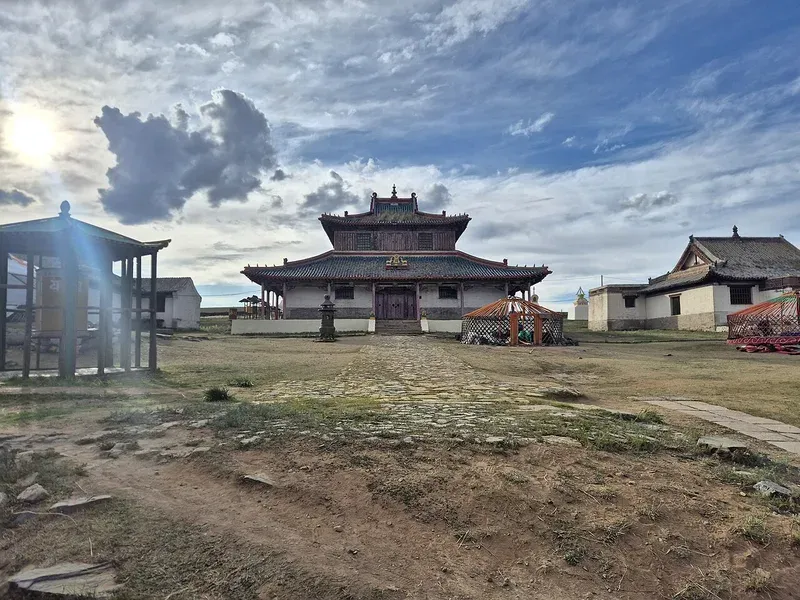
- Erdene Zuu Monastery — at Kharkhorin; Mongolia's oldest surviving Buddhist monastery, ringed by a wall of over 100 stupas.
- Khar Balgas (Ordu-Baliq) — the ruined city of the Uyghur Khaganate, dating from the 8th–9th centuries, with surviving walls and earthworks.
- Turkic monuments and inscriptions — including memorial complexes and runic inscriptions associated with the Turkic khaganates, scattered across the wider valley landscape.
- Orkhon Waterfall (Ulaan Tsutgalan) — a roughly 20 m waterfall on the Orkhon River, set in a basalt gorge formed by ancient volcanic activity; one of the valley's natural highlights.
- Tövkhön Monastery — a hilltop hermitage monastery in a forested setting in the surrounding Khangai mountains.
The Orkhon Valley rewards slow, active travel. Horse riding across the steppe and along the river is the quintessential valley experience, and trekking routes link the waterfall, monasteries and herder camps. Visiting nomadic herder families — sharing tea, seeing the daily round of pastoral life — is central to a trip here. The valley is excellent for hiking and photography, and the Orkhon Waterfall is a natural focus for a day's walking and swimming in the river pools below. Some travellers undertake multi-day horse treks. With clear skies, stargazing is superb.
Planning Orkhon Valley? Want these on a customised itinerary?
Ask on WhatsAppWhere to eat?
Dining in the valley is at ger camps and with herder families, serving Mongolian staples — mutton soups, tsuivan (fried noodles), buuz (steamed dumplings) — and homemade dairy products such as dried curd (aaruul), yoghurt and clotted cream. Tourist ger camps may offer a few simple European-style dishes. Kharkhorin has the nearest proper restaurants and guanz canteens. Vegetarians should carry their own supplies, as meat-free options are scarce in the valley.
Where to drink?
Drinks in the valley centre on the Mongolian standards — salty milk tea (süütei tsai) and, in summer, airag (fermented mare's milk), both commonly offered by herder hosts. Ger camps may stock beer and basic drinks. Do not drink untreated water from the river; carry bottled water or boil and treat what you use.
Planning Orkhon Valley? We’ll book the stays and dining for you.
Ask on WhatsAppWhere to stay?
- Budget: Staying with a nomadic herder family in a shared ger is the cheapest and most authentic option, broadly in the region of 35,000 ₮ per bed (a rural Mongolia rate as of early 2024).
- Mid-range: A range of tourist ger camps throughout the Orkhon Valley and around Kharkhorin offer comfortable gers, shared bathrooms and meals.
- Upscale / heritage: A few higher-end ger camps in the valley provide en-suite gers and full board.
Wild camping is possible by the river; carry all supplies and leave no trace.
What should you buy?
There are no markets within the valley itself; Kharkhorin is the place to buy crafts and supplies, with stalls near the monastery selling Mongolian souvenirs — felt and wool products, carved items, religious objects. Herder families and ger camps may sell homemade dairy products such as dried curd and yoghurt. Buy food and provisions in Kharkhorin or Arvaikheer before heading into the valley.
Where to go next?
- Kharkhorin — at the valley's edge; site of ancient Karakorum and gateway town to the Orkhon Valley.
- Erdene Zuu Monastery — at Kharkhorin; Mongolia's oldest surviving Buddhist monastery.
- Orkhon Waterfall — within the valley; a striking waterfall in a basalt gorge.
- Tövkhön Monastery — a hilltop hermitage monastery in the surrounding Khangai mountains.
- Arvaikheer — the Övörhangay provincial capital to the south; a transport hub and stopover town.
- Tsenkher Hot Springs — to the northwest in Arkhangai province; geothermal springs popular as an onward stop on a central Mongolia loop.
Nearby in Övörhangay
More places to explore around Orkhon Valley.


Guide content as of May 2026. Portions adapted from Wikivoyage, CC BY-SA 4.0.

Contact Us
Get in touch with us.
Get in touch
Contact Us
Tell us where you'd like to go and how you like to travel. A real Tripcuro planner — not a bot — will craft an itinerary around you.
- Personalised, hassle-free planning end-to-end
- Transparent pricing, no hidden costs
- 24/7 support for complete peace of mind