
Övörhangay
Mongolia · Province · 9 destinations with guides
Photography coming soonWhy visit?
Övörhangay sits in central Mongolia, a province that bridges two worlds: the green, well-watered Khangai mountains and forested valleys in its north, and the dry gravel steppe sliding toward the Gobi in its south. That contrast of landscapes within a single province — alpine meadow and river on one side, semi-desert on the other — gives Övörhangay both varied scenery and an unusually rich concentration of things to see.
For travellers, Övörhangay is one of the most rewarding provinces in the country, because it holds the Orkhon Valley — a cultural landscape inscribed on the UNESCO World Heritage List for its two thousand years of nomadic pastoral history and its place at the political heart of successive steppe empires. The valley's grasslands were grazed by the powers that shaped Central Asia, and the province preserves the threads of that history in its monasteries, ruins and sacred sites.
The provincial capital is Arvaikheer, a steppe town that serves as the transport and supply hub. But the destination most associated with Övörhangay is Kharkhorin (Karakorum) — the site of the 13th-century imperial capital of the Mongol Empire and of Erdene Zuu, the country's oldest surviving Buddhist monastery. With the Orkhon Waterfall and the Khangai's hot springs and valleys also within its borders, Övörhangay packs in landscape, history and monastic culture in a way few Mongolian provinces match.
When is the best time to visit?
The comfortable season is mid-June to early September, when the Khangai valleys are green, rivers run full and ger camps are open. July is the Naadam month, and Kharkhorin holds festivities of its own; the warm days and long light make midsummer the most popular time. September brings golden autumn colour in the Khangai forests and clear skies with fewer visitors.
Övörhangay's split geography produces noticeable internal variation: the northern Khangai is cooler, wetter and greener, while the southern steppe is hotter and drier. Winters everywhere are long and very cold with snow and hard frost, and spring is short, windy and dusty. The Khangai's hot springs are a draw in the cooler shoulder seasons, but high passes and tracks become difficult outside summer.
Tell us your dates and we'll shape a Övörhangay route around them.
WhatsAppHow do you get around?
Arvaikheer, the provincial capital, is the hub, and paved roads connect it with Ulaanbaatar and with Kharkhorin, making the province's two main centres reasonably accessible by road. Long-distance buses and shared vans run between the capital and Arvaikheer, and between Ulaanbaatar and Kharkhorin, from the city's western and provincial bus terminals. There is no railway in the province.
For the Orkhon Valley, the waterfall, the Khangai hot springs and the remoter soums, a hired jeep with driver is the standard approach, as roads beyond the main paved corridor are unpaved tracks. Many travellers visit Övörhangay — and Kharkhorin in particular — on organised tours from Ulaanbaatar, often as part of a wider central Mongolia loop. Arvaikheer also has an airport with flights from the capital.
What should you eat?
Food in Övörhangay is mainstream central Mongolian — mutton and beef as steamed buuz, fried khuushuur, noodle soups (guriltai shol) and khorkhog, with abundant dairy. The Khangai's good pasture makes this strong dairy country: aaruul dried curds, clotted cream (öröm), yoghurt and salty milk tea (süütei tsai) are excellent, and in summer the valleys produce plenty of fermented mare's milk (airag).
Kharkhorin and Arvaikheer have simple restaurants and guanz canteens aimed at travellers and locals, and ger camps in the Orkhon Valley serve full meals to guests. Vegetarians will find traditional steppe food heavily meat-based and should expect limited meat-free choices outside the main towns.
Want the scenic legs and stays booked for you? Just ask.
WhatsAppWhat is the culture like?
The Naadam Festival in July — wrestling, horse racing and archery — is the main annual event, celebrated in Arvaikheer, Kharkhorin and the soum centres. Tsagaan Sar, the lunar new year in late winter, is the major family festival. Kharkhorin's connection to imperial history also makes it a focus for cultural events tied to Mongol heritage.
Övörhangay's defining cultural anchor is Buddhist and historical: Erdene Zuu Monastery at Kharkhorin, founded in 1585 and the oldest surviving Buddhist monastery in Mongolia, built partly from the rubble of the imperial capital of Karakorum. The province belongs to the Khalkh Mongol mainstream, with its traditions of morin khuur fiddle music, khöömii throat singing, long song, and nomadic felt and leather crafts.
What are the standout experiences?
- Visit Erdene Zuu Monastery at Kharkhorin — Mongolia's oldest surviving monastery, ringed by a wall of 108 stupas, on the site of the Mongol Empire's capital.
- Explore the ruins of Karakorum, the 13th-century imperial capital, and the Kharkhorin museum that interprets the empire's heart.
- Travel the Orkhon Valley, a UNESCO World Heritage cultural landscape recording two thousand years of nomadic pastoral history.
- See the Orkhon Waterfall (Ulaan Tsutgalan), a basalt-framed cascade in the Khangai mountains, a scenic centrepiece of the valley.
- Soak in the Khangai hot springs and ride horses through the green northern valleys, combining landscape and relaxation away from the steppe.
Top Destinations
Every destination in Övörhangay with a guide — tap a place for the full guide.

Arvaikheer
Arvaikheer is the capital of Övörhangay Province (Ovorhangay Aimag)…

Erdene Zuu Monastery
Erdene Zuu Monastery is the oldest surviving Buddhist monastery in…

Kharkhorin
Kharkhorin is a small town in Övörhangay Province, central Mongolia…

Orkhon Valley
The Orkhon Valley is one of the great cultural landscapes of Mongolia…
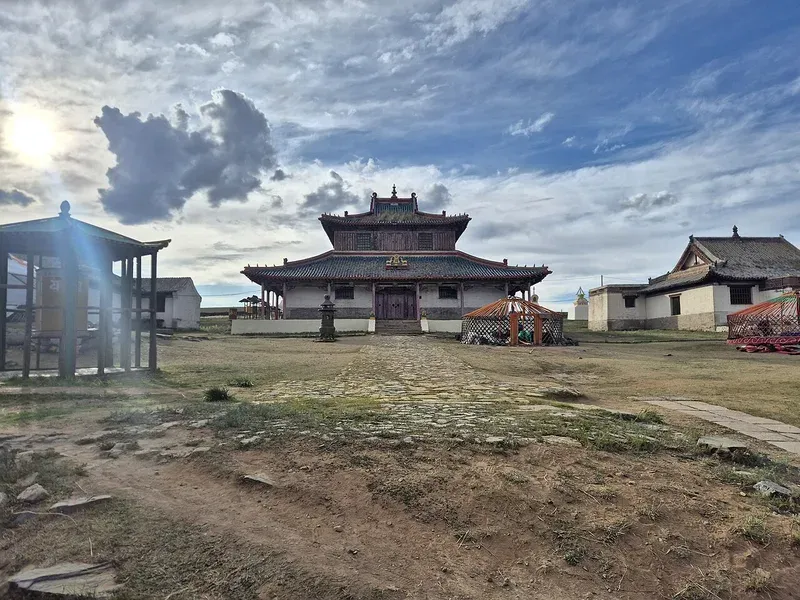
Shankh Monastery
Shankh Monastery is a small, historic Buddhist monastery in…

Tovkhon Monastery
Tövkhön Monastery is a small but deeply atmospheric hermitage…
Bat-Olzii
Bat-Olzii is a small rural settlement (soum centre) in Övörhangay…
Khujirt
Khujirt is a small town in Övörhangay Province, central Mongolia…
Orkhon Waterfall
The Orkhon Waterfall — known in Mongolian as Ulaan Tsutgalan — is the…
Pair the highlights of Övörhangay into one easy trip — we'll plan the route.
WhatsApp
Contact Us
Get in touch with us.
Get in touch
Contact Us
Tell us where you'd like to go and how you like to travel. A real Tripcuro planner — not a bot — will craft an itinerary around you.
- Personalised, hassle-free planning end-to-end
- Transparent pricing, no hidden costs
- 24/7 support for complete peace of mind