
Kinkaku-ji
Kyoto, Japan
Why visit Kinkaku-ji?
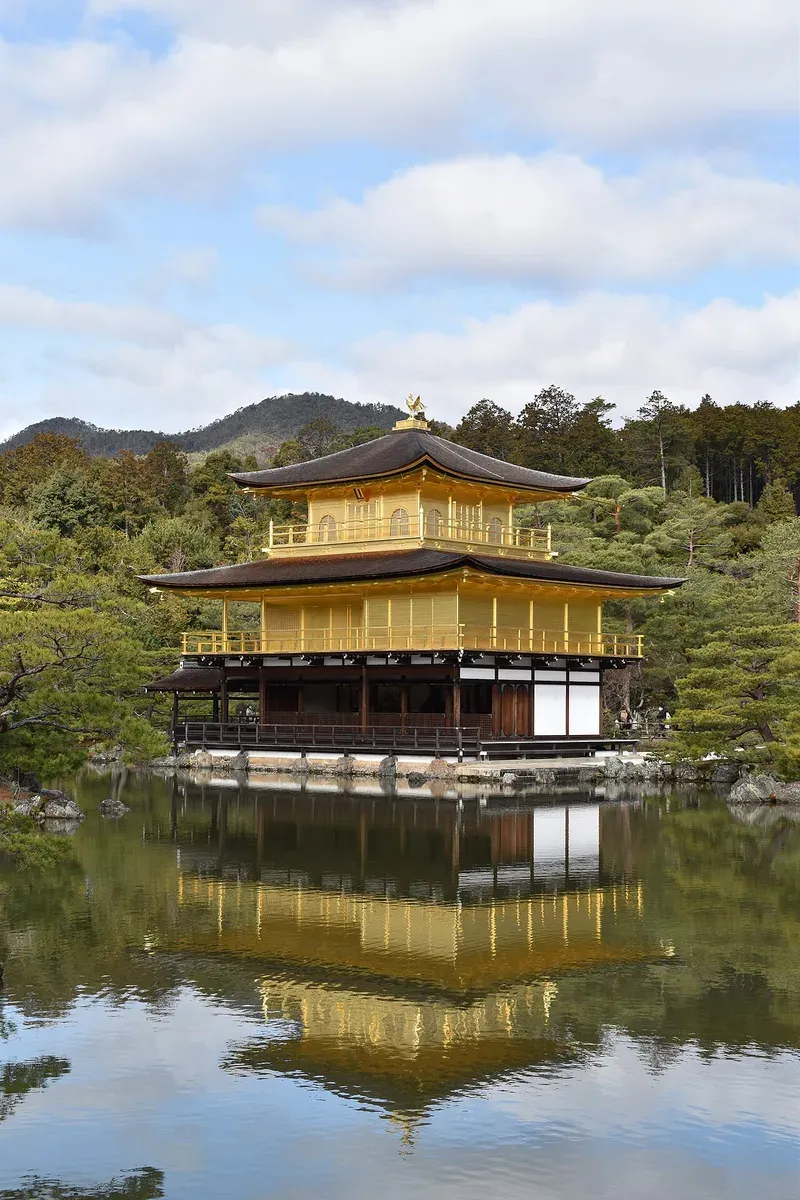
Kinkaku-ji (金閣寺, the "Temple of the Golden Pavilion") is one of the most famous sights in Japan and a defining image of Kyoto. Formally named Rokuon-ji, it is a Zen temple in the city's northern hills whose centrepiece is a three-storey pavilion, two of its floors sheathed entirely in gold leaf, mirrored in the still water of a landscaped pond. The pavilion began life in 1397 as part of the lavish retirement villa of the shogun Ashikaga Yoshimitsu and was converted into a Zen temple after his death. The present building is a faithful reconstruction completed in 1955, after the original was destroyed by arson in 1950 — an event made famous by Yukio Mishima's novel The Temple of the Golden Pavilion.
For visitors, Kinkaku-ji is essentially a single, spectacular set-piece rather than a sprawling complex. The pavilion is admired from a fixed walking route around the surrounding stroll garden, which is itself a designated Special Historic Site and Special Place of Scenic Beauty; the building cannot be entered. The temple is part of the UNESCO World Heritage listing of the Historic Monuments of Ancient Kyoto. It sits in the city's North district, an area also rich in other notable temples.
Kinkaku-ji is beautiful in every season — the gold against fresh green in spring, against autumn maples, and most strikingly when capped with snow in winter. It is also one of Kyoto's most visited sites, so early morning or late afternoon on a weekday offers a calmer experience. Allow about an hour for the full walking circuit.
Planning Kinkaku-ji? Tell us your dates and we’ll tailor the trip.
Ask on WhatsAppHow do you get there?
By Train
There is no railway station directly at Kinkaku-ji. The nearest rail access is the Kitano-Hakubaicho terminus of the Keifuku (Randen) tram line, from which it is a moderate walk or short bus ride. Most visitors reach the temple by city bus rather than by train.
Kinkaku-ji is reached most easily by Kyoto city bus from Kyoto Station, Shijo-Kawaramachi or other hubs — several routes stop at the Kinkakuji-michi stop near the entrance, with a flat-rate adult fare within the central zone. IC cards (ICOCA, Suica) are accepted. The temple grounds themselves are visited on foot via a one-way garden path that takes about an hour to walk; the route is gently sloping and well maintained. Taxis are an easy alternative for getting to and from the temple. There are no scams of note; the main practical issue is the crowd density on the viewing route at peak times.
What are the things to do?
- The Golden Pavilion (Kinkaku) — The temple's reason for existence: a three-storey pavilion with its upper two floors covered in gold leaf, topped by a bronze phoenix, reflected in the Kyoko-chi ("Mirror Pond"). Each floor is built in a different architectural style. Viewed from across the pond; the interior is not open.
- The stroll garden — A classic Muromachi-period landscape garden around the pond, with carefully placed islands, rocks and pines, designed to be experienced along a set walking path.
- Sekkatei tea house and grounds — Further along the route, a small tea house and additional garden features, including a statue and a pond where visitors traditionally toss coins for luck.
- Fudo-do hall — A small hall near the exit enshrining the deity Fudo Myoo.
Kinkaku-ji is a place to see rather than to busy oneself with activities, and the main thing to do is to walk the garden circuit slowly and enjoy the pavilion from its several viewpoints, including the classic shot across the pond. Visiting at opening time gives the calmest and most photogenic experience. Combine the temple with the surrounding North district, which is dense with worthwhile sights — it pairs especially well with Ryoan-ji, home of Japan's most famous Zen rock garden, a short distance away, and with Ninna-ji, another World Heritage temple nearby. Together these make a satisfying half-day or full day of temple walking.
Planning Kinkaku-ji? Want these on a customised itinerary?
Ask on WhatsAppWhere to eat?
There are tea houses and casual eateries near the temple grounds and along the bus routes, generally serving simple Japanese fare — soba and udon noodles, rice sets, matcha sweets and soft-serve. The North district has more dining choice within a short ride. Shojin-ryori, the vegetarian Buddhist cuisine, is available at some temple-linked restaurants in the wider area and suits vegetarians.
Where to drink?
Near the temple exit and along the approach, tea houses serve matcha and sencha green tea with seasonal sweets, and matcha soft-serve is widely available. Cafés in the surrounding district serve coffee and light refreshments. Tap water throughout Kyoto is safe to drink.
Planning Kinkaku-ji? We’ll book the stays and dining for you.
Ask on WhatsAppWhere to stay?
Kinkaku-ji is visited as a stop on a Kyoto itinerary rather than a base in itself; most travellers stay in central Kyoto, where accommodation is plentiful in every tier.
What should you buy?
A small shop near the exit sells temple-related goods: amulets and charms, postcards, incense and Kinkaku-ji souvenirs. The North district has further craft and souvenir shops. Prices are fixed and bargaining is not practised in Japan.
Where to go next?
- Ryoan-ji — A short distance away in the North district; home to Japan's most famous Zen rock garden.
- Ninna-ji — Nearby; a World Heritage temple with a five-storey pagoda and late-blooming cherry trees.
- Central Kyoto — A bus ride south; Nijo Castle, the Imperial Palace and Nishiki Market.
- Arashiyama — Western Kyoto; bamboo groves and riverside scenery.
- Higashiyama and Gion — Eastern Kyoto; Kiyomizu-dera, the geisha quarter and the Philosopher's Path.
- Fushimi — South Kyoto; the torii-lined Fushimi Inari shrine and sake breweries.
Nearby in Kyoto
More places to explore around Kinkaku-ji.
Guide content as of May 2026. Portions adapted from Wikivoyage, CC BY-SA 4.0.

Contact Us
Get in touch with us.
Get in touch
Contact Us
Tell us where you'd like to go and how you like to travel. A real Tripcuro planner — not a bot — will craft an itinerary around you.
- Personalised, hassle-free planning end-to-end
- Transparent pricing, no hidden costs
- 24/7 support for complete peace of mind