
Kaziranga National Park
Assam, India
Why visit Kaziranga National Park?
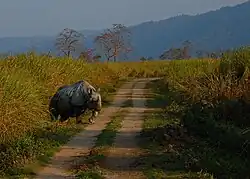
Kaziranga National Park (pronounced kah-zih-rawng-ah; Assamese Kājiraṅā) is the star of Assam's wildlife and one of the oldest national parks in India. Spread across roughly 430 km² along the south bank of the Brahmaputra, it is a UNESCO World Heritage Site and, above all, the great stronghold of the Indian one-horned rhinoceros — it holds the largest population of the species anywhere in the world. The landscape is classic Brahmaputra floodplain: tall elephant-grass meadows, swampy lagoons, shallow pools and patches of dense forest, drawing well over 170,000 visitors a year.
Its conservation story runs back more than a century. Lady Curzon visited the area in 1904 and, though she saw only rhino footprints, urged her husband Lord Curzon to act; the area was notified as a reserve forest in 1905, hunting was banned in 1908, and it was established as a national park in 1974. The park has been expanded over the years — at times controversially, with neighbouring villages displaced — and anti-poaching enforcement here has been notably aggressive. There are no fences marking the park edge, and visitors should never wander into the park area outside organised, guided safaris.
Kaziranga is open to visitors from around October to April and closes during the monsoon (roughly May to September, dates vary) when the Brahmaputra floods the grasslands and the park becomes inaccessible; the 2019 floods killed scores of large animals, including rhinos. The climate is tropical — hot and humid from April to June, cool and dry from November to February. The best time to visit is the cool, dry winter, when the grass has burnt off and animals are easier to see, and the shoulder months of September–October and February–March; February–March is also strong for migratory birds.
Planning Kaziranga National Park? Tell us your dates and we’ll tailor the trip.
Ask on WhatsAppHow do you get there?
By Plane
The nearest airport is at Jorhat (JRH), about 96 km away, with regular flights to Kolkata, Delhi and Guwahati. Guwahati's Lokpriya Gopinath Bordoloi International Airport (GAU), around 217 km away, has far wider connectivity and is the more common arrival point for travellers entering Assam. From either airport, a hired taxi or a resort transfer covers the road journey to the park gateway at Kohora on NH-37.
By Train
The nearest railway station is Furkating, about 80 km from the park, connected by trains from Delhi and Kolkata. From the station, continue to Kohora by road taxi or bus. Book reserved rail tickets in advance via IRCTC, especially in the October–April season.
By Car / Road
Buses serve Kohora town on the Guwahati–Jorhat route — from Guwahati (about 217 km, around ₹200), Jorhat (96 km, ₹70), Tezpur (75 km, ₹50), and also Nagaon, Dibrugarh and Tinsukia. Get down at Kohora, where most hotels and the safari booking office are located. If arriving from a trip to Arunachal Pradesh, Tezpur is the easiest place to pick up a bus. Guided motorcycle tours from Guwahati or Kohima are another option, often run as multi-state adventure rides through Assam, Meghalaya, Nagaland and Arunachal Pradesh.
The park is divided into ranges, each with its own entry gate, and there is no public transport inside — you move around strictly on organised safaris by jeep (terrain vehicle) or, in places, by elephant. The main zones are the Central zone (Kohora) in Golaghat District, the most popular and accessible with the most hotels; the Western zone (Bagori) in Nagaon District, the second most visited and often combined with Kohora; the Eastern zone (Agaratoli) near Bokakhat, quieter and a favourite for birdwatchers; and the Burapahar zone (Ghorakhati), the least developed. Kohora and Bagori are linked by local buses. Within Kohora town itself, short hops are easily covered on foot or by autorickshaw. The simplest approach is to let your hotel arrange all safaris — they can book everything if advised before 7PM the previous day.
What are the things to do?
The whole point of Kaziranga is wildlife-watching from a jeep or an elephant's back. The tall elephant grass means an elevated viewpoint helps enormously, and a good pair of binoculars is essential.
One-horned rhinoceros — the park's celebrity animal, often seen close up, especially from elephant-back in the grasslands; sightings are common across the Central and Western zones.
Elephants, wild water buffalo and swamp deer (barasingha) — all readily seen in the grasslands and around water bodies; Kaziranga holds one of the last truly wild Asian water buffalo populations.
Tigers — Kaziranga has an exceptionally high tiger density, but the dense, tall grass means they are seldom actually spotted.
Birdlife — over 490 recorded bird species, including storks, fish-eagles and the greater adjutant stork; the Eastern (Agaratoli) zone is the prime birding range, best in winter.
Jeep (terrain vehicle) safari — the main way to explore, with morning and evening departures across the zones; fares vary by range and are arranged through your hotel or the safari association office at Kohora.
Elephant safari — early-morning rides into the grassland for up-close rhino encounters, available at the Kohora and Bagori gates, lasting about an hour; in winter the later batch is better, as fog and a late sunrise can spoil the first slot.
Combine zones — visit the Western and Central ranges by both jeep and elephant; choose the Eastern range if birds and photography are your priority.
Cultural evenings at the lodges — many resorts round off the day with Assamese music and food.
Planning Kaziranga National Park? Want these on a customised itinerary?
Ask on WhatsAppWhere to eat?
Dining around Kaziranga is mostly through the tourist lodges and resorts, which run their own kitchens — convenient, though food can be on the expensive side. There are a few simple rice hotels at Kohora near the National Highway serving Assamese thali-style meals of rice, dal, river fish and vegetables, and the bus office cum resting place at Kohora has food available to non-passengers too. Vegetarian meals are easy to arrange; flag dietary needs at your lodge when booking.
Where to drink?
Meals at the lodges come with tea and bottled or boiled drinking water. There are several liquor shops at Kohora, though alcohol is not cheap, and chilled bottles can be hard to find given frequent power shortages in the area. Do not drink tap or untreated water — stick to sealed bottled or boiled water throughout.
Planning Kaziranga National Park? We’ll book the stays and dining for you.
Ask on WhatsAppWhere to stay?
- Budget: The Assam Tourism Department complex opposite the Kohora bus stop has a cluster of economical tourist lodges — Bonani, Aranya, and the Kohora forest inspection bungalow among them — with rooms roughly ₹400–2,000 per night; staying here is convenient as safaris can be booked directly through the on-site association office.
- Mid-range: Borgos Resort (Sildubi Goan, Kohora), Landmark Woods near the Western range, and The Nature-Hunt Eco Camp are well-regarded comfortable choices close to the gates.
- Upscale / heritage: IORA – The Retreat at Bogorijuri, about 2 km from the park, offers luxury and thematic suites; Wild Grass Resort, set back from the highway with specialist guides and an old-world jungle-lodge atmosphere, is a long-standing favourite — advance booking is strongly advised in season.
What should you buy?
In Kohora and near the Mihimukh entrance, shops sell forest products and local handicrafts — handwoven Assamese textiles, bamboo and cane items, and tea from the surrounding estates make good buys. Bargaining is acceptable at the smaller stalls.
Where to go next?
- Tezpur (~75 km) — historic town and gateway to the eastern Himalaya, on the north bank of the Brahmaputra.
- Nameri National Park (~110 km) — a tiger reserve known for river rafting and birdwatching, near Tezpur.
- Jorhat (~96 km) — gateway town with the nearest airport, and the jumping-off point for Majuli.
- Majuli — the vast Brahmaputra river island, famous for its Vaishnavite satras (monasteries).
- Guwahati (~217 km) — Assam's largest city, with the Kamakhya Temple and the main international airport.
- Kohima — the hill capital of Nagaland, reachable by road for those continuing into the Northeast.
Nearby in Assam
More places to explore around Kaziranga National Park.
Guide content as of May 2026. Portions adapted from Wikivoyage, CC BY-SA 4.0.

Contact Us
Get in touch with us.
Get in touch
Contact Us
Tell us where you'd like to go and how you like to travel. A real Tripcuro planner — not a bot — will craft an itinerary around you.
- Personalised, hassle-free planning end-to-end
- Transparent pricing, no hidden costs
- 24/7 support for complete peace of mind