
Hoollongapar Gibbon Sanctuary
Assam, India
Why visit Hoollongapar Gibbon Sanctuary?
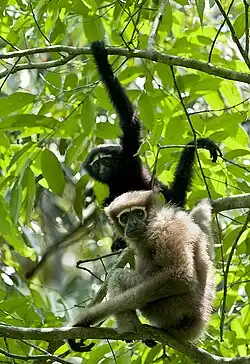
Hoollongapar Gibbon Sanctuary is a compact, evergreen forest reserve in the Jorhat district of Assam, famous as the home of the western hoolock gibbon — India's only ape. The sanctuary is also one of the few places in the country where seven primate species share a single forest: besides the gibbon, you may spot the stump-tailed macaque, northern pig-tailed macaque, rhesus macaque, capped langur, the slow loris, and Assamese macaque. The forest is a relatively small island of greenery surrounded by tea estates, and the canopy is split in two by a railway line that runs through the reserve — a quirk that has shaped how the gibbons move and live.
The reserve was upgraded to a wildlife sanctuary in 1997 and renamed in 2004 to honour the hoollong tree (Dipterocarpus macrocarpus), the tall hardwood that dominates the upper canopy. For visitors, the appeal is intimate rather than grand: there are no big-game thrills here, but the chance to hear the gibbons' loud, whooping morning calls and to watch a family group swing through the treetops is a genuine highlight of any Assam itinerary.
The best time to visit is the cool, dry season from November to March, when trails are firm and primate activity is easy to observe in the early morning. The monsoon (June to September) makes the forest leech-ridden and paths muddy, while April and May are hot and humid. Mornings are by far the best time of day — gibbons call and feed soon after dawn.
Planning Hoollongapar Gibbon Sanctuary? Tell us your dates and we’ll tailor the trip.
Ask on WhatsAppHow do you get there?
By Plane
The nearest airport is Jorhat Airport (IATA: JRH), roughly 20–25 km away, with flights to Kolkata and Guwahati. Guwahati's Lokpriya Gopinath Bordoloi International Airport (IATA: GAU) is the larger gateway, about 300 km west, with wide domestic and limited international connections. From either airport, a pre-arranged taxi or hired car is the practical way to reach the sanctuary; expect a Jorhat taxi to cost in the region of ₹800–1,200 for the transfer.
By Train
The closest railhead is Mariani Junction, only a few kilometres from the sanctuary, served by trains on the Northeast Frontier Railway network with connections to Jorhat, Dibrugarh and Guwahati. The railway line famously cuts through the sanctuary itself. Book reserved seats in advance through IRCTC, especially in the November–March travel season.
By Car / Road
The sanctuary lies near Mariani, off the Jorhat–Mariani road. Jorhat town is about 20 km away (around 45 minutes); Sivasagar is roughly 70 km. Roads from Jorhat are generally in fair condition. Buses and shared sumos run between Jorhat and Mariani, after which a short local taxi or autorickshaw covers the final stretch to the forest gate.
The sanctuary itself is explored on foot — visitors walk forest trails accompanied by a mandatory forest department guide, who knows where the resident gibbon groups are likely to be found. There is no internal transport. To reach the gate and move around the surrounding area, autorickshaws and local taxis from Mariani are the main options; ride-hailing apps are unreliable this far from a major city, so arrange a car through your accommodation or driver. Carry cash, agree fares before setting off, and start early to make the most of the morning.
What are the things to do?
- Western hoolock gibbon — the star attraction, and the reason most travellers come. Listen for their resonant duetting calls at dawn, then follow your guide to watch family groups brachiate (swing) through the high canopy. Sightings are good but not guaranteed; patience and an early start help.
- Other primates — capped langur, stump-tailed macaque, northern pig-tailed macaque, rhesus and Assamese macaques, and the nocturnal Bengal slow loris. Few forests anywhere let you see so many primate species in one walk.
- Birdlife and forest flora — the evergreen canopy shelters hornbills, woodpeckers, drongos and many smaller birds, plus towering hollong trees and a dense understorey of cane and orchids.
The headline activity is a guided morning forest walk in search of gibbons and other primates — a quiet, slow-paced experience best suited to travellers who enjoy wildlife watching and birding rather than dramatic safaris. Bring binoculars, wear muted clothing, and budget two to three hours. Photographers should carry a telephoto lens, as the gibbons stay high in the canopy.
The sanctuary pairs naturally with the surrounding tea estates, and several travellers combine a morning gibbon walk with a tea-garden visit or tasting. It also works well as a side trip on a wider Upper Assam circuit taking in Kaziranga National Park and the historic temples and tanks of Sivasagar.
Planning Hoollongapar Gibbon Sanctuary? Want these on a customised itinerary?
Ask on WhatsAppWhere to eat?
There are no restaurants within the sanctuary; meals are taken in Jorhat or arranged through your accommodation, and many lodges and tea bungalows provide home-style Assamese cooking. The regional cuisine is light and subtly flavoured — expect steamed rice, dal, fish curries, khar (an alkaline preparation), masor tenga (a tangy fish curry), and fresh seasonal greens.
- Tea-estate bungalow meals — if you stay at a heritage tea bungalow, set-menu Assamese or colonial-style meals are usually the best food in the area.
- Jorhat town restaurants — the town has a spread of mid-range Indian and Assamese eateries serving thalis, biryani and North Indian standards.
- Local dhabas near Mariani — simple, inexpensive rice-and-curry meals for budget travellers and quick stops.
Vegetarian food is widely available; ask in advance for specific dietary needs, as choice is limited near the sanctuary.
Where to drink?
The obvious local drink is Assam tea, served strong and milky, and best sampled fresh on or near an estate. Bottled water, soft drinks and tea or coffee are available in Jorhat and Mariani; carry your own water for the forest walk. Stick to sealed bottled or filtered water and avoid untreated tap water. Alcohol is available in Jorhat at licensed shops, bars and some hotels, though the area around the sanctuary itself is quiet with few dedicated bars.
Planning Hoollongapar Gibbon Sanctuary? We’ll book the stays and dining for you.
Ask on WhatsAppWhere to stay?
- Budget: Simple guesthouses and lodges in Jorhat and near Mariani offer basic rooms at roughly ₹800–1,500 per night.
- Mid-range: Jorhat town has several comfortable hotels in the ₹2,000–4,000 range, a convenient base for early-morning sanctuary visits.
- Upscale / heritage: The area's distinctive option is a stay in a heritage tea-estate bungalow around Jorhat, offering colonial-era charm, garden walks and full-board Assamese meals; rates vary widely by property.
What should you buy?
There are no shops inside the sanctuary, so buy what you need in Jorhat or Mariani. Assam is best known for its tea — orthodox and CTC black teas from the surrounding estates make an excellent, easy-to-carry souvenir. Look also for handwoven Assamese silk, especially muga (golden silk) and eri, sold as stoles, mekhela chador and scarves, plus bamboo and cane craftwork. Prices in shops are generally fixed; mild bargaining is acceptable in open markets.
Where to go next?
- Jorhat (~20 km, ~45 min) — the regional hub, gateway to Majuli and home to Assam's tea heritage.
- Majuli (ferry from near Jorhat, ~1–2 hr) — the great river island and centre of Vaishnavite satra culture.
- Sivasagar (~70 km, ~1.5 hr) — historic Ahom-dynasty capital, with palaces, temples and vast tanks.
- Kaziranga National Park (~120 km, ~3 hr) — UNESCO-listed park famed for one-horned rhinos and tigers.
- Dibrugarh (~130 km, ~3 hr) — tea-country city and a stop on Upper Assam itineraries.
Nearby in Assam
More places to explore around Hoollongapar Gibbon Sanctuary.




Guide content as of May 2026. Portions adapted from Wikivoyage, CC BY-SA 4.0.

Contact Us
Get in touch with us.
Get in touch
Contact Us
Tell us where you'd like to go and how you like to travel. A real Tripcuro planner — not a bot — will craft an itinerary around you.
- Personalised, hassle-free planning end-to-end
- Transparent pricing, no hidden costs
- 24/7 support for complete peace of mind