
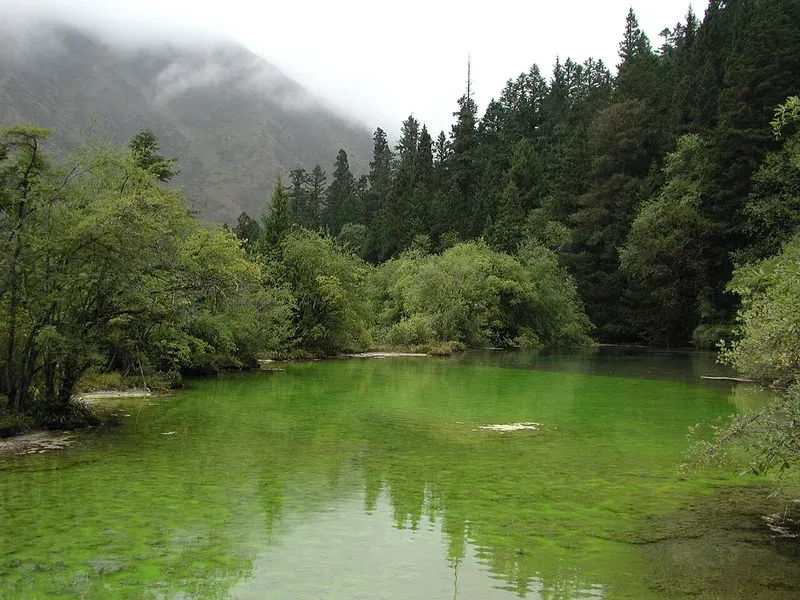
Songpan
Sichuan Sheng, China
Why visit Songpan?
Songpan (æ?¾æ½˜; SÅ?ngpÄ?n) is a small, walled town tucked into the high valleys of northern Sichuan at roughly 2,800 m elevation, sitting on the Min River at the edge of the Tibetan-Qiang cultural belt. Founded as a Tang-dynasty garrison and later expanded into a Ming-era frontier town, it was for centuries a key checkpoint on the tea-horse trade route between the Sichuan lowlands and the Tibetan plateau. Today most travellers use it as a base camp for horse treks into the surrounding mountains and as a stopover on the way to Jiuzhaigou and Huanglong, but the surviving stone gates of the old city wall, the Hui Muslim and Tibetan quarters, and the mountain backdrop give Songpan a character its glossier neighbours have lost.
The town itself is compact — a long main street running north-south between the old city gates, with the bus station at the north end and silver smiths clustered at the south. Tibetan, Qiang, Hui and Han communities all live here, and a short walk down the main road takes you past Tibetan textile shops, a Hui-run noodle joint, and a Ming-dynasty gate within a few hundred metres. In summer (especially July-August), tour buses pour in from Chengdu and the streets fill with day-trippers buying souvenirs; the place is markedly quieter in spring and autumn.
The best windows to visit are late May to mid-June and September to mid-October, when daytime temperatures are mild (15-22°C), the mountain passes are open, and crowds are lighter than peak summer. Winter (December-February) is cold, snowy, and many trekking outfits scale back. Avoid the early-October Golden Week holiday unless you enjoy queueing.
Planning Songpan? Tell us your dates and we’ll tailor the trip.
Ask on WhatsAppHow do you get there?
By Plane
Jiuzhai Huanglong Airport (JZH) is the nearest air gateway, about 80 km north of Songpan at roughly 3,400 m elevation — currently one of the highest civil airports in China. Sichuan Airlines operates regular flights from Chengdu (about 1 hour). Onward transport from the airport is by shared minivan or taxi to Songpan; expect to negotiate.
By Car / Road
Songpan sits on the G213 highway and is reached almost entirely by road. The town's bus station is at the north end of town, a few blocks north of the old north gate, and is the hub for all overland arrivals.
- Chengdu — roughly 335 km south; buses take around 11 hours via the Min River valley. The road climbs steeply and can be slow in rain or after landslides.
- Jiuzhaigou Nature Reserve — about 2 hours north by bus.
- Huanglong National Park — short hop north; frequent connections in season.
- Zoige (Ruoergai) and Langmusi — buses north to Langmusi on the Gansu border take about 5 hours.
- Xiahe (Gansu) is reachable by chaining buses via Tongren and Hezuo.
Road quality on the Chengdu-Songpan route has improved but expect mountain switchbacks and the occasional weather-related closure; in summer, landslides are not unusual.
The town is small enough to cover entirely on foot in 20-30 minutes end to end. Tricycle taxis circulate the main street for short hops — agree the fare before getting in, typically a few yuan within town. For trips into the surrounding hills, locals hire motorcycles or horses; horses are by far the more common option and are arranged through the horse-trekking outfits (see Do).
There is no metro, no ride-hailing app coverage to speak of, and minimal need for either. The main scams to watch are inflated tricycle fares for foreigners and pushy "guides" hanging around the bus station offering tours at marked-up rates — book treks directly with established outfits near Emma's Kitchen instead.
What are the things to do?
Old City Walls and Gates — Songpan's defining sight. The surviving Ming-era gates (notably the North Gate and West Gate) still stand and can be climbed for views over the rooftops and river. Free to walk through; some gate towers charge a small fee to ascend.
The West Gate and West Trail — Opposite the horse-trekking company, follow the stream toward the dam and take the track on the left. About 45 minutes' walk brings you out of town into open valley, with paths branching to the foot of two 4,000-m peaks.
Guanyin Pavilion — On a hill southwest of town. The shrine itself is closed, but the climb up gives one of the best panoramas of the walled town and the mountains beyond. Free.
Min River bridges and old quarter — The covered wooden bridges across the Min and the lanes of the Hui Muslim quarter (with the mosque) and Tibetan quarter are worth a slow wander rather than a checklist visit.
Horse treks into the mountains — The signature Songpan experience. Trips run from a single day up to a week, visiting Tibetan villages, alpine lakes, and high meadows. Prices are roughly ¥200 per day including food and camping/village homestay. A 3- or 4-day trek to Ice Mountain (Xuebaoding area) costs around ¥450; the 4-day version adds a filler camp day rather than significantly more ground. Treks are physically demanding — expect to walk a fair share on the downhill return to rest the horses, and to sleep in basic tents. Most outfits are run through one consolidated horse-trekking company; book through your guesthouse or directly at the office near the West Gate. Tell the owner up front you do not want guides striking the horses; saying "no" firmly on the trail helps too.
Day hike to the West Gate trail and beyond — A good acclimatisation walk before any multi-day trek.
Day trip to Huanglong National Park — Calcite terraced pools roughly 1.5-2 hours north; spectacular and high enough (3,000-3,500 m) that altitude matters.
Day trip to Jiuzhaigou — World-famous valley of lakes and waterfalls, around 2 hours by bus.
Hot springs — Several small springs operate in the surrounding valleys, often visited as part of a horse trek.
Planning Songpan? Want these on a customised itinerary?
Ask on WhatsAppWhere to eat?
Songpan's food scene is a three-way mix of Sichuan, Tibetan, and Hui (Chinese Muslim) cooking, with a handful of traveller-friendly cafés thrown in. The signature local dish to seek out is SuÄ?ncài Miànkuài (é…¸è?œé?¢å?—) — a Tibetan-style soup of square hand-cut noodles, potatoes, and yak meat in a tangy red-orange broth.
- Emma's Kitchen — Long-running traveller café about 30 m south of the bus station (turn left on the main road). Strong Chinese and Western menu and good coffee — skip the pizza. The owner Emma also runs tour info, car rental, ticket booking, a book swap, and laundry. Friendly, English-speaking, and a useful information hub. Budget.
- Sarah Yang's — Another small traveller-oriented spot serving Chinese and Western dishes; Sarah is generous with local information. Budget.
- Hui family noodle shop (SuÄ?ncài Miànkuài) — Cross the street from Emma's Kitchen, walk up the hill a short way; it's on the left. You'll see a glass panel into the kitchen where the family hand-cuts the noodles. Excellent and authentic. Budget.
- Tibetan teahouses near the south gate — Yak butter tea, tsampa, and momos in low-key settings used mainly by locals. Budget.
- Hotpot restaurants along the main street — Sichuan má-là hotpot is well represented; look for places busy with locals rather than the brightly-lit tourist fronts. Mid-range.
Dietary notes: vegetarian eating is workable but not common — ask for sù (ç´ ) dishes and watch for lard. Halal food is straightforward in the Hui quarter (look for the green crescent). Gluten-free is genuinely hard here given the noodle and bread focus.
Where to drink?
Nightlife is minimal — locals and travellers do their drinking in restaurants rather than dedicated bars. Chinese lager (Snow, Tsingtao) is everywhere and cheap. Yak butter tea and sweet milk tea are the local Tibetan staples worth trying at least once. BÄ?ijiÇ” is sold in every small shop; the home-distilled version offered at some guesthouses (notoriously by the owner of Good Luck Guesthouse) is best approached with caution.
Emma's Kitchen and Sarah Yang's are the obvious daytime coffee stops.
Water safety: do not drink the tap water. Stick to bottled or boiled water; the kettles in guesthouses are fine. Altitude means you'll need to drink more than you think — aim for 3+ litres a day.
Planning Songpan? We’ll book the stays and dining for you.
Ask on WhatsAppWhere to stay?
Budget
- Ice Mountain Hostel (+86 13111805096 / +86 837 7233050) — In the yard left of Emma's Kitchen, behind the larger hotel run by the trekking outfit's "big boss." Clean rooms, electric blankets (essential at this altitude), laundry, internet, very friendly staff who also run the adjacent massage shop. Beds ¥20-30. Ask at Emma's if you can't find the entrance.
- Good Luck Guesthouse (+86 837 7231556) — Near the bus station, run by Huang Xin. Dorm beds ¥12-20, though the owner can be reluctant to rent them. Bare-bones; declining the homemade bÄ?ijiÇ” is wise.
- Jiaotong BÄ«nguÇŽn (交通宾馆) — Attached to the bus station. Singles without bathroom from ¥25. Convenient for early buses, not much else.
What should you buy?
The main street is lined with shops selling Tibetan and Qiang textiles, silver jewellery, prayer wheels, Tibetan hats, and "antiques" (almost all newly made). Bargaining is essential — start at 30-40% of the asking price and expect to settle around half.
For silver, walk to the far southern end of the main street, where actual silver smiths work in small open-front workshops. You can sometimes watch a piece being hammered out, and prices are dramatically lower than the tourist-strip shops a few blocks up.
Do not buy furs. Songpan's stalls openly display pelts of leopard, lynx, fox, and other species sourced via poaching in China and neighbouring countries. Buying them feeds an illegal trade that is gutting the region's wildlife, and the items are likely illegal to import home in any case.
Where to go next?
- Jiuzhaigou Nature Reserve — ~2 hours north by bus. UNESCO-listed valley of multicoloured lakes and waterfalls; Sichuan's most famous natural sight.
- Huanglong National Park — Short drive north. Travertine terraced pools at 3,500 m; often done as a same-day or one-night side trip from Songpan.
- Langmusi — ~5 hours north on the Sichuan-Gansu border. Tibetan monastery town in high grasslands; far quieter than Jiuzhaigou.
- Zoige (Ruoergai) grasslands — En route to Langmusi. Wide-open Tibetan pastureland, yak herds, wildflowers in summer.
- Chengdu — ~11 hours south by bus. Sichuan's capital: pandas, teahouses, the Sichuan-cuisine homeland.
- Maerkang (Barkam) — West across the mountains. Useful for visa extensions (which are no longer possible in Songpan) and a jumping-off point for the Aba Tibetan heartland.
Nearby in Sichuan Sheng
More places to explore around Songpan.

Guide content as of May 2026. Portions adapted from Wikivoyage, CC BY-SA 4.0.

Contact Us
Get in touch with us.
Get in touch
Contact Us
Tell us where you'd like to go and how you like to travel. A real Tripcuro planner — not a bot — will craft an itinerary around you.
- Personalised, hassle-free planning end-to-end
- Transparent pricing, no hidden costs
- 24/7 support for complete peace of mind