
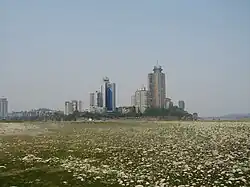
Leshan
Sichuan Sheng, China
Why visit Leshan?
Leshan (乐山) sits at the confluence of the Dadu, Min and Qingyi rivers in southern Sichuan, about 130 km south of Chengdu. The city's defining feature is the colossal Tang-dynasty Leshan Giant Buddha, carved into the red sandstone cliff of Lingyun Hill overlooking the river confluence — at roughly 71 metres tall, it is the largest stone-carved Buddha statue in the world. Together with neighbouring Mount Emei, the site forms a joint UNESCO World Heritage listing, and the two are almost always visited as a pair. The Buddha was commissioned in the early 8th century by the monk Haitong, who according to tradition hoped its presence would calm the turbulent river currents at the confluence, which were sinking boats; the rock cleared from the cliff during the decades-long carving is said to have genuinely reshaped the riverbed and eased the currents.
Beyond the Buddha, Leshan is a workaday riverside city with fragments of its historic city walls, a scattering of Buddhist temples, and a food culture built around Sichuan staples and the locally-associated "qiaojiao beef" (跷脚牛肉, "raised-leg beef") tradition. Most international travellers stay only a night or two, treating Leshan as the base for the Buddha and a springboard to Mount Emei, but the older city core rewards a slower visit, and the Shawan district to the west — associated with the writer and historian Guo Moruo — adds a quieter, more literary counterpoint.
Climate is humid subtropical: hot, sticky summers (June–August, often above 30°C) with monsoon rain and frequent river mist, and cool, damp, grey winters (roughly 5–10°C). Spring (March–May) and autumn (September–early November) are the most comfortable and clearest windows for visiting and photographing the cliff-side Buddha. Chinese national holidays — especially the Spring Festival period, the early-May holiday and the October National Day "Golden Week" — bring long queues for the Buddha staircase and should be avoided if possible.
Planning Leshan? Tell us your dates and we’ll tailor the trip.
Ask on WhatsAppHow do you get there?
By Plane
Leshan has no commercial airport of its own. The practical options are:
- Chengdu Tianfu International (TFU) — roughly 200 km away by road, or reachable by transferring to the Chengdu–Leshan intercity high-speed rail line.
- Chengdu Shuangliu International (CTU) — somewhat closer, with a high-speed rail connection running from a station at the airport to Leshan.
From either Chengdu airport, the simplest route is to transfer to a high-speed rail station and take the bullet train south to Leshan.
By Train
The Chengdu–Leshan–Emeishan intercity high-speed line is the standard way in. Trains run frequently from Chengdu's main stations and reach Leshan in roughly an hour. Leshan's main railway station connects to the city centre and the Giant Buddha scenic area by local bus. Book through the official 12306 platform or a booking site; bring your passport, since it doubles as the ticket for ID-linked entry at Chinese stations.
By Car / Road
Driving from Chengdu takes roughly two hours on modern toll expressways in good condition. Long-distance buses still run between Leshan and Chengdu and other Sichuan cities, though high-speed rail has largely superseded them on the Chengdu corridor. Leshan has more than one intercity bus station serving different directions (Chengdu and points north, versus Emeishan and points south) — check which terminal your route uses before setting out.
The central sights cluster tightly enough that a single day on foot, by local bus, and with the occasional taxi covers most of what visitors come for.
- Public bus — inexpensive and reasonably frequent; a direct route links the railway station area to the Giant Buddha scenic area.
- Taxi — metered, with a modest flagfall; most rides within the city are cheap. Look for the meter to be running.
- Ride-hailing — Didi works well in Leshan for travellers with a Chinese-linked payment method, removing most language friction.
- Ferry — the river ferry that circles past the Buddha's cliff face is run as part of the sightseeing experience rather than as ordinary transport (see See, below).
Scams are rare, but touts near the Giant Buddha boat dock sometimes push overpriced "VIP" boat trips instead of the standard public ferry — compare the price against the posted ticket rate before boarding.
What are the things to do?
Leshan Giant Buddha Scenic Area
- Leshan Giant Buddha — the headline sight: a roughly 71-metre Tang-dynasty seated Buddha carved into the cliff at the rivers' confluence. There are two ways to see it — climb down the narrow cliff-side staircase to stand at the Buddha's feet (queues can run to an hour or more mid-morning; arrive at opening or later in the afternoon to avoid the worst of it), or take the river ferry, which crosses in front of the cliff face, pauses for photographs, and returns without requiring the staircase queue. In periods of low water, parts of the riverbed below the statue are sometimes exposed, offering an alternative vantage point.
- Wuyou Temple — a quieter island monastery near the Buddha, linked to the mainland by a footbridge; often skipped by tour groups, which is part of its appeal.
- Oriental Buddha Park — a Buddhist-themed park adjoining the Giant Buddha scenic area, with a large collection of Buddhist statuary; reactions to it vary, from those who enjoy its scale to those who find it kitsch.
- Leshan Giant Buddha Museum — a museum near the scenic area with context on the carving's history and the wider Sichuan Buddhist tradition.
Central Leshan
- Old city wall fragments — surviving sections of the historic Jiazhou city walls, rebuilt across several dynasties, scattered through the modern city centre; more pleasant to encounter while walking between sights than to visit as a standalone destination.
- Tieniu Gate ("Iron Bull Gate") — a historic city gate standing on the riverbank near the city government area.
- Suji Ancient Town — a revived historic riverside quarter on the old pilgrim route toward Mount Emei, now a food-and-heritage district with renovated lanes; closely associated with the local qiaojiao beef tradition and a pleasant place for an evening stroll.
Shawan District
Guo Moruo's former residence — a historic courtyard home associated with the 20th-century writer, historian and archaeologist Guo Moruo (1892–1978), with an adjoining museum on his life, in Shawan district west of central Leshan.
Visit the Buddha at first light — arriving near opening time lets you see the cliff-side staircase before the day's tour groups arrive, and the early light on the red sandstone is generally the most striking of the day.
Combine the staircase descent with the river ferry — the two views of the Buddha (from directly below, and from the water) are genuinely different experiences, and doing both in one visit is the standard approach.
Day trip to Mount Emei — one of China's Four Sacred Buddhist Mountains, reachable from Leshan by high-speed rail or road in well under an hour. The summit area (Jinding, the Golden Summit) is known for its cloud-sea views and resident macaques; most travellers day-trip from Leshan, though serious hikers may prefer to stay overnight near the mountain.
Evening stroll in Suji Ancient Town — livelier and more atmospheric after dark, when the food stalls are busiest.
Walk the riverbank promenade near Tieniu Gate at dusk for a view across all three rivers meeting, with the Buddha's cliff visible across the water.
Planning Leshan? Want these on a customised itinerary?
Ask on WhatsAppWhere to eat?
Leshan punches well above its size on food, and Chengdu residents are known to drive down on weekends specifically to eat here. Signature local dishes include:
- Qiaojiao niurou (跷脚牛肉) — literally "raised-leg beef," a peppery beef-and-offal broth traditionally eaten perched on a stool with one leg raised, associated with Suji and now popular across Sichuan.
- Bobo ji (钵钵鸡) — cold skewered chicken and vegetables soaked in numbing red chili oil, served in a ceramic bowl; Leshan is often credited as its origin.
- Doufu nao (豆腐脑) — a Leshan-style soft tofu pudding served savoury rather than sweet, topped with crispy bits, peanuts and chili.
A cluster of qiaojiao beef stalls and Sichuan restaurants can be found in and around Suji Ancient Town and the streets near the old city walls, ranging from simple noodle-shop-style spots to more comfortable sit-down restaurants; a handful of larger hotels also run more formal Sichuan banquet restaurants. Vegetarians are reasonably well served by tofu, mushroom and vegetable Sichuan dishes — ask for "no meat" (不要肉). Halal options exist around the city's small Hui Muslim community but are not widespread; look for green crescent signage. Gluten-free dining is difficult given the ubiquity of soy sauce and wheat noodles; plain rice and rice noodles are the safer choices.
Where to drink?
- Tea culture — teahouses are a social institution across Sichuan, and Leshan is no exception; riverside and courtyard teahouses serve bottomless gaiwan tea for a modest price, with no pressure to hurry.
- Local baijiu — Sichuan is baijiu country, and well-known regional brands from nearby Yibin and Luzhou are widely available in shops and restaurants.
- Standard Chinese lagers (Tsingtao, Snow and similar) are sold everywhere; a modest bar scene exists around the central pedestrian streets, and international hotel bars are a reliable option for cocktails.
Water safety: tap water is not potable; use bottled or boiled water, and avoid ice at informal eateries.
Planning Leshan? We’ll book the stays and dining for you.
Ask on WhatsAppWhere to stay?
- Budget: guesthouses and small hostels cluster around the old town area, generally offering simple private rooms and sometimes dorm beds.
- Mid-range: several Chinese hotel chains operate comfortable, predictable branches near the railway station and around the city centre.
- Upscale: Leshan has international-chain hotels on the riverfront, including branded properties from major hospitality groups, some with rooms overlooking the Buddha area.
What should you buy?
Leshan is not a major shopping destination, but a few things are worth seeking out:
- Ebony carvings — a regional specialty; quality and price vary considerably, so compare pieces at more than one shop before buying, and expect bargaining outside formal museum shops.
- Sichuan pepper and chili products — vacuum-packed Sichuan peppercorns, chili oil and dried chilies make compact, customs-friendly souvenirs, best bought at a supermarket rather than a tourist stall.
- Tea — green tea from the wider Sichuan tea-growing region is widely sold; stick to sealed tins from established brands for anything you plan to bring home.
Cash is increasingly uncommon; Alipay and WeChat Pay are near-universal, and many foreign cards can now be linked to a tourist-facing digital wallet.
Where to go next?
- Mount Emei — a short high-speed rail trip away; the other half of the joint World Heritage listing, with its Golden Summit, monasteries and cloud-sea views.
- Chengdu — Sichuan's capital, roughly an hour away by rail; pandas, teahouse culture, and one of China's most celebrated food scenes.
- Ya'an — a tea-country city with a well-known panda base and misty tea mountains, reachable by road.
- Zigong — the "Salt Capital," known for a notable dinosaur museum and a well-regarded winter lantern festival.
- Yibin — gateway to the Shunan Bamboo Sea and a major baijiu-producing city at the source of the Yangtze proper.
- Jiuzhaigou — a longer trip (overnight bus or a flight via Chengdu), but among the most striking alpine-lake landscapes in China if you have an extra two or three days to spare.
Nearby in Sichuan Sheng
More places to explore around Leshan.
Guide content as of July 2026. Portions adapted from Wikivoyage, CC BY-SA 4.0.

Contact Us
Get in touch with us.
Get in touch
Contact Us
Tell us where you'd like to go and how you like to travel. A real Tripcuro planner — not a bot — will craft an itinerary around you.
- Personalised, hassle-free planning end-to-end
- Transparent pricing, no hidden costs
- 24/7 support for complete peace of mind