
Karijini National Park
Western Australia, Australia
Why visit Karijini National Park?
Karijini National Park sprawls across 627,000 hectares of the Pilbara in remote inland Western Australia, a landscape so old it predates almost everything else on the planet. The rocks here are part of a 2.5-billion-year-old craton — a fragment of the earth's original crust that was never recycled by plate tectonics. Layers of dolomite, banded iron formation and shale, laid down on a primordial seabed and later thrust skyward as the Hamersley Range, have been carved by streams into a labyrinth of deep red, ribbon-banded gorges. The result is one of Australia's most distinctive landscapes: narrow slot canyons, plunge pools, seasonal waterfalls and rippled rock formations glowing in every shade of ochre, rust and rose. The park was gazetted in 1969 and renamed Karijini — the Banjima word for the Hamersley Range — in 1991. It remains the traditional country of the Banjima, Yinhawangka and Eastern Guruma peoples.
Climate is the single biggest factor in planning a visit. The dry winter months from May to September are the only sensible window: days are warm and clear (20–28°C), nights are cool and sometimes frosty, and the gorges are at their most accessible. From June to September wildflowers — mulla mullas, Karijini wattle — bloom across the savannah. Summer (November to March) is brutal: daytime temperatures regularly exceed 40°C, thundery downpours can trigger flash floods in the gorges, and the area is occasionally raked by tropical cyclones. Park rangers close gorges without warning when rain is forecast — heed them.
Karijini has no town, no shops, no fuel and almost no mobile reception. There are essentially three clusters to orient around: Dales Gorge in the east (Fortescue Falls, Fern Pool, Dales campground); the central gorges off Weano Road (Joffre, Hancock, Weano, Knox, Red — plus the Eco Retreat); and Hamersley Gorge in the far northwest, an hour's drive from the others on Hwy 136. Mount Bruce sits to the south by Karijini Drive. The southern half of the park, beyond the freight railway corridor, is trackless expedition country.
Planning Karijini National Park? Tell us your dates and we’ll tailor the trip.
Ask on WhatsAppHow do you get there?
By Plane
The closest commercial airport is Paraburdoo (PBO), about 110 km southwest of the park's western entrance. Qantas operates several daily non-stop flights from Perth (roughly 2 hours); Hertz and Europcar have rental desks at the terminal. A 4WD is not required to reach the main visitor areas, but a higher-clearance 2WD is more comfortable on graded sections.
Alternative airports, all with daily Perth flights and car rental, include Newman (ZNE) ~200 km southeast, Port Hedland (PHE) ~300 km north, Karratha (KTA) ~300 km northwest, and Exmouth Learmonth (LEA) for those combining Karijini with Ningaloo Reef. There is no airport shuttle, taxi or rideshare service to the park — a hire car is essential.
By Car / Road
Karijini lies west of the Great Northern Highway (Hwy 95) between Port Hedland and Newman, both major refuelling stops.
- From Perth: ~1,400 km / 15–17 hours via Hwy 95. Most visitors break the drive at Meekatharra or Newman.
- From Port Hedland: 316 km / ~3.5 hours south on Hwy 95, then west on Karijini Drive from the Juna Downs turn-off.
- From Newman: 178 km / ~2 hours north on Hwy 95.
- From Exmouth: ~600 km / 7 hours via the NW Coastal Highway and Hwy 136.
Karijini Drive crosses the park and connects to all the main sites (visitor centre, Dales, Joffre, Weano, Mount Bruce, Eco Retreat) and continues west to Tom Price (80 km from the central gorges). Hwy 136 runs outside the northern park boundary and provides the only access to Hamersley Gorge. Most of Hwy 136 is now sealed; remaining graded sections are 2WD-friendly but rough on caravans.
The nearest fuel is at Tom Price (80 km west) and Auski Roadhouse (105 km east). Top up before entering and carry extra water — there is no fuel anywhere inside the park.
Park entry fee: $17 per private vehicle (up to 12 occupants), $10 per motorcycle, valid for single entry. Multi-day Holiday Passes ($30 for 5 days, $50 for 14 days) covering all WA national parks are better value if you're visiting more than one park. Dogs are not permitted anywhere in the park.
You need your own vehicle — full stop. There is no public transport, no shuttle and no taxi service within or to the park. Sites are spread over distances of 30–80 km on a mix of sealed and well-graded unsealed roads. A 2WD is fine for all the major lookouts and trailheads; high clearance is appreciated on the corrugated approach to Hamersley Gorge after dry-season grading wears off.
Tour operators based at the Karijini Eco Retreat and out of Tom Price (e.g. Lestok Tours, West Oz Active) run guided gorge walks and the abseiling/canyoning experiences in the restricted Class 5 sections of Hancock and Weano gorges, which require a licensed guide.
Cycling is technically permitted on roads but the distances, heat and lack of shoulders make it impractical and dangerous. Walking between sites is not feasible.
Mobile coverage is essentially absent. As of recent updates, Telstra provides a patchy signal along the Great Northern Highway and at Hamersley Gorge; Optus has 4G at the visitor centre, Eco Retreat and Dales campground (around a 3 km radius). Carry a satellite phone or PLB for the gorges.
What are the things to do?
Gorges and waterfalls
- Fortescue Falls & Fern Pool (Dales Gorge). The park's most accessible and most photographed swimming hole. Fortescue Falls cascades over terraced red rock; a 400 m walk further upstream leads to Fern Pool, a tranquil paperbark-fringed swimming hole considered a sacred site by the Banjima — swim quietly and don't jump in.
- Circular Pool & Three Ways Lookout (Dales Gorge). The Dales Gorge Rim Walk (2 km return) gives the panoramic version; the Gorge Walk (2 km, Class 4) drops to Circular Pool at the gorge's other end.
- Joffre Falls. Crescent-shaped natural amphitheatre with a near-perfect curve of striated rock. The descent is 1.5 km / ~2 hours return and involves scrambling and chimneying on rock faces — Class 5.
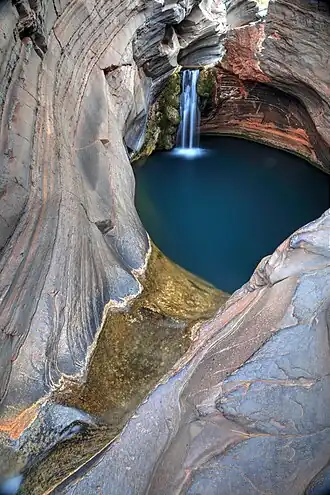
- Weano Gorge — Handrail Pool. The signature Karijini photo: a slot canyon descending to a turquoise pool reached by a handrail-aided drop. Class 5, around 1 km return from Weano Day Use Area.
- Hancock Gorge — Kermit's Pool. The fluted "spider walk" through a narrow gorge is one of the park's set-piece scrambles. Class 5; beyond Kermit's Pool requires a guide.
- Oxer Lookout (Weano Recreation Area). The grandstand view, looking down on the junction of Weano, Hancock, Red and Joffre gorges — best in late afternoon.
- Knox Gorge & Lookout. Quieter than Weano/Joffre. The lookout is roadside; the descent into the gorge is 2 km / ~3 hours, Class 5.
- Kalamina Gorge. The gentlest of the central gorges — Class 4, ~3 km return — with a small waterfall and pool. A good warm-up.
- Hamersley Gorge. Spectacular rippled, folded rock formations created by tectonic compression, with a deep, safe swimming pool below. ~90 minutes' drive from the central gorges via Hwy 136; sealed access road and toilets at the lower car park.
Mountains and viewpoints
- Mount Bruce (Punurrunha). WA's second-highest peak at 1,234 m. A 3 km unsealed track off Karijini Drive leads to the trailhead. The Marandoo View walk (500 m) gives an easy taste; Honey Hakea trail continues 4 km uphill to the halfway viewpoint. The full 9 km / 9-hour summit return is for cool weather and fit hikers only.
Cultural and interpretive
- Karijini Visitor Centre, Banjima Drive (+61 8 9189 8121, 9 AM–4 PM, closed peak summer). Architecturally striking, shaped like a goanna; excellent exhibits on Banjima culture, Pilbara geology and the park's flora and fauna. Stop here first for current track closures and conditions.
All gorge descents are classified by Parks and Wildlife on a 1–6 scale. Trails marked Class 5 are unmarked and require scrambling; Class 6 (restricted areas of Hancock and Weano below Kermit's Pool) requires a licensed guide.
- Swim the gorges. Fortescue Falls, Fern Pool, Hamersley Gorge, Circular Pool and Handrail Pool all have safe swimming holes. Water is cold even in summer — the gorges see little direct sun.
- Guided abseiling and canyoning. West Oz Active and Pilbara Eco Tours run half-day and full-day trips into the restricted lower sections of Hancock and Weano gorges, including abseils into the upper Class 6 zones. Expect to pay around $300–$450 for a full day.
- Stargazing. Karijini sits hundreds of kilometres from any significant light pollution. Even casual naked-eye stargazing from Dales campground is extraordinary; the Eco Retreat occasionally runs astronomy sessions in season.
- Wildflower walking (June–September). Mulla mullas, Sturt desert peas, Karijini wattles and dozens of acacia species bloom across the spinifex savannah after winter rain.
- Sunset at Oxer Lookout or Junction Pool Lookout. The low angled light fires the iron in the gorge walls and turns the canyons a deep blood-orange. Bring a head torch for the walk back.
- Wildlife spotting at dawn. Red kangaroos, euros (wallaroos), rock wallabies, echidnas and dingoes are most active in the cool early hours. Watch for them on the roads — vehicle strikes are a serious risk.
Planning Karijini National Park? Want these on a customised itinerary?
Ask on WhatsAppWhere to eat?
Food options in Karijini are minimal — this is wilderness camping country, and most visitors self-cater. Stock up on a full trip's worth of supplies before entering the park, including extra water, and bring a cooler with ice.
- Karijini Eco Retreat Restaurant (Weano Rd, +61 8 9286 1731). The only sit-down restaurant inside the park. A modern Australian menu making strong use of native ingredients — kangaroo, barramundi, bush tomato, lemon myrtle. Open daily, April–October to 8 PM, November–March to 6:30 PM. Capacity is tight; book your table when you book your room, or call ahead if camping. Mains $40–$55.
- Eco Retreat Burger Bar. Open daily during high season for casual takeaway: gourmet burgers, wraps and fries from around $20–$28. No bookings.
- Dales campground BBQ area. Gas BBQs and shaded picnic tables — bring your own food. There's no shop at Dales.
- Auski Munjina Roadhouse (110 km east at the jcn of Hwy 134 and the Great Northern Highway). Hearty truckie-style meals — steak sandwiches, fish and chips, big breakfasts — at the end of a long drive. A lifesaver if you arrive late.
- Tom Price Hotel Motel (Central Rd, Tom Price, 80 km west). Pub bistro with parmas, steaks and a Sunday roast; the closest town dining.
- Red Emperor Bar & Grill (Newman, ~200 km south). Reliable steakhouse if you're approaching from the south.
Vegetarian options exist at the Eco Retreat and in Tom Price/Newman but are limited; vegan and gluten-free travellers should bring most of their own provisions.
Where to drink?
The Eco Retreat bar is the only licensed venue inside the park, serving WA wines, Pilbara-brewed beers (Matso's, Gage Roads) and cocktails until late. It's lively in dry-season high cycles and quiet in shoulder.
Water: Drinking water is available at the Visitor Centre and Eco Retreat. Dales campground has no running water — bring at least 4–5 L per person per day. Tap water at facilities is safe to drink. Gorge water is generally clean but should be treated or filtered if you intend to drink it; algae blooms occur in stagnant pools late in the dry.
Planning Karijini National Park? We’ll book the stays and dining for you.
Ask on WhatsAppWhere to stay?
Budget
- Dales Campground (Dales Rd, off Karijini Drive, +61 8 9189 8121). The only park-run campground; basic but well-located for Fortescue Falls and the eastern gorges. Drop toilets, gas BBQs, picnic tables, no running water, no power. Open year-round; bookings essential June–September via the DBCA Park Stay system. Adult $15/night, child $3.
- Karijini Eco Retreat — unpowered camping (off Weano Rd). Tent and caravan pitches with access to hot showers, basic kitchen facilities and the restaurant — a slightly civilised camping option close to Joffre and Weano. Pitch from $50/night.
Mid-range
- Auski Munjina Roadhouse (Great Northern Highway, 110 km east, +61 8 9176 6988). Simple, clean motel rooms with ensuites, plus an attached restaurant, campsite and fuel. Useful if you arrive after dark. Double room from around $170; powered sites from $40.
- Tom Price Tourist Park (Tom Price, 80 km west). Cabins, ensuite caravan sites and a pool — the most comfortable budget-mid option within reach. Cabins from $180.
Upscale / heritage
- Karijini Eco Retreat — Eco Tents & Deluxe Eco Tents (off Weano Rd, +61 8 9286 1731, [email protected]). The park's only upscale lodging, owned and operated by the Gumala Aboriginal Corporation. Permanent safari-style tents with ensuites, decks and either queen or king bedding, scattered through spinifex country a short walk from Joffre Falls. Off-grid solar, no Wi-Fi, full restaurant on site. Eco tents from around $280; deluxe/family tents from $450. Closed briefly in peak summer — check seasonal opening.
- Mount Florance Station Stay (~120 km north of the park, off Hwy 136). Working cattle station offering renovated homestead rooms and a shearers' quarters — heritage Pilbara pastoral character in a more remote setting. From around $250.
What should you buy?
The Karijini Visitor Centre has the only retail outlet inside the park: a small shop selling souvenirs, books on Pilbara geology and Banjima culture, postcards, basic film and SD cards, and locally made Banjima-inspired crafts. Profits support park operations and the traditional owners.
For groceries, fuel, ice and outdoor gear, stock up before arrival in Tom Price (IGA supermarket, Coles), Newman (Woolworths, Coles) or Port Hedland. The Eco Retreat keeps a small selection of essentials (drinks, snacks, sunscreen, ice) at the reception kiosk but at remote-Pilbara prices — assume double the city rate.
There is no bargaining culture. Bring cash; while card payments work at the Visitor Centre and Eco Retreat, signal-related outages are common.
Where to go next?
- Tom Price (80 km / ~1 hr west). Mining town with full services, supermarkets, fuel and the launch point for guided tours of Rio Tinto's working iron-ore mines.
- Millstream Chichester National Park (~250 km north / 3 hrs via Hwy 136). Comparatively lush oasis of palm-fringed pools (Python Pool, Deep Reach) on the former Millstream Station — a gentle contrast to Karijini's red rock.
- Karratha & the Burrup Peninsula / Murujuga (~350 km north / ~4 hrs). Coastal city giving access to Murujuga National Park and the world's largest concentration of Aboriginal rock art (over a million petroglyphs).
- Port Hedland (316 km / ~3.5 hrs north). The world's largest bulk-export port; staggering iron-ore ship-loading operations, plus turtle-nesting beaches at Cemetery Beach (Oct–Feb).
- Newman (178 km / ~2 hrs south). Gateway to Mount Whaleback (the world's largest open-cut iron-ore mine, tours bookable) and the spectacular Karlamilyi (Rudall River) National Park further east — true wilderness.
- Exmouth & Ningaloo Reef (~600 km / 7 hrs west). The natural pair-up: red Pilbara gorges followed by World Heritage fringing reef, whale sharks (Mar–Aug) and humpback whale interactions (Aug–Oct).
Nearby in Western Australia
More places to explore around Karijini National Park.

Guide content as of May 2026. Portions adapted from Wikivoyage, CC BY-SA 4.0.

Contact Us
Get in touch with us.
Get in touch
Contact Us
Tell us where you'd like to go and how you like to travel. A real Tripcuro planner — not a bot — will craft an itinerary around you.
- Personalised, hassle-free planning end-to-end
- Transparent pricing, no hidden costs
- 24/7 support for complete peace of mind