
This is Part 13, the final post in our 13-part Angkor series. Read Part 1: Where is the Largest Hindu Temple in the World? | Read Part 12: Beyond Angkor Thom
Every stone at Angkor tells a story. But the largest story, the one that wraps around all the others, is the story of Cambodia itself. It starts with a Brahmin and a naga princess. It passes through an empire that built the largest religious monument on Earth. It nearly ends in a genocide that erased a quarter of the population. And today, it is being retold by a young couple taking wedding photos in front of Angkor Wat, the bride dressed as an apsara, the groomsmen laughing beside them.
This is that story.
The beginning: Kaundinya and Soma
Cambodia’s founding legend is carved into the walls of the Bayon and Banteay Chhmar. A Brahmin named Kaundinya arrives by sea. A naga princess named Soma, daughter of the serpent king who rules the waters, comes to meet him. They marry. The kingdom is born.
The legend is the Khmer origin myth, and it tells you everything about how Cambodia saw itself: born from the union of an Indian Brahmin (law, writing, religion, the state) and a local serpent spirit (the land, the water, the ancestors). Cambodia is neither wholly Indian nor wholly indigenous. It is the child of both.
The naga remains everywhere in Angkor. It is the balustrade on the causeway to Angkor Thom, the serpent pulled in the Churning of the Ocean of Milk, the hood of the multi-headed snake that protects the Buddha. The naga is Cambodia. The Brahmin is the Sanskrit carved into the temple walls. Together they made the Khmer Empire.
The empire: the Angkor centuries
From the 9th to the 15th century, the Khmer Empire was the dominant power in mainland Southeast Asia. Its kings built Angkor, first as a series of capitals centered on different temples, then as the walled megacity of Angkor Thom. At its peak, the Greater Angkor region was home to nearly a million people, the largest pre-industrial urban complex on the planet.
The empire was Hindu, then Mahayana Buddhist, then Theravada Buddhist. Each layer was added to the previous one, not erased. The temples of the earlier centuries were maintained, repurposed, and re-sanctified as the religion evolved. Angkor Wat went from Vishnu’s temple to Buddha’s temple without ever stopping being a holy place.
The empire fell in the 14th and 15th centuries, pushed by a combination of climate change (megadrought followed by extreme monsoons, which the hydraulic system could not handle), political pressure from the rising Siamese kingdom of Ayutthaya, and a slow shift of population and economic power toward the coast and the Mekong. Angkor was not sacked and abandoned in a single dramatic event. It was drained of people over decades, until the jungle reclaimed what the people had left.
The temples are Cambodia
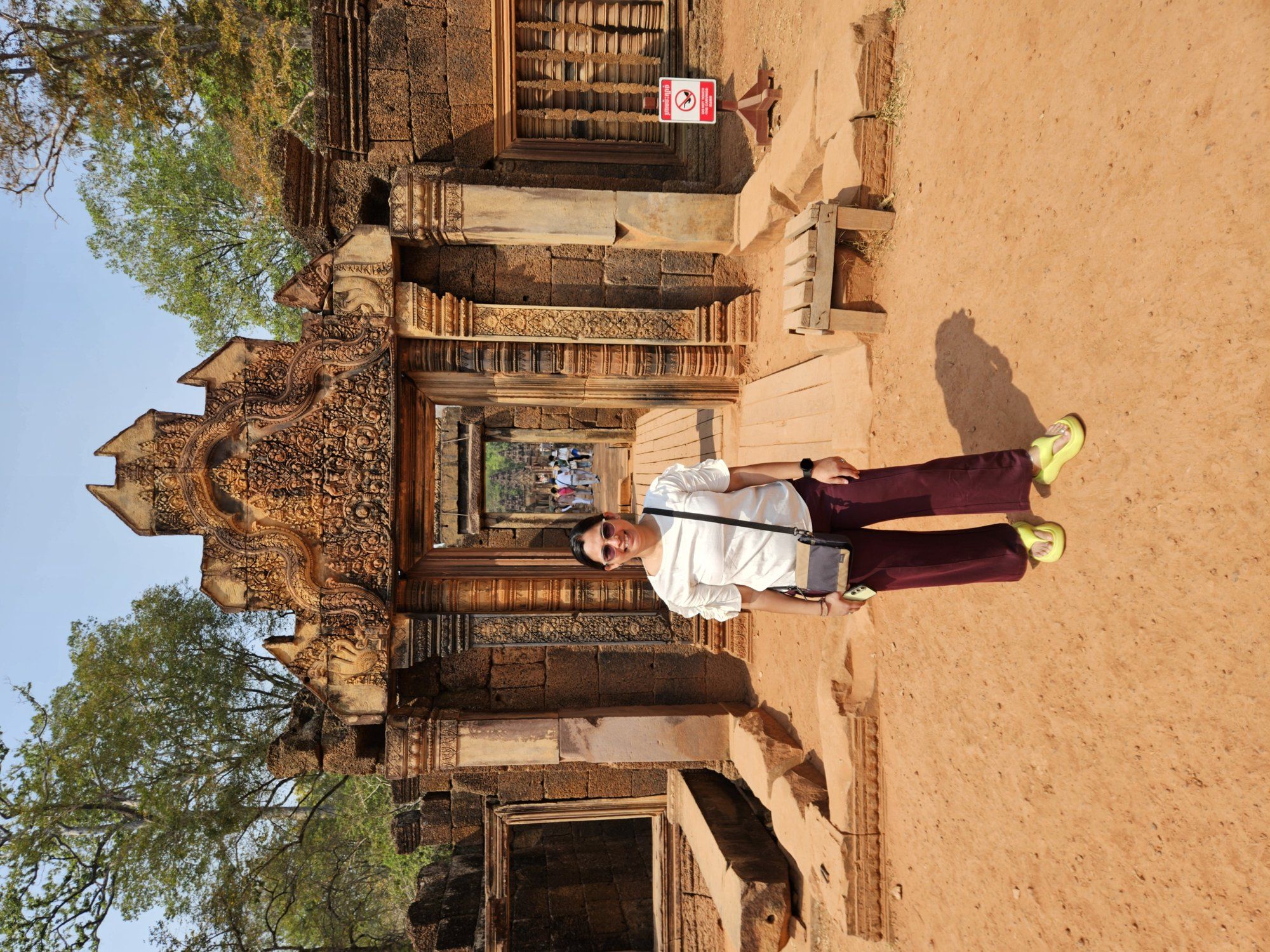
The temples never fully disappeared. Khmer monks continued to worship at Angkor Wat. The forest covered the outer stones, but the central sanctuary was never abandoned. The temple that appears on the Cambodian flag, the only flag in the world to carry a building, has been in continuous use since the 12th century.
The French “rediscovery” of Angkor in the 19th century changed the temples’ meaning. They became objects of Western scholarship, then symbols of national identity for Cambodians under French colonial rule, then the centrepiece of a tourism industry that slowly rebuilt the country’s economy.
Aditya noted something that stuck with him: “For Cambodians, the Khmer Empire and Apsara and Angkor are their national symbols and they emulate it in most places.” The temples are not relics. They are the template for what Cambodia wants to be.
The genocide: the near-death of a people
The Khmer Rouge regime of 1975–1979 killed an estimated two million Cambodians, roughly a quarter of the population. The regime targeted the educated, the religious, the urban. It destroyed families, erased records, and nearly killed the classical arts. The Apsara dance tradition that claimed a direct line to Angkor Wat’s carvings lost most of its practitioners. The dancers were murdered alongside the teachers, the doctors, the artists.
Aditya did not visit the genocide memorial sites. But he learned about it from a conversation that made the scale human. “Over a beer with the hotel manager, he told me about how genocide affected Cambodian society and how you see mostly young people around. People tend to marry early, in their early twenties mostly.”
The demographic scar is visible. The population pyramid of Cambodia is still abnormal decades later: a missing generation, the elderly and the very young, with a thin middle. The genocide did not end when the Khmer Rouge fell. Its effects are still being felt in every marriage, every birth, every family gathering.
“People do not talk much about Khmer Rouge as it was a bad phase in their era,” Aditya said. It is a recent wound, and silence is one way of managing it. The genocide is not a tourist attraction. It is the context behind every smile you receive in Siem Reap.
Revival: the young country
Since the peace accords of the 1990s, Cambodia has rebuilt with remarkable speed. Angkor was declared a UNESCO World Heritage site in 1992. The tourism industry grew from nothing to millions of visitors a year. The temples that survived the empire, survived the jungle, and survived the war became the economic engine of a new Cambodia.
Pre-wedding shoots: a generation reclaiming its symbols
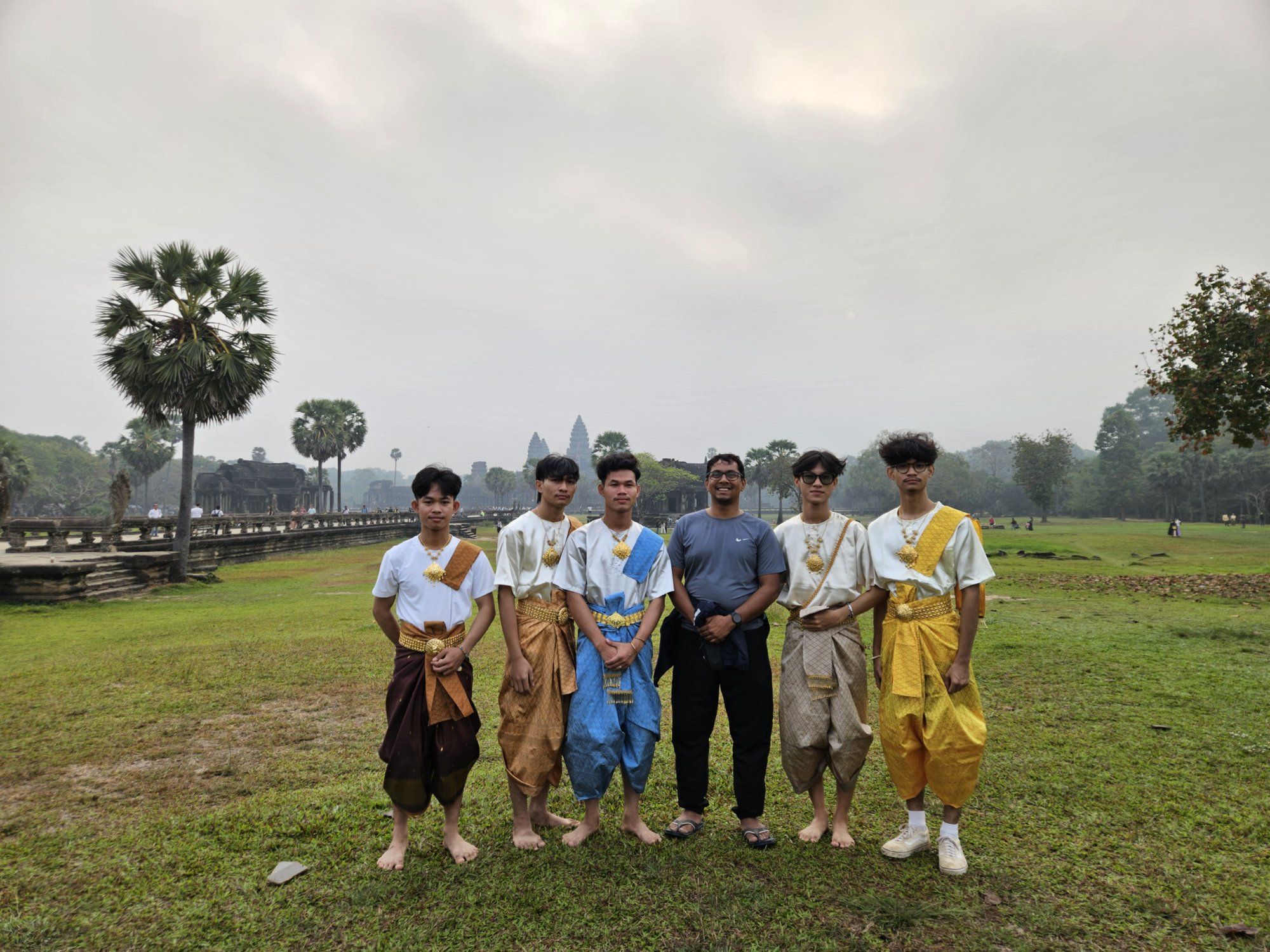
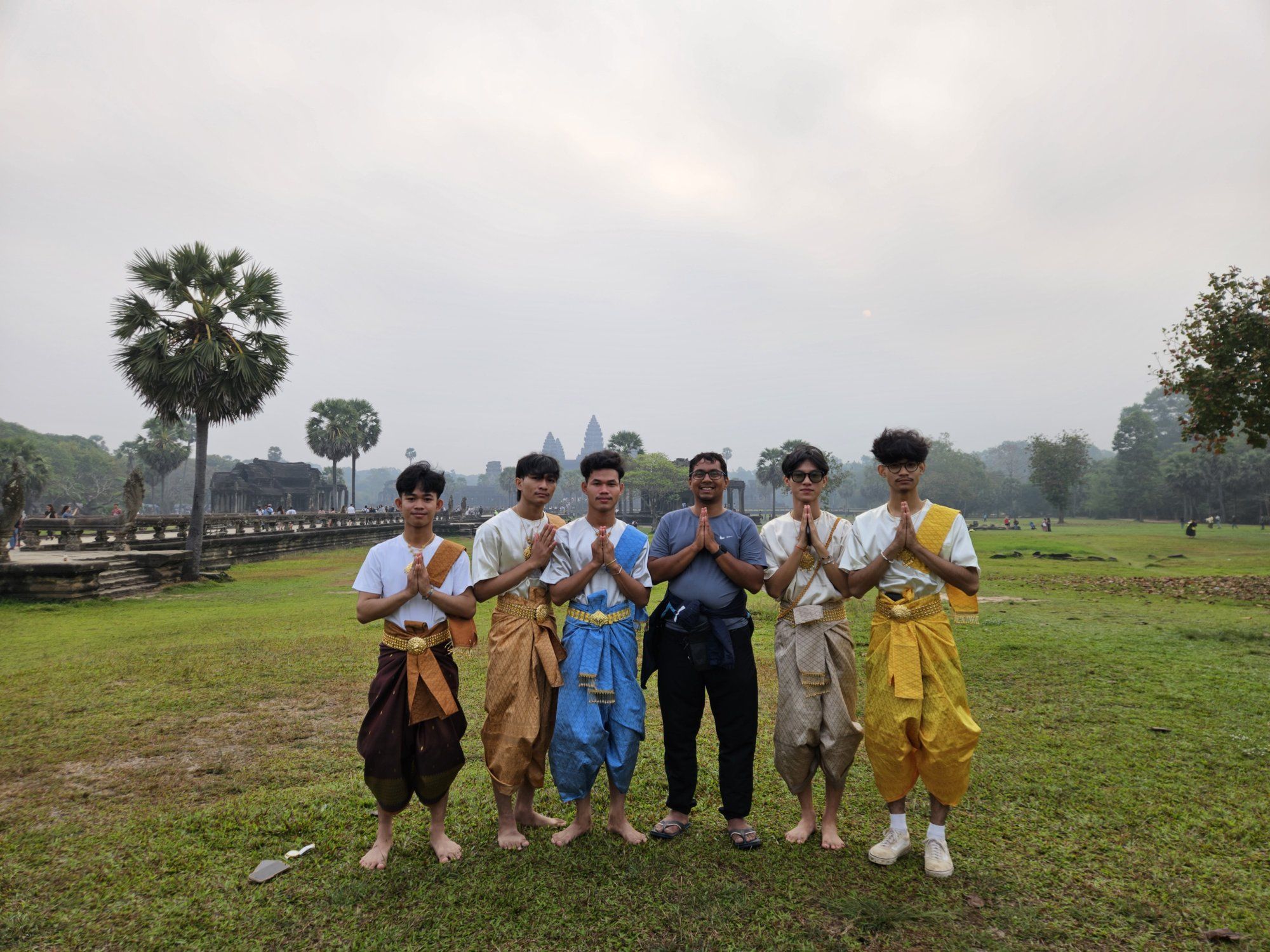
One morning at Angkor Wat, Aditya walked past a wedding photoshoot. The bride was dressed as an apsara. The groomsmen were in matching suits. The photographer was directing them against the backdrop of the temple towers.
“I saw a pre-wedding shoot happening for a Cambodian couple who were really young,” Aditya said. “I started talking with their group. The bride was dressed like an Apsara. I finally took a photo with the groomsmen.”
He learned that the couple had come from Krong Battambang. There were eight to ten shoots happening every day on the grounds of Angkor Wat, mostly on the open lawns, with the temple towers in the background. The apsara dress is not a costume. It is an assertion. A young Cambodian woman dressed as a celestial dancer on her wedding day is connecting herself to the empire that built the temple behind her.
Aditya was invited to the wedding in Battambang, three days later. He had to leave the next day. But the invitation itself was the point: the generosity, the openness, the ease with which strangers became guests.
The Cambodia of today
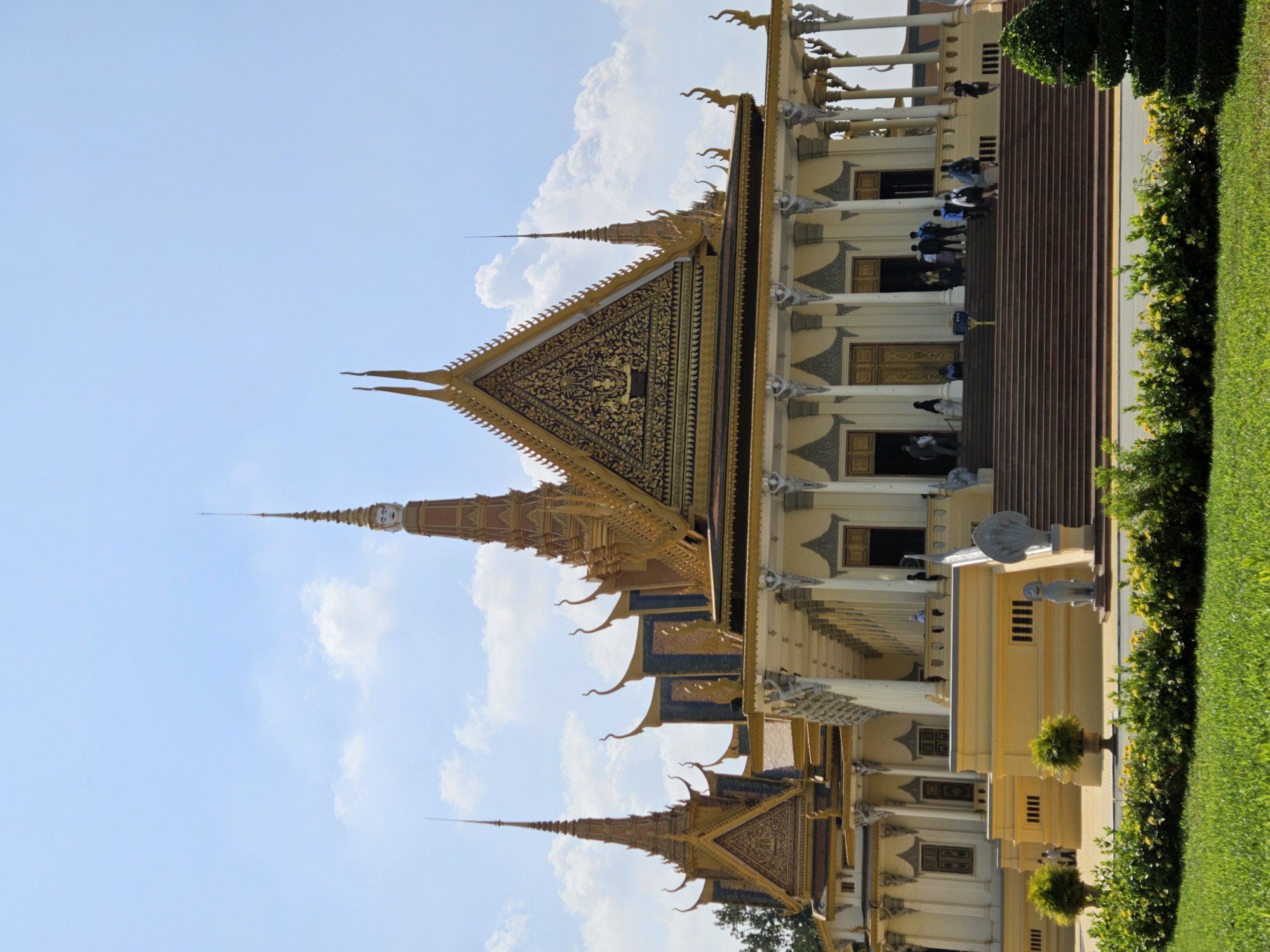
“The thing surprising about Cambodia,” Aditya said, “is excellent quality of fruits, vegetables, juices, food — all organic. People are extremely hospitable. The taxis and tuk tuks booked via app arrive on time and function well.”
Mangoes for $1, each weighing nearly a kilogram. Iced coffee with a fruity finish. Vendors who are universally sweet. A country that has been through the worst the 20th century could throw at it, and has come out the other side friendly, functional, and proud of the empire that left the largest stones on Earth.
What the series was for
Thirteen posts. One temple complex. One country.
Part 1 introduced Angkor Wat, the largest religious monument on Earth. Parts 2 and 3 took you inside its walls and its sanctuary. Parts 4 through 6 explored Angkor Thom and its hidden interiors. Part 7 gave you the actual itinerary that works. Part 8 revealed the water system that made it all possible. Part 9 showed you Siem Reap, the gateway town. Part 10 was the handbook for Indian travellers. Part 11 traced the apsara from stone to living dance. Part 12 took you beyond the main temples to Banteay Srei and the holy mountain.
And this final part told the story of the country that built it all.
Book Your Cambodia Journey With Tripcuro
Tripcuro designs your Cambodia journey end to end, from flights out of your city and the Angkor temple pass to a Siem Reap stay with exclusive perks. We know the guides, the routes, the restaurants that work for Indian travellers, and the quiet corners most people miss. Tell us your dates and we will build a bespoke itinerary around them.