
Udawalawe National Park
Uva Province, Sri Lanka
Why visit Udawalawe National Park?
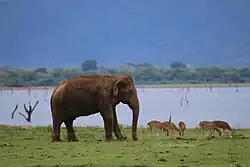
Udawalawe National Park — also spelled Udawalawa — straddles the boundary of Sabaragamuwa and Uva provinces in southern Sri Lanka and ranks among the island's finest and most reliable wildlife destinations. It is, above all, elephant country: large herds roam its open grasslands and the shores of the Udawalawe Reservoir, and sightings on a half-day jeep safari are close to guaranteed. For many visitors this is the easiest place in Sri Lanka to watch wild elephants at close range, which makes Udawalawe the island's third most visited wildlife sanctuary.
The park was created in 1972 to protect animals displaced by the construction of the Udawalawe Reservoir, on land previously farmed by slash-and-burn (chena) cultivation. It spreads across roughly 308 km² of mostly flat terrain — a mix of grassland, scrub and evergreen forest, punctuated by ponds and tanks that draw wildlife into the open. The highest point, Ulgala or "the pointed rock," rises to 373 m. The landscape shifts visually with the seasons, from parched yellow in the dry months to green after the rains. Beyond elephants, expect deer, water buffalo, golden jackals, mugger crocodiles and monitor lizards, plus a strong supporting cast of birds, including the European roller and black-necked stork.
Sitting on the boundary of the island's wet and dry zones, Udawalawe is warm year-round, with average temperatures of about 24–29 °C and annual rainfall above 1,500 mm. Wildlife viewing is good throughout the year. Early morning and late afternoon are the best times for sightings and the most comfortable in the heat; the drier months tend to concentrate animals around remaining water. Most visitors base themselves in Udawalawe town, at the south-western edge of the reservoir.
Planning Udawalawe National Park? Tell us your dates and we’ll tailor the trip.
Ask on WhatsAppHow do you get there?
By Plane
The nearest international gateway is Bandaranaike International Airport (CMB) near Colombo, roughly 165–180 km away by road — generally a four-to-five-hour drive. There is no airport bus to Udawalawe; a private car or taxi arranged in advance is the simplest option. The Mattala Rajapaksa International Airport in the south is closer but has very limited scheduled service.
By Train
Udawalawe has no railway station. The most useful option is to take the train down the Southern Line; from the line's terminus at Beliatta you can continue to Udawalawe by taxi (about an hour, around Rs. 10,000) or by bus via Nonagama. Travellers coming from the hill country can ride the scenic train to Ella, then complete the trip by bus.
By Car / Road
Udawalawe is well connected by road and bus. From Colombo, buses run from the Bastian Mawatha terminal to Embilipitiya (about 3½ hours, Rs. 175–350), from where local buses or a taxi (around 1 hour, Rs. 3,500–5,300) reach Udawalawe; the route 98 bus also serves the area directly. From Ella, the simplest route is a Kataragama-bound route 31-1 bus to Thanamalwila, then a frequent route 98 bus toward Colombo, getting off near your hotel — or a private taxi (about 2½ hours, Rs. 12,000–20,000). From Arugam Bay, take the westbound route 98 from Pottuvil along Thanamalvila Road, the town's main street.
Within the park, travel is by vehicle only — you either hire a permitted jeep with driver or join an organised safari; getting around independently on foot is not allowed. Safaris typically last several hours, and drivers radio one another with sighting news, which is good for spotting animals but can mean clusters of jeeps around a popular elephant. You may stop the vehicle and, where the driver judges it safe, briefly get out. Around Udawalawe town itself, tuk-tuks handle short hops and local buses run along the main road; agree tuk-tuk fares in advance, as meters are not used.
What are the things to do?
As a national park, Udawalawe is about wildlife rather than fixed monuments — the "sights" are the animals and the landscape.
Wild elephants — The park's signature attraction. Large herds, including young calves, are seen on most safaris around the grasslands and reservoir margins.
Udawalawe Reservoir — The large tank at the heart of the park; its shoreline draws elephants, water birds and crocodiles, and provides the park's most photogenic backdrop.
Birdlife — Resident and migratory species including the European roller, black-necked stork, raptors and numerous waterbirds; serious birders should bring binoculars.
Other wildlife — Spotted deer, water buffalo, golden jackals, mugger crocodiles (often seen basking in the late afternoon) and monitor lizards. Leopards are present but rarely seen.
Elephant Transit Home — A facility near the park where orphaned wild elephant calves are rehabilitated; public feeding sessions are held at set times each day. Check current schedules and fees locally.
Jeep safari — The reason to come. A vehicle, driver and spotter can be arranged in Udawalawe town, online, or through your accommodation; with many operators available, read reviews and shop around rather than simply taking the first tout at the bus stop. Online half-day tours (around 6 hours) for two people, including vehicle, driver and entrance fee, start from roughly US$100; guesthouses may arrange a half-day safari with English-speaking driver, a six-seat vehicle and breakfast in the park for around Rs. 8,500, with entrance fees paid separately.
Early-morning and late-afternoon game drives — Schedule safaris around dawn (departures often around 05:30) or the late-afternoon golden hour for the best sightings and cooler conditions.
Visit the Elephant Transit Home — Time your trip to catch a scheduled calf-feeding session.
Fees and permits: The park entrance fee for foreign visitors works out to roughly Rs. 3,000–5,000 per person, calculated from a base entry charge plus service charge, a per-vehicle fee and VAT, then converted from US dollars at the day's exchange rate. No advance permit is needed, but carry your passport and some extra cash for tips, water and snacks near the entrance.
Planning Udawalawe National Park? Want these on a customised itinerary?
Ask on WhatsAppWhere to eat?
There are no restaurants inside the park, so most meals are taken in Udawalawe town or at your accommodation, and it is essential to bring food and water for the safari itself. The town offers simple, inexpensive Sri Lankan fare — rice and curry built around vegetable dishes, dhal, sambols and a sharp achar relish, plus short eats such as vegetable rotti and vadai from bakeries. Many guesthouses cook rice and curry, hoppers or kottu to order and will pack a breakfast for early game drives.
- Udawalawe town eateries (budget) — Small local rice-and-curry shops along the main road, cheap and freshest at lunchtime.
- Guesthouse and lodge kitchens (budget–mid-range) — Often the most reliable meals, with packed safari breakfasts available on request.
If you bring food into the park, pack it only in biodegradable wrapping (paper, degradable polythene) or reusable containers, and carry out all litter. Vegetarian options are easy throughout; specify no dried fish if eating strictly vegetarian.
Where to drink?
Bring plenty of water for the safari — there is none available inside the park, though bottled water can be bought at the entrance store. In town, tea is served strong and sweet at every stall, and fresh fruit juices and king-coconut water (thambili) are widely available and welcome in the heat. Alcohol is low-key; some guesthouses and licensed outlets serve beer, but this is not a nightlife destination. Avoid tap water — stick to bottled or properly filtered water.
Planning Udawalawe National Park? We’ll book the stays and dining for you.
Ask on WhatsAppWhere to stay?
Sleeping inside the national park is not permitted. It is best to spend the night in Udawalawe town, at the south-western edge of the reservoir, so you can start your safari early; avoid arriving in town too early in the day, as there are no other attractions to fill the time.
- Budget: Numerous simple guesthouses and homestays in and around Udawalawe town offer basic double rooms at modest rates; book online or arrange on arrival (touts will approach you at the bus stop).
- Mid-range: A range of mid-range guesthouses and small hotels offer more comfortable rooms, some with gardens or swimming pools.
- Upscale: Several higher-end lodges and safari-style properties around the park edge cater to those wanting comfort, with pools, cabanas and arranged safaris.
What should you buy?
There is little shopping at Udawalawe beyond the basics. A small store at the park entrance sells souvenirs, hats, water and snacks, which is also a sensible last stop for supplies before a safari. Udawalawe town has ordinary shops for everyday goods. There is no significant craft or market scene; if you want handicrafts or tea, buy them in larger towns en route. Prices for informal souvenirs at the entrance are negotiable, so a little polite bargaining is fine.
Where to go next?
- Embilipitiya (~25 km, ~45 min) — The nearest large town and a useful transport hub.
- Ella (~2–2.5 hr) — Hill-country favourite with the Nine Arches Bridge and dramatic views.
- Sinharaja Forest Reserve (~2–3 hr) — UNESCO-listed rainforest rich in endemic birds and wildlife.
- Tissamaharama (~1.5–2 hr) — Gateway to Yala and Bundala national parks.
- Mirissa / Galle (~2.5–3 hr) — South-coast beaches, whale watching and a historic Dutch fort.
- Ratnapura (~2 hr) — The "City of Gems," centre of Sri Lanka's gem trade.
Nearby in Uva Province
More places to explore around Udawalawe National Park.
Guide content as of May 2026. Portions adapted from Wikivoyage, CC BY-SA 4.0.

Contact Us
Get in touch with us.
Get in touch
Contact Us
Tell us where you'd like to go and how you like to travel. A real Tripcuro planner — not a bot — will craft an itinerary around you.
- Personalised, hassle-free planning end-to-end
- Transparent pricing, no hidden costs
- 24/7 support for complete peace of mind