
Polonnaruwa
North Central Province, Sri Lanka
Why visit Polonnaruwa?
Polonnaruwa is the second of Sri Lanka's great ancient capitals, and for many travellers the most rewarding of the Cultural Triangle's ruined cities. After Chola invaders from southern India conquered Anuradhapura, the kingdom's centre shifted here; King Vijayabahu I formally declared Polonnaruwa the capital in the 11th century, and it held that status into the 13th century. Its golden age came under King Parakramabahu I, who built palaces, monasteries, image houses and the vast irrigation reservoir still known as the Parakrama Samudra, the "Sea of Parakrama". UNESCO inscribed the ancient city on its World Heritage List in 1982.
What makes Polonnaruwa stand out is its compactness and the quality of its sculpture. Whereas Anuradhapura's monuments are scattered over many kilometres and can begin to feel repetitive, Polonnaruwa's ruins are concentrated in one walkable archaeological park strung along a single road. A short tuk-tuk ride from your guesthouse to the entrance and you can spend a satisfying day among palaces, the famous Quadrangle of religious buildings, towering stupas and the serene rock-cut Buddhas of the Gal Vihara. If you have time for only one ancient capital, Polonnaruwa is the easier and more visually striking choice.
The town has two parts: the ancient city to the north, and the new town to the south and east where most hotels, guesthouses and the bus station are found. The dry-zone climate is hot throughout the year; the more comfortable, drier season runs roughly from May to September, while the northeast monsoon brings rain from about October to January. Start early and carry water and sun protection — there is little shade among the ruins by midday.
Planning Polonnaruwa? Tell us your dates and we’ll tailor the trip.
Ask on WhatsAppHow do you get there?
By Plane
The nearest airfield is Hingurakgoda Airport (HIM), but it had no scheduled flights as of 2025. Sigiriya Airport (GIU) is another option and has occasionally been served by Cinnamon Air light aircraft and seaplanes from Colombo-Bandaranaike, Batticaloa and Trincomalee. Most travellers fly into Bandaranaike International Airport (CMB) near Colombo and continue overland — Polonnaruwa is about 216 km away.
By Train
One train a day runs from Colombo Fort to Polonnaruwa, departing around 13:45 and arriving about 18:36, a journey of roughly 5 hours (3rd class around SLR 360, 2nd class around SLR 1,450). With only one daily service, book ahead and confirm current timings; many travellers find the bus or a car more convenient.
By Car / Road
By road Polonnaruwa is around 216 km from Colombo and about 66 km east of Dambulla. A private transfer typically costs in the range of SLR 21,000–30,000; hotels can arrange one. Buses are frequent and cheap: from Colombo an intercity bus takes roughly 6–8 hours; from Anuradhapura direct buses run through the day (about 100 km, around 3 hours); and from Kandy the 150 km trip takes about 4½ hours, stopping at Dambulla. Note that Polonnaruwa Bus Stand is around 4 km east of the main ruins — if your hotel is nearer the archaeological park, ask the conductor to drop you closer, for example at the Clock Tower.
Bicycles are the best way to get around Polonnaruwa. The ancient city is flat and its monuments line up conveniently along one main road, so a relaxed cyclist can cover everything in a day. Most guesthouses rent bikes, and there are also rental stands in front of the main entrance (not to be confused with the ticket office at the Museum), charging around 750–1,000 LKR per adult bike, with cheaper kids' bikes (around 500 LKR), child seats and tandems available. The bikes are basic but fine for the paved circuit. For short hops in the new town, tuk-tuks are plentiful — agree the fare first.
The one-day entrance ticket for the ancient city costs US$25; the combined Cultural Triangle round-ticket is no longer sold. South Asian nationals receive a substantial discount, so carry your passport. Tickets are bought at the museum ticket office, and you should keep yours to hand for checks within the site.
What are the things to do?
Polonnaruwa's monuments are concentrated in the archaeological park just north of the new town, around 140 km north of Kandy. Heading roughly south to north along the main road:
Royal city and southern monuments
- King Parakramabahu I Statue — A striking rock-cut figure, near the Potgul Vehera, traditionally identified as the great king (some say a sage).
- Potgul Vehera — Monastery ruins attributed to King Parakramabahu I, notable for an unusual circular brick structure on the lower terrace.
- The Royal Palace — The remains of Parakramabahu's once-multi-storeyed palace, its thick brick walls still impressive.
- Royal Court (Council Chamber) and Kumara Pokuna — The audience hall with its carved elephant base, and a finely built royal bathing pool fed by stone channels.
- King Nissanka Malla's Palace — Palace ruins beside the Parakrama Samudra reservoir.
The Quadrangle (Dalada Maluwa) — A raised terrace holding the city's holiest cluster of buildings:
- Vatadage — A circular relic house with concentric terraces, guard-stones and four seated Buddhas; one of Polonnaruwa's most photographed monuments.
- Atadage and Thuparamaya — Early image houses, the latter with notably thick walls still standing.
- Gal Pota (Stone Book) — A colossal stone slab inscribed with the achievements of Nissanka Malla.
- Nissanka Latha Mandapaya — A small pavilion with delicate stone columns carved to resemble lotus stalks.
Northern monuments
- Rankoth Vehera — A large, well-preserved bell-shaped stupa.
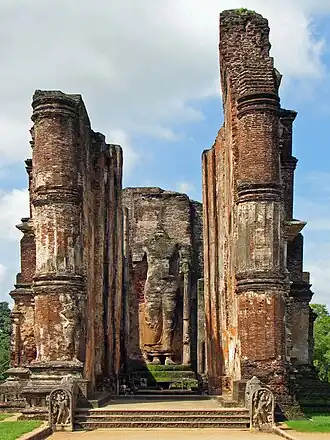
- Lankatilaka Gedige — A towering brick image house, roofless but with soaring walls and a giant standing Buddha; sometimes called "the Glory of Sri Lanka".
- Kiri Vihara — A white dagoba whose original lime plaster has survived remarkably well.
- Gal Vihara — The masterpiece of Polonnaruwa: four Buddha images carved from a single granite face, including a celebrated reclining Buddha. About 5.5 km north of the centre at Nissankamallapura.
- Demala Maha Seya, Lotus Pond and Thivanka Image House — A huge unfinished stupa, an elegant lotus-shaped bathing pool, and an image house famed for its frescoes.
- Shiva Devale (Siva Devale No. 2) — A small, finely built Chola-era Hindu stone temple, a reminder of the South Indian influence on the city.
Also worth noting are the Alahana Pirivena monastic complex and the great Topa Wewa / Parakrama Samudra reservoir, whose bund makes a fine spot for sunset.
Most visitors spend a full day cycling the ruins, which is itself the headline activity. Beyond that, Polonnaruwa is an excellent base for wildlife safaris: the surrounding district holds several reserves, and a guided afternoon jeep trip to Minneriya or Kaudulla National Park to see elephants is highly recommended — arrange a guide through your guesthouse. The bund of the Parakrama Samudra is a pleasant place for an evening stroll, and birdwatching around the tank is rewarding. Climbing Sigiriya, an easy day trip, is another popular outing from here.
Planning Polonnaruwa? Want these on a customised itinerary?
Ask on WhatsAppWhere to eat?
Polonnaruwa's food is straightforward dry-zone Sri Lankan cooking — rice and curry, kottu, hoppers and short eats — served in modest local "hotels" (small restaurants) and guesthouse kitchens. A sensible rule here is to avoid eating from open-market food stalls and to steer clear of places that rely on street touts or that you cannot see into from the road. A reliable, very cheap option is Gama, a local joint south of the ruins and museum, known for a tasty vegetable curry buffet for around Rs 350. Guesthouses generally serve good home-cooked rice-and-curry dinners if ordered in advance, and bakeries around the new town do cheap rolls and pastries. Vegetarian food is plentiful, as much Sri Lankan cooking is plant-based; ask for fewer chillies if you prefer milder flavours.
Where to drink?
Public drinking of alcohol is not socially acceptable in Sri Lanka, and Polonnaruwa has little in the way of bars. Where alcohol is available it is usually within hotel and guesthouse bars, stocking local Lion beer and arrack, the coconut-based spirit. Far more in keeping with the town are non-alcoholic drinks: fresh king-coconut water (thambili) from roadside stalls, strong sweet Ceylon tea, fresh lime sodas and bottled soft drinks. Do not drink tap water; stick to bottled or filtered water, which all accommodation provides.
Planning Polonnaruwa? We’ll book the stays and dining for you.
Ask on WhatsAppWhere to stay?
- Budget — The new town has plenty of budget hotels and guesthouses, with prices starting around Rs 1,500–2,000 per person per night. Lagassa Lodge (#95 Circular Road) has clean, modern rooms built in 2017, large bathrooms and good food, around LKR 2,000.
- Mid-range — The Village Polonnaruwa (Parakrama Lake Road, Potugal Mawatha, about 1 km south) from around US$45; Polonnaruwa Resthouse on the Parakrama Samudra, run by the Ceylon Hotels Corporation, from around US$55; and Hotel Seruwa, also CHC-run, cheaper with a pleasant location.
- Upscale / heritage — The Royal Lotus Hotel at Giritale (about 12 km northwest), a modern resort beside the Giritale Tank, around US$65–130; and Pharo Lake (Thidas Arana Lake), at No. 42 Deewara Mawatha, set on a peninsula about 4 km from the ruins with sweeping lake views where elephants often roam, around US$80 for a lake-view room.
A note on safety: do not sleep or lie on the grass, because of the risk of bites from venomous snakes or insects.
What should you buy?
Polonnaruwa is not a major shopping town. Souvenir stalls operate around the ancient city and museum, selling postcards, carved wooden figures, masks and replica artefacts — bargain politely, and never buy items presented as genuine antiquities, as their export is illegal. The new town has ordinary shops, a market and grocery stores for everyday needs and snacks. For a wider choice of crafts, batiks and spices, most travellers shop at Dambulla or Kandy.
Where to go next?
- Minneriya National Park (about 25 km) — Famous for the dry-season gathering of elephants.
- Kaudulla National Park (nearby, towards Habarana) — A quieter elephant-safari alternative.
- Dambulla (about 67 km west) — Golden cave temples and a Cultural Triangle hub.
- Sigiriya — The iconic rock fortress, an easy day trip.
- Batticaloa (east coast) — A relaxed coastal city with lagoons, beaches and Dutch-era forts.
- Knuckles Mountain Range — A rugged conservation area to the southwest, excellent for trekking and cooler air.
Nearby in North Central Province
More places to explore around Polonnaruwa.

Guide content as of May 2026. Portions adapted from Wikivoyage, CC BY-SA 4.0.

Contact Us
Get in touch with us.
Get in touch
Contact Us
Tell us where you'd like to go and how you like to travel. A real Tripcuro planner — not a bot — will craft an itinerary around you.
- Personalised, hassle-free planning end-to-end
- Transparent pricing, no hidden costs
- 24/7 support for complete peace of mind