

Coromandel Town
Waikato, New Zealand
Why visit Coromandel Town?
Coromandel Town is a small, leafy settlement of around 1,500 people on the western shore of the Coromandel Peninsula, looking out across the sheltered waters of the Hauraki Gulf to Auckland. The town's character is shaped by its 19th-century gold rush past — kauri logging and gold mining boomed here from the 1850s after Charles Ring's strike on Driving Creek in 1852, and many of the wooden colonial-era buildings along Kapanga and Wharf Roads survive, giving the centre a heritage feel quite unlike the surf towns on the peninsula's east coast. Today the economy runs on aquaculture (the green-shell mussels grown in the bay are famous nationwide), small-scale arts and crafts, and tourism.
Visitors come for a combination that's hard to find elsewhere in New Zealand: a working historic township, easy access to native forest in the Coromandel Forest Park, a strong artisan community (Barry Brickell's Driving Creek railway and pottery being the best-known legacy), and the seafood. The pace is unhurried, distances are walkable, and the town serves as a quiet base for exploring the western and northern parts of the peninsula.
The climate is mild and humid maritime. Summer (December–February) is the peak season — warm, busy, and the only realistic time to swim — and accommodation books out around Christmas and Waitangi Day. Autumn (March–April) is arguably the best time to come: settled weather, fewer crowds. Winter (June–August) is wet and can be cold by NZ standards, but the bush is at its greenest and the town is very quiet. The settlement itself is compact: a single main commercial strip along Kapanga Road and Wharf Road, with residential streets and B&Bs sprinkled around it; Hannaford's Wharf, where the Auckland ferry docks, sits about 15 minutes north by road.
Planning Coromandel Town? Tell us your dates and we’ll tailor the trip.
Ask on WhatsAppHow do you get there?
By Plane
There is no airport at Coromandel Town. The nearest commercial airport is Auckland Airport (AKL), roughly 190 km away by road (about 3 hours via SH1 and SH25), or alternatively reached via the Auckland–Coromandel passenger ferry (see By Car / Road below for the ferry option). Whitianga Aerodrome (WTZ), on the east coast of the peninsula, takes small Sunair flights from Auckland and Tauranga and is about 45 km (1 hour) east by road, but most travellers find it simpler to fly into Auckland and drive.
By Car / Road
Coromandel sits on State Highway 25, the main loop road around the peninsula.
- From Thames, 54 km / about 1 hour north on SH25. The road is sealed but narrow and winding, hugging the coast — allow extra time and don't trust GPS estimates.
- From Auckland, around 3 hours by road via Thames.
- From Whitianga, 45 km / 1 hour east via SH25 over the Whangapoua hill, or via the unsealed 309 Road, so named (depending on who you ask) either for its 309 bends or for the 309 minutes the old horse-drawn coaches took. The 309 is rough gravel but passable in a normal car if driven slowly, and it passes The Waterworks and several short bushwalks.
- From Kuaotunu, 28 km / about 30 minutes west.
Ferry from Auckland: Explore Group runs a passenger ferry from Auckland's Viaduct Harbour to Hannaford's Wharf at Coromandel on weekends. Sailings depart Friday evening and Saturday/Sunday mornings, with return trips Friday evening and early afternoon on Saturdays and Sundays. Most crossings take around 2 hours and stop at Rotoroa Island and Man O' War Bay on Waiheke Island en route; one trip each way per weekend has an extended ~90-minute stop at Man O' War Bay. A shuttle bus from Hannaford's Wharf into town is included in the fare.
Bus: InterCity coaches connect Auckland and Thames, with onward services up the peninsula to Coromandel Town. Frequencies are limited (typically once daily) — book ahead in summer.
The town centre is small enough to cover on foot in 15 minutes end to end. There is no local bus or taxi rank to speak of; for trips out to Hannaford's Wharf, Driving Creek, or trailheads in the Coromandel Forest Park you'll want a car, a bike, or to pre-arrange a shuttle. Some accommodations rent bikes or arrange transfers. Ride-hailing apps (Uber etc.) do not operate here.
What are the things to do?
Driving Creek Railway and Potteries, Kennedy Bay Rd. The town's signature attraction. Sculptor Barry Brickell began building this narrow-gauge mountain railway in his back yard in the 1970s to haul clay down from the hills above his pottery; over decades it grew into an elaborate line of spirals, tunnels, viaducts and switchbacks, climbing to a summit lookout known as the "Eyefull Tower" with views over the regenerating native bush and out across the Hauraki Gulf. One-hour return trip approx. NZ$20 (verify current adult rate at the gate).
Coromandel Goldfield Centre and Stamper Battery, Buffalo Rd. Working stamper battery demonstrating how quartz was crushed to extract gold during the peninsula's 19th-century rush; guided tours and panning. A good companion to the School of Mines Museum.
School of Mines Museum, 841 Rings Rd. Local-history museum in the original 1898 mining school building, with mineral specimens, mining tools and town memorabilia. Seasonal hours — check locally.
The Waterworks, 471 The 309 Rd (about 7 km from town along the 309). A quirky outdoor theme park of water-powered kinetic sculptures and inventions, much loved by families. Open daily 10AM–6PM Nov–Mar, 10AM–4PM Apr–Oct. Adult NZ$25, child NZ$20.
Coromandel Forest Park. Native bush reserve covering much of the peninsula's spine, with kauri remnants, waterfalls, and historic kauri-driving dam sites. Several access points within a short drive of town; the Kauaeranga Valley visitor centre (DOC), better reached from Thames, is the main hub for park information.
Walk to the Long Bay coastal track for easy beach and headland walking just north of town.
Take a mussel-farming or seafood cruise from Coromandel Wharf — several operators run half-day trips out into the harbour with shucked mussels straight from the lines and commentary on the aquaculture industry.
Drive (or cycle) the 309 Road as a half-day loop, stopping at the Waterworks, the kauri grove, and the short walks to Waiau Falls.
Tramp in the Coromandel Forest Park — short options from town include the Tokatea Lookout track; longer day walks like the Pinnacles (from Kauaeranga Valley) make a good full-day excursion if based here.
Browse the artist studios. Coromandel has a long-standing community of potters, woodturners and painters; pick up the Coromandel Coast Arts Tour map from the i-SITE for self-guided studio visits.
Sea kayak in the harbour — sheltered waters and views back to the town make for an easy paddle.
Planning Coromandel Town? Want these on a customised itinerary?
Ask on WhatsAppWhere to eat?
The town punches above its weight on seafood, and the Coromandel green-lipped mussel — large, plump, and farmed in the harbour just offshore — is the local signature. You'll see them grilled, steamed in white wine and garlic, and battered into fritters across most menus. Smoked fish, scallops in season, and whitebait fritters in spring are also worth seeking out.
- Peppertree Restaurant & Bar, 31 Kapanga Rd, ☏ +64 7 866 8211, [email protected]. Daily 10AM–9PM. All-day brunch and dinner; reliable choice in the centre with a strong line in local seafood and lamb.
- The Coromandel Mussel Kitchen (on SH25 just south of town). Casual brewery-and-restaurant pairing the local mussels in every conceivable preparation with their own beer; a near-mandatory stop for first-time visitors.
- Umu Café, Kapanga Rd. Daytime brunch and coffee spot popular with locals.
- Driving Creek Café (near the railway). Vegetarian-friendly café in a garden setting; good lunch option if you're already out at the railway.
Vegetarian options are widely available; gluten-free is well understood at most cafés. There are no dedicated halal restaurants in town.
Where to drink?
New Zealand's wine and craft-beer culture is well represented for a town of this size. Coromandel Brewing Co. (at the Mussel Kitchen) brews a small range of pale ales and lagers on site and is the most distinctive drinking spot. Cafés along Kapanga Road serve the strong flat-white-style coffee that's standard nationwide. Tap water is safe to drink throughout the town and at established accommodation; if you're filling bottles at backcountry streams in the Forest Park, treat or filter as you would anywhere in NZ bush.
Planning Coromandel Town? We’ll book the stays and dining for you.
Ask on WhatsAppWhere to stay?
Budget
- Tui Lodge Backpackers, 60 Whangapoua Rd. Long-running hostel with dorms and private rooms in a converted homestead about 1 km from the centre. Dorms typically NZ$35–45, private rooms from around NZ$90.
- Coromandel Top 10 Holiday Park, Rings Rd. Tent and powered sites, cabins and self-contained units; powered site for two from around NZ$50, cabins from NZ$110.
Mid-range
- Anchor Lodge Coromandel, 448 Wharf Rd. Motel-style units and apartments with a pool, walking distance to the wharf. Doubles typically NZ$180–250.
- Coromandel Court Motel, 365 Kapanga Rd. Central, well-kept motel rooms with kitchenettes; doubles from around NZ$170.
Upscale / heritage
- Driving Creek Villas, 21A Colville Rd. Self-contained two-bedroom villas in native bush a short drive north of town, designed in sympathy with the Brickell tradition; nightly rates typically NZ$350–450.
- Jacaranda Lodge, 3387 Tiki Rd (about 4 km south of town). Boutique B&B in a heritage homestead with gardens; doubles typically from NZ$300 including breakfast.
What should you buy?
Coromandel's shopping is small-scale and craft-focused. Look for studio pottery (a direct legacy of Barry Brickell and the Driving Creek tradition), kauri-wood bowls and turning, local honey and manuka products, and smoked or fresh green-lipped mussels to take away. The Saturday-morning market on Kapanga Rd (seasonal) is a good place to combine produce, crafts and baked goods. Bargaining is not a New Zealand norm — prices in shops and at markets are fixed.
For groceries, the Four Square Supermarket at 50 Wharf Rd (daily 7AM–7PM) is the main self-catering stop.
Where to go next?
- Kuaotunu (28 km / 30 min east) — quiet east-coast beach village, good swimming and a well-known wood-fired pizzeria.
- Whitianga (45 km / 1 hr east via SH25, or via the 309 Road) — larger east-coast resort town, base for Cathedral Cove and Hot Water Beach.
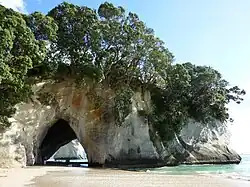
- Hahei and Cathedral Cove (~70 km / 1.5 hr) — iconic sea-arch beach reached by walking track or kayak.
- Hot Water Beach (~75 km / 1.5 hr) — dig your own thermal pool in the sand at low tide.
- Colville and Port Jackson (60–80 km north) — end-of-the-road drive to the remote tip of the peninsula, with empty beaches and DOC campsites.
- Thames (54 km / 1 hr south) — the peninsula's largest town, with Victorian streetscape, more gold-mining heritage, and the gateway to the Kauaeranga Valley and the Pinnacles tramp.
Nearby in Waikato
More places to explore around Coromandel Town.
Guide content as of May 2026. Portions adapted from Wikivoyage, CC BY-SA 4.0.

Contact Us
Get in touch with us.
Get in touch
Contact Us
Tell us where you'd like to go and how you like to travel. A real Tripcuro planner — not a bot — will craft an itinerary around you.
- Personalised, hassle-free planning end-to-end
- Transparent pricing, no hidden costs
- 24/7 support for complete peace of mind