
Dzavhan
Mongolia · Province · 7 destinations with guides
Photography coming soonOverview
Dzavhan (also romanised as Zavkhan, Mongolian: Завхан) is a landlocked province (aimag) in western Mongolia, bordered by Russia to the north. Its administrative centre is Uliastai, one of Mongolia's historically significant cities. The province covers roughly 82,500 km² of extraordinarily varied terrain — from the snow-capped peaks of the Khangai Mountains in the east to the arid shores of Khyargas Nuur (a large saltwater lake) in the west, with vast stretches of steppe and forest in between.
Dzavhan is one of Mongolia's most remote and least-visited provinces, which is both its challenge and its appeal. Road infrastructure is sparse outside the main settlements, and many communities are accessible only by rough tracks or seasonal roads. For travellers willing to make the effort, the reward is a landscape that feels genuinely untouched — pristine alpine meadows, ancient volcanic formations, and some of the most dramatic mountain scenery in the country centred on the Otgontenger massif, the sacred peak that crowns the eastern Khangai range.
The province's population is small (around 65,000–70,000), predominantly ethnic Khalkh Mongols with a Kazakh minority in some western districts. Livestock herding remains the dominant way of life, and the nomadic pastoral culture here is largely unmediated by tourism infrastructure.
When to Visit
The best months to visit Dzavhan are June through September. July and August offer the warmest temperatures (daytime highs of 20–25 °C in the lowlands, cooler at altitude) and the greenest landscapes. The Naadam festival period (around 11–13 July) brings celebrations to Uliastai and smaller district centres, featuring wrestling, horse racing, and archery.
Spring (April–May) and autumn (September–October) are transitional and cold, with temperatures dropping well below freezing at night. Winter is extreme — temperatures in Uliastai can plunge to −35 °C or below, and many mountain passes become impassable due to heavy snow. The Otgontenger area is effectively inaccessible from late October through May. Summer thunderstorms can make unpaved roads muddy and treacherous; a 4×4 vehicle is essential outside the Uliastai–Tosontsengel corridor.
Tell us your dates and we'll shape a Dzavhan route around them.
WhatsAppGetting Around
Dzavhan has no railway line and no airport with regular scheduled service (Uliastai has an airstrip, but scheduled flights are irregular and subject to cancellation). The primary way to reach the province is by road — typically a long overland journey from Ulaanbaatar (roughly 1,000 km, 20+ hours by vehicle).
Within the province, the main route runs between Tosontsengel (in the east, on the Kharkhorin–Ölgii highway corridor) and Uliastai (about 200 km west on increasingly rough tracks). A road continues west from Uliastai toward Khyargas Nuur and onward into Uvs Province, though conditions deteriorate significantly beyond Uliastai.
Shared jeeps and Russian Furgon vans are the main form of inter-settlement transport. Schedules are informal — vehicles depart when full, typically from the local market or bus station area in each town. Hiring a private 4×4 with driver is the most reliable option for reaching remote areas such as Otgontenger. Fuel availability is inconsistent outside Uliastai and Tosontsengel; carry spare fuel.
Top Destinations
- Uliastai — the provincial capital and historic garrison town, one of Mongolia's oldest settlements, with a small but atmospheric centre and access to surrounding mountain valleys
- Tosontsengel — the main eastern gateway to Dzavhan, a small town on the Khangai steppe and a stopping point on the Ulaanbaatar–Ölgii overland route
- Aldarkhaan — a district centre and the closest settlement to the sacred Otgontenger peak, used as a base for treks into the protected area
- Otgontenger Strictly Protected Area — home to Otgontenger Uul (4,021 m), the highest peak of the Khangai range and one of Mongolia's most sacred mountains, with glaciers, alpine lakes, and challenging trekking
Want the scenic legs and stays booked for you? Just ask.
WhatsAppCuisine
Food in Dzavhan is typical of rural western Mongolia: simple, hearty, and heavily reliant on dairy and meat. Mutton and goat dominate the diet, prepared as buuz (steamed dumplings), khorkhog (hot-stone stew), or boiled with flour noodles. In summer, airag (fermented mare's milk) and aaruul (dried curd) are widely available from herder camps. Suutei tsai (milk tea) is the universal beverage.
Restaurants in Uliastai offer basic Mongolian and Chinese-influenced dishes — fried noodles, rice with meat, simple soups. Vegetarian options are essentially nonexistent outside Uliastai and even there very limited. Travellers should carry supplementary provisions (canned goods, instant noodles, dried fruit) for stretches between settlements, where there may be nothing but herder camps offering dairy and tea.
Culture & Festivals
Dzavhan's cultural life centres on the nomadic pastoral traditions common to western Mongolia. The Naadam festival (mid-July) is the main annual event in Uliastai, with wrestling, horse racing, and archery competitions drawing participants from across the province.
The region has a tradition of long-song (urtyn duu) singing and horsehead fiddle (morin khuur) performance, though these are encountered at informal gatherings rather than scheduled performances. Buddhist heritage is modest but present — Uliastai historically had several monasteries, most destroyed during the Stalinist purges of the 1930s; small-scale revival has occurred at some sites.
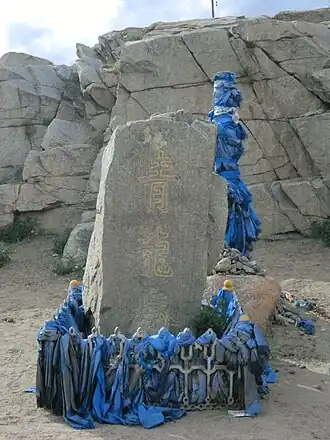
Otgontenger Uul holds deep spiritual significance. The mountain is considered sacred in Mongolian shamanic and Buddhist traditions alike, and periodic ritual ceremonies (ovoo worship) are held at stone cairns on its approaches. Access to the peak area requires a permit from the protected area administration.
Travelling during a festival? We'll plan around the crowds.
WhatsAppNotable Experiences
- Trek to the base of Otgontenger Uul — a multi-day horse or foot trek from Aldarkhaan through alpine valleys to the glaciers at the foot of Mongolia's most sacred peak (permit required, best July–August)
- Overland drive from Tosontsengel to Uliastai — a rugged 200 km journey through the Khangai Mountains, crossing high passes with panoramic views of forested valleys and open steppe
- Visit Khyargas Nuur — a large, starkly beautiful saltwater lake in the province's western reaches, known for its mineral hot springs and populations of migratory birds
- Stay with nomadic herder families — the relative absence of formal tourism infrastructure means that hospitality is genuine; spending a night in a ger camp with a herding family offers an unscripted window into pastoral life
- Explore Uliastai's historic centre — one of Mongolia's oldest continuously inhabited sites, with traces of its Qing-era garrison past and a small but worthwhile local museum
Top Destinations
Every destination in Dzavhan with a guide — tap a place for the full guide.

Telmen Lake
Telmen Lake (Telmen Nuur) is a large lake in the north of Dzavhan pro…
Uliastai
Uliastai (Mongolian: Улиастай, also spelled Uliyasutai) is the capita…
Aldarkhaan
Aldarkhaan is a small rural settlement (soum centre) in Dzavhan Provi…
Khar Lake
Khar Lake (Khar Nuur, "Black Lake") is one of the freshwater lakes sc…
Otgon Tenger Strictly Protected Area
Otgon Tenger Strictly Protected Area (SPA) is a protected region in D…
Otgontenger Uul
Otgontenger Uul (Mongolian: Отгонтэнгэр уул, meaning "Youngest Sky Mo…
Tosontsengel
Tosontsengel is a town in the northeast of Dzavhan province in wester…
Pair the highlights of Dzavhan into one easy trip — we'll plan the route.
WhatsApp
Contact Us
Get in touch with us.
Get in touch
Contact Us
Tell us where you'd like to go and how you like to travel. A real Tripcuro planner — not a bot — will craft an itinerary around you.
- Personalised, hassle-free planning end-to-end
- Transparent pricing, no hidden costs
- 24/7 support for complete peace of mind