
Dundgovi
Mongolia · Province · 7 destinations with guides
Photography coming soonOverview
Dundgovĭ ("Middle Gobi") is the province that bridges the Mongolian steppe and the true desert to the south. It is one of the most accessible doorways into the Gobi: close enough to Ulaanbaatar for a manageable overland trip, yet far enough to deliver the wide, dust-blown horizons, rocky semi-desert and big skies that define the region. The provincial capital, Mandalgovĭ, is a small, low-rise town that functions mainly as a waypoint — a place to stock up, refuel and reorient before pushing deeper into the Gobi.
Geographically this is classic Gobi country: not the rolling sand seas of imagination but mostly a flat-to-undulating rocky semi-desert, the Mongolian word govĭ itself describing arid gravel plains rather than dunes. The climate is drier and slightly warmer than central Mongolia, though winters remain bitterly cold and spring brings the notorious Gobi dust storms — strong enough that provincial schools sometimes close and herders weight down their gers against the wind.
For travellers, Dundgovĭ's appeal is its scenery and its sense of remoteness without extreme commitment. The province holds ancient temple ruins, scattered monasteries, rocky outcrops good for hiking, and a landscape long valued by palaeontologists for its dinosaur fossils. It is often combined with the more famous attractions further south in Ömnögovĭ to form a single Gobi itinerary.
When to Visit
Mid-May through September is the workable season. Summer (June–August) is warm to hot by day with a large temperature swing into the cool of night — a hallmark of the desert — while precipitation, what little there is, peaks in July and August. May and September are cooler and pleasant for travel, and trips into October are not unheard of given the Gobi's relatively mild shoulder seasons.
The season to avoid, or at least prepare carefully for, is spring: March through May brings frequent, severe sand and dust storms, reduced visibility, and disrupted road travel. Winter is harsh and frigid — the Gobi is the world's coldest desert — and most visitor infrastructure closes. Whatever the month, carry far more water than you think you need and dress for both heat and sharp cold.
Tell us your dates and we'll shape a Dundgovi route around them.
WhatsAppGetting Around
Dundgovĭ has no passenger rail of note, and getting around is overwhelmingly a matter of road travel. Mandalgovĭ is the hub: two daily buses connect it with Ulaanbaatar, departing the capital around 08:00 and 14:00, a trip of roughly six hours or less since the paved road was completed. The Sainshand area to the east is reachable by the Trans-Mongolian Railway, which is the practical way into the eastern Gobi.
Between towns and out to the sights, the realistic options are shared jeeps and minivans (porgon/mikr) that leave when full, or — far more reliable — a privately hired 4x4 with a local driver. Tourism infrastructure across the wider Gobi remains thin, so flexibility is essential: hire through hotels or local contacts, expect a driver's fee in the range of US$50–75 per day plus their food and lodging, and budget for the relatively high cost of fuel. Distances are long and stretches of unpaved track are normal once you leave the main corridors.
Top Destinations
- Altai — capital of neighbouring Govĭ-Altai province; a remote western Gobi gateway town beneath the Altai mountains.
- Bayanhongor — provincial capital known for hot springs, oases and access to the Great Gobi Strictly Protected Area.
- Dalanzadgad — the prosperous mining town that serves as the main base for exploring Gobi Gurvan Saikhan National Park.
- Mandalgovĭ — Dundgovĭ's own dusty capital, the closest practical Gobi base to Ulaanbaatar.
- Sainshand — a growing industrial city on the Trans-Mongolian Railway, home to a major monastery and the Danzanravjaa legacy.
- Zamiin-Uud — the main border crossing into China and a key Trans-Mongolian rail stop.
- Gobi Gurvan Saikhan National Park — the "Three Beauties of Gobi", with the Yolyn Am ice canyon, flaming cliffs and singing dunes.
- Khamar Monastery — an important Tibetan Buddhist pilgrimage and "energy centre" in the Gobi near Sainshand.
Want the scenic legs and stays booked for you? Just ask.
WhatsAppCuisine
Eating in Dundgovĭ means eating Gobi-style, with the same meat-and-dairy core as the rest of Mongolia plus a distinctive desert touch: camel. Camel meat appears in stews and dumplings, and camel milk — lightly fermented, mildly alcoholic — is offered in herding households (it is an acquired taste and known to be hard on the digestion). The staples are the national favourites: buuz and khuushuur dumplings, the noodle-and-meat dish tsuivan, and stone-cooked khorkhog.
Mandalgovĭ, Dalanzadgad and Sainshand each have a handful of hotel restaurants, simple canteens and supermarkets where you can eat and resupply; the larger Gobi towns offer a slightly wider range. Out in the desert, food is whatever the ger camp or host family provides. Vegetarian and other special diets are difficult to maintain on the road — fresh produce is scarce and menus are built around meat — so self-catering for part of any desert leg is wise.
Culture & Festivals
The two big fixtures of the year are Naadam (mid-July), with its wrestling, horse racing and archery contests held in Mandalgovĭ and the soum centres, and Tsagaan Sar, the Lunar New Year (January–February), an intensely family-focused festival of feasting. Rural Gobi Naadams are intimate affairs and a fine window onto local life.
Dundgovĭ's cultural identity is rooted in Buddhist and nomadic traditions. The province preserves ruins of monasteries and temples destroyed in the 1930s, and several monastic communities have revived. The eastern Gobi in particular is associated with Noyon Khutagt Danzanravjaa, the 19th-century monk, poet and playwright whose legacy centres on Khamar Monastery and the museum in Sainshand. Local crafts follow Mongolian norms — felt, leather and horse gear — and the music of the morin khuur accompanies celebrations.
Travelling during a festival? We'll plan around the crowds.
WhatsAppNotable Experiences
- Crossing the Gobi by rail to Zamiin-Uud — riding the Trans-Mongolian line through the eastern Gobi to the Chinese border, a classic slow-travel journey.
- A Gobi 4x4 circuit — hiring a driver and looping through rocky semi-desert, ancient temple ruins and scattered monasteries, often combined with the headline sights of Ömnögovĭ.
- Pilgrimage to Khamar Monastery — visiting the stupas and "energy centre" near Sainshand, an important site for Tibetan Buddhists and ritual cleansing.
- Fossil and dinosaur landscapes — exploring a desert that has yielded some of the world's most famous dinosaur bones and eggs.
- Stargazing and ger-camp nights — sleeping under the exceptionally clear desert skies, a defining Gobi experience far from any light pollution.
Top Destinations
Every destination in Dundgovi with a guide — tap a place for the full guide.

Erdenedalai
Erdenedalai is a sum (district) centre in the northwest of Dundgovĭ p…
Mandalgovi
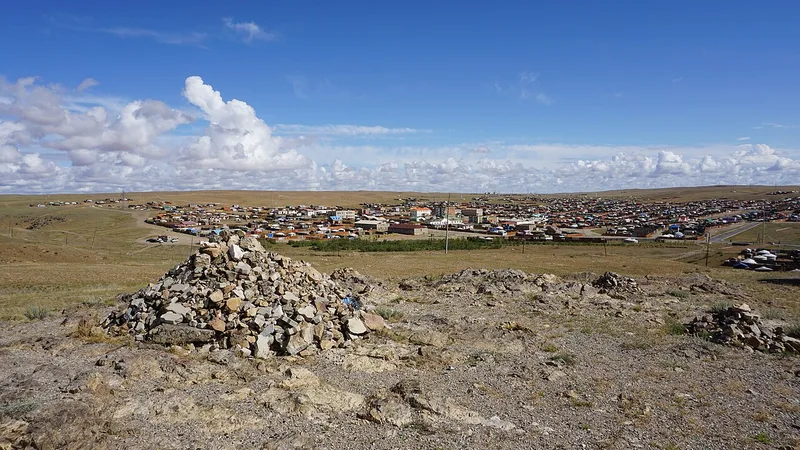
Mandalgovi is the capital of Dundgovĭ province, a small, dusty town s…
Baga Gazriin Chuluu
Baga Gazriin Chuluu ("small place of rocks") is a granite rock format…
Gurvansaikhan
Gurvansaikhan is a small settlement (soum centre) in Dundgovĭ Provinc…
Ikh Gazriin Chuluu
Ikh Gazriin Chuluu ("great place of rocks") is a granite rock massif…
Sum Khokh Burd
Sum Khökh Burd is a ruined temple set on a small island in a shallow…
Tsagaan Suvarga
Tsagaan Suvarga ("white stupa") is one of the most photographed natur…
Pair the highlights of Dundgovi into one easy trip — we'll plan the route.
WhatsApp
Contact Us
Get in touch with us.
Get in touch
Contact Us
Tell us where you'd like to go and how you like to travel. A real Tripcuro planner — not a bot — will craft an itinerary around you.
- Personalised, hassle-free planning end-to-end
- Transparent pricing, no hidden costs
- 24/7 support for complete peace of mind