
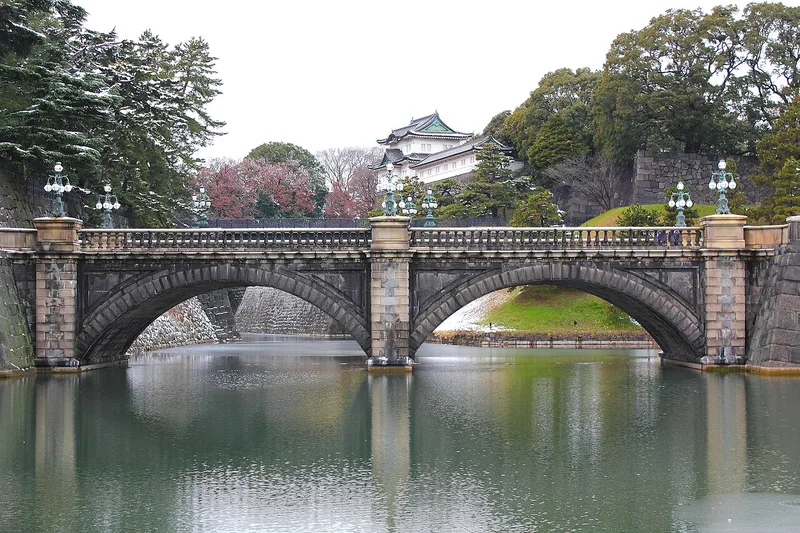
Imperial Palace
Tokyo, Japan
Why visit Imperial Palace?
The Imperial Palace (皇居, Kōkyo) is the primary residence of the Emperor of Japan, occupying a large, moated green expanse at the very centre of Tokyo, in the Chiyoda ward. It stands on the site of the former Edo Castle, the seat of the Tokugawa shogunate that ruled Japan for more than 250 years until the Meiji Restoration of 1868, after which the emperor moved from Kyoto and the castle grounds became the imperial residence. The palace's stone walls, moats and surviving guard towers are among the most tangible reminders of Edo-era Tokyo in the modern city.
Most of the palace complex is a working residence and closed to the public, but several parts are accessible. The East Gardens (Higashi-Gyoen) — the former castle keep area — are open to visitors free of charge, with ruined fortifications, lawns and seasonal plantings. The inner grounds can be seen on guided tours arranged through the Imperial Household Agency, and the grounds open more widely a couple of times a year. Surrounding the palace are popular public spaces: the gravel plaza of the Outer Garden with its famous Nijubashi bridge view, and the Kitanomaru area to the north.
The palace shares Tokyo's humid subtropical climate: mild winters, hot and humid summers, a June–early July rainy season, and a September typhoon risk. Spring cherry blossom and autumn foliage are the most scenic times in the gardens.
Planning Imperial Palace? Tell us your dates and we’ll tailor the trip.
Ask on WhatsAppHow do you get there?
By Plane
There is no direct airport link, but the palace sits beside Tokyo Station and is among the easiest sights in the city to reach. From Narita Airport (NRT), the Narita Express runs directly to Tokyo Station; from Haneda Airport (HND), take the Tokyo Monorail or Keikyu line and transfer toward Tokyo Station.
By Train
The palace is a short walk from Tokyo Station (JR lines and the Marunouchi subway). Other convenient stations include Ōtemachi (several subway lines, closest to the East Gardens' Ōte-mon gate), Nijūbashimae (Chiyoda line, for the Outer Garden), and Takebashi (Tōzai line, for the Kitanomaru side). Trains from across Tokyo and the shinkansen network converge on Tokyo Station.
By Car / Road
The palace is reached via Tokyo's expressway network, but driving in central Tokyo is impractical given congestion and parking costs. The rail network is overwhelmingly the better choice.
The palace grounds and the surrounding gardens and plazas are explored entirely on foot — comfortable shoes are advisable, as distances around the moats are considerable. The accessible areas (East Gardens, Outer Garden, Kitanomaru) connect via public paths and bridges. Surrounding subway stations cover longer trips, with fares from about ¥180; IC cards (Suica, PASMO) are simplest. There are no tuk-tuks and no significant tourist scams. Security checks apply at the East Gardens entrances.
What are the things to do?
Imperial Palace East Gardens (皇居東御苑, Higashi-Gyoen) — The former keep area of Edo Castle, open free to the public, with massive stone foundations of the old donjon, surviving guard towers, lawns and seasonal gardens including a Japanese garden and an iris bed.
Nijubashi bridge — The much-photographed double-arched stone bridge over the inner moat, viewed from the Outer Garden — the classic postcard image of the palace.
Outer Garden (Kōkyo Gaien) — A broad gravel plaza of carefully tended pine trees in front of the palace, freely open and a popular spot for the Nijubashi view.
Surviving castle towers and gates — Edo-era structures such as the Fujimi-yagura watchtower and historic gates dot the moat-lined perimeter.
Kitanomaru Park — A wooded park on the northern side of the grounds, home to the Nippon Budokan and the National Museum of Modern Art.
Walk the East Gardens — A relaxed circuit of the former castle keep, free and open most days.
Take a guided tour of the inner grounds — Free tours arranged through the Imperial Household Agency offer a closer look at areas otherwise off-limits; book in advance.
Jog the palace loop — The roughly 5-km path encircling the moats is one of Tokyo's most popular running routes.
Boat at Chidorigafuchi — In spring, the moat at Chidorigafuchi, on the northwestern side, is a celebrated cherry-blossom spot where rowing boats can be hired.
Time a special opening — The grounds open more widely to the public on a couple of occasions each year, typically around New Year and the Emperor's birthday.
Planning Imperial Palace? Want these on a customised itinerary?
Ask on WhatsAppWhere to eat?
There is little dining within the palace grounds themselves, so meals are best taken in the surrounding districts. Marunouchi, immediately east, has a dense concentration of restaurants across all price levels, from quick lunch spots to refined dining; Tokyo Station's restaurant floors and the Gransta complex offer further options, including the famous Tokyo Ramen Street.
Where to drink?
Cafés and bars cluster in Marunouchi and around Tokyo Station, ranging from coffee shops to upscale lounges and rooftop bars with views toward the palace greenery. Tap water across Tokyo is safe to drink.
Planning Imperial Palace? We’ll book the stays and dining for you.
Ask on WhatsAppWhere to stay?
The palace is surrounded by some of Tokyo's most prestigious accommodation.
- Budget — Budget options are scarce in the immediate Marunouchi area; hostels and business hotels are easier to find a short ride away.
- Mid-range — Business and boutique hotels around Tokyo Station and nearby districts, typically ¥15,000–30,000 per night.
- Upscale — Landmark luxury hotels overlook the palace grounds, including properties in Marunouchi and the Hibiya area; expect rates from ¥50,000 upward.
What should you buy?
The palace grounds themselves are not a shopping destination, but the adjacent Marunouchi district offers some of Tokyo's most polished retail — the Marunouchi Building, KITTE and the boutiques lining Marunouchi Naka-dōri — and Tokyo Station's interior holds extensive souvenir and food shopping, including Character Street. Prices are fixed; bargaining is not customary.
Where to go next?
- Marunouchi — Immediately east, the polished business and shopping district by Tokyo Station.
- Ginza — A short walk or ride south, the luxury shopping district.
- Kitanomaru Park — On the palace's north side, with the Budokan and modern-art museum.
- Yasukuni Shrine — Just northwest, a historically significant and controversial shrine.
- Akihabara — A short ride away, Tokyo's "Electric Town".
- Nihonbashi — Just east, a historic mercantile district and the traditional zero point of Japan's road network.
Nearby in Tokyo
More places to explore around Imperial Palace.
Guide content as of May 2026. Portions adapted from Wikivoyage, CC BY-SA 4.0.

Contact Us
Get in touch with us.
Get in touch
Contact Us
Tell us where you'd like to go and how you like to travel. A real Tripcuro planner — not a bot — will craft an itinerary around you.
- Personalised, hassle-free planning end-to-end
- Transparent pricing, no hidden costs
- 24/7 support for complete peace of mind