
Oboke
Tokushima, Japan
Why visit Oboke?
Oboke (大歩危) is a spectacular river gorge in western Tokushima Prefecture, on the island of Shikoku, administered as part of Miyoshi City. Together with the neighbouring gorge of Koboke just to the north, it forms one of Shikoku's great natural landscapes — a deep, rugged canyon where the Yoshino River carves between sheer rock cliffs. The names tell the story: Oboke means roughly "big steps dangerous" and Koboke "small steps dangerous", an apt warning about the perils of crossing the gorges on foot in earlier times.
The two gorges merge into one another so seamlessly that it is hard to say where Koboke ends and Oboke begins; Oboke is the larger, near the Kochi prefecture border, with Koboke immediately to the north. The Yoshino River — fast, clear and lined with dramatic folded rock — flows down from Kochi Prefecture toward the town of Ikeda. National Highway 32 and the JR Dosan train line both follow the river through the gorges, so the scenery is on display even from the road or rail.
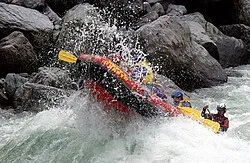
The big draws here are the river views and the white-water rafting through Japan's most exciting rapids. The area is also tied to Japanese folklore: the country lore holds that the rugged, dangerous landscape of Oboke and Koboke once drew the highest concentration of youkai — mythical monsters — in Japan, a heritage celebrated in a local monster museum and an annual festival. Spring and autumn bring the most comfortable weather and the best foliage; the rafting season runs from roughly mid-spring through autumn, while winter is cold and quiet.
Planning Oboke? Tell us your dates and we’ll tailor the trip.
Ask on WhatsAppHow do you get there?
By Plane
The nearest airports are those of Shikoku — Kochi, Takamatsu, Tokushima and Matsuyama — with Kochi the closest by travel time. For international connections, Kansai Airport near Osaka is the gateway. Cars can be rented at any of the airports.
By Train
Both Oboke and Koboke have stations on the JR Dosan Line, which runs between Kochi and Takamatsu via Ikeda. Nearly all trains, including express services, stop at JR Oboke Station; Koboke Station is served by local trains only. Taxis are available from Oboke Station, and some accommodation and rafting operators offer station pick-up if booked ahead. Iyaguchi, Awa-Kawaguchi and Tosa-Iwahara stations along the line are also local-train only.
By Car / Road
Travel by car is recommended — without one, reaching trailheads and many services means a long walk along a road without sidewalks. National Highway 32 winds along the Yoshino River through the gorges. From Osaka, Kobe or Tokushima, take the toll expressway, exit at Ikeda (Ikawa-Ikeda IC), follow Route 192 west to Route 32, then head south; the valley narrows through Iyaguchi and Koboke before reaching Oboke. From the Kochi side, head north on Route 32 (about 1 hr 15 min from Kochi City), or take the expressway to Otoyo IC and continue north (about 30 minutes). A tunnel on Route 45 links Oboke to the western Iya Valley. Buses from Ikeda's Awa-Ikeda Bus Terminal serve Koboke and Oboke and continue toward the Iya Valley, but services are sparse and schedules change often.
A car is the most practical way to get around Oboke and Koboke; the gorges, rafting put-in points, rest stops and hot springs are strung out along Route 32. Two bus systems operate — Shikoku Kotsu (Yonkoh) buses from Ikeda, which run through the main areas and on to the Iya Valley, and Miyoshi City municipal buses based in Awa-Kawaguchi, which double as school buses and run mainly on weekdays. The two systems sometimes connect and sometimes do not, so plan carefully and ignore outdated printed timetables. A reasonably good sidewalk runs along Route 32 between the Oboke Michi-no-Eki and the WestWest rest area, making a scenic 30–40 minute walk through the gorge. Tipping is not customary in Japan.
What are the things to do?
- Oboke and Koboke Gorge — The spectacular canyon formed by the Yoshino River, with its steepest, most rugged stretch between JR Koboke Station and Tosa-Iwahara Station; viewable by raft, pleasure boat, or by walking or driving Route 32.
- Monster Museum — A museum of Japanese youkai (mythical monsters) inside the Oboke Michi-no-Eki, reflecting the local lore that the gorges were home to the highest concentration of monsters in Japan; large monster carvings stand along roadsides in the area.
- Lapis Oboke (Oboke Michi-no-Eki) — The curving wooden roadside rest station between WestWest and the Oboke intersection, with 24-hour bathrooms, souvenirs, a café, travel information and the paid Monster Museum.
The headline activity is the rapids rushing through the gorge — Japan's biggest and most exciting white water, set among striking rock formations and crystal-clear water. White-water rafting through the class-4 rapids is the signature experience, offered by several operators; Happy Raft, based just over the border in Kochi beside JR Tosa-Iwahara Station, runs half- and full-day trips from ¥5,500/¥10,000 with English-speaking guides, and Go!Go! Adventure, run with the Momonga Village Guesthouse, offers half-day trips from around ¥4,000 and full days from around ¥9,000. Canyoning — descending streams and waterfalls on rope — is available with most rafting companies. For a calmer alternative, a 30-minute pleasure-boat cruise runs from the Hotel Mannaka rest area daily 09:00–17:00 (¥1,080/¥540 adults/children). After the river, several hotels — Kenmi Hotsprings Hotel, Hotel Mannaka and Sun River Oboke — offer hot-spring baths, with day-use options.
Planning Oboke? Want these on a customised itinerary?
Ask on WhatsAppWhere to eat?
The local specialities are ayu and amego — river fish, salted and barbecued on a skewer. The Woody Rest, on Route 32 a few hundred metres north of the Iyaguchi intersection, serves local soba and udon plus Japanese set meals, with an English menu and English-speaking owner (open Th–Tu 11:00–19:30). The WestWest rest area in Koboke holds a 7-Eleven and two restaurants, including a ramen café and an adjacent soba noodle restaurant. Dining options are limited and tied to rest stops and hotels; vegetarian, halal and gluten-free choices are limited, so plan ahead.
Where to drink?
Rest stops and hotels serve coffee, tea and soft drinks, and the convenience store at WestWest is a useful stop. Tokushima sake and shochu are available in the area. Evening options are limited in this rural gorge setting. Tap water is safe to drink throughout Japan.
Planning Oboke? We’ll book the stays and dining for you.
Ask on WhatsAppWhere to stay?
- Budget: Guesthouses such as the rafting-linked Momonga Village Guesthouse, and other minshuku in the area, offer inexpensive rooms.
- Mid-range: Riverside hotels including Hotel Mannaka and Sun River Oboke offer comfortable rooms, many with hot-spring baths and gorge views.
- Upscale / heritage: Hot-spring hotels such as Kenmi Hotsprings Hotel, and the restored farmhouse and ryokan accommodation of the nearby Iya Valley, offer more atmospheric upscale stays.
What should you buy?
Several roadside rest areas along Route 32 are the main places to shop. WestWest, between the Oboke and Koboke stations, is the largest, with a 7-Eleven, a café and ramen restaurant, a souvenir shop and a Mont Bell outdoor store stocking hiking, camping and rafting gear. The Oboke Michi-no-Eki has a wide range of local souvenirs, and the Oboke-kyo River Cruise Rest Area opposite Hotel Mannaka sells local souvenirs by the river. For groceries, Boke-Mart near JR Oboke Station and the Furutani Food Shop in Yamashiro town are the best stocking-up points, especially if heading into the Iya Valley. Prices are fixed; bargaining is not customary in Japan.
Where to go next?
- Iya Valley (a short drive via the Route 45 tunnel) — A remote mountain valley with vine bridges and hot springs.
- Ikeda / Miyoshi (about 20–30 min by train) — The main town and transport hub for the area.
- Mount Tsurugi (via the Iya Valley) — The second-highest peak in western Japan.
- Kochi (via the Dosan Line) — The prefectural capital on Shikoku's Pacific coast.
- Takamatsu (via the Dosan Line) — The "Udon Kingdom" and gateway to the Seto Inland Sea.
Nearby in Tokushima
More places to explore around Oboke.


Guide content as of May 2026. Portions adapted from Wikivoyage, CC BY-SA 4.0.

Contact Us
Get in touch with us.
Get in touch
Contact Us
Tell us where you'd like to go and how you like to travel. A real Tripcuro planner — not a bot — will craft an itinerary around you.
- Personalised, hassle-free planning end-to-end
- Transparent pricing, no hidden costs
- 24/7 support for complete peace of mind