
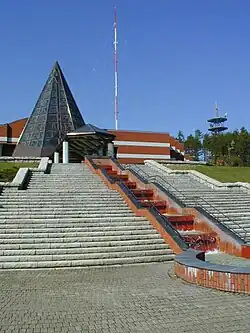
Abashiri
Hokkaido, Japan
Why visit Abashiri?
Abashiri (網走) is a small city on the northern coast of Hokkaido, facing the Sea of Okhotsk and serving as the capital of the Okhotsk Subprefecture. Once impossibly remote, the name Abashiri long carried a chill for would-be lawbreakers: it was the site of Japan's first maximum-security prison, opened in 1890 when Meiji-era reformers chose to copy Western penal practice rather than simply execute convicted criminals. In practice, "enlightenment" meant backbreaking hard labour — much of it road construction — and, for difficult cases such as political prisoners, unheated cells in a region where winter temperatures often plunge below -20°C. The original prison closed in 1984, though a newer facility continues the tradition.
Today's Abashiri is a workaday modern town, dominated by the implements and smells of its largest industry, fishing. It is not a place travellers come for the townscape itself, but it functions as the closest thing northern Hokkaido has to a transport hub, and as a base for some genuinely worthwhile natural attractions.
The headline draw is winter: from roughly February to March the famous drift ice (ryūhyō) of the Okhotsk Sea surrounds the coast, and icebreaker cruises take visitors right out among it. Summer is mild and a good time for the prison and pack-ice museums and the nearby national parks. The town is fairly spread out, with a network of buses radiating from JR Abashiri Station.
Planning Abashiri? Tell us your dates and we’ll tailor the trip.
Ask on WhatsAppHow do you get there?
By Plane
The nearest airport is Memanbetsu Airport (MMB), about 16 km south of Abashiri. Buses connect the airport to the train station before and after flights (25 minutes, ¥880).
By Train
Abashiri Station is the terminus of JR Hokkaido's Sekihoku Main Line from Asahikawa and the Senmo Main Line from Kushiro via the Akan-Mashu lakes. There are five direct trains daily from Asahikawa and Sapporo: the twice-daily limited express Okhotsk runs directly from Sapporo (5 hours 25 minutes, ¥10,870 in 2025; from Asahikawa 3 hours 46 minutes, ¥8,890); the twice-daily rapid express Taisetsu (3 hours 54 minutes, ¥5,940); and the once-daily rapid Kitami (4 hours 30 minutes, ¥5,940). From Kushiro there are four daily local services that stop at every station, with no seat reservations possible.
By Car / Road
Night buses from Sapporo (around ¥8,000) are the cheapest way to reach Abashiri, arriving at the Abashiri Bus Terminal a short walk east of JR Abashiri Station.
Abashiri is fairly spread out, and a network of buses radiates from JR Abashiri Station. For the main museums, take a bus toward Mt. Tento. There are no autorickshaws or ride-hailing concerns; buses and taxis from the station cover most needs.
What are the things to do?
Abashiri Prison Museum (網走監獄) — The original buildings of the infamous prison, relocated partway up Mt. Tento and now an open-air museum, complete with wax figures of prisoners and a hair-raising display of shackles and prison paraphernalia. Daily 09:00–17:00; ¥1,050. Take a bus toward Mt. Tento.
Museum of Northern Peoples (北方民族博物館) — A modern museum documenting the lives of northern peoples around the world — not only Japan's Ainu, but Canadian Inuit, Scandinavian Saami and others — with much of the material in English. Tu–Su 09:00–17:00; ¥450. Bus toward Mt. Tento, get off at Hoppō-minzoku-hakubutsukan-mae.
Okhotsk Ryūhyō Museum (オホーツク流氷館) — A museum devoted to the Okhotsk Sea's drift ice, where you can learn all about pack ice and even touch some in a room kept at -15°C (coats provided). Spring–fall 08:00–18:00; ¥520.
Icebreaker Aurora (おーろら) — In winter, when pack ice surrounds the town, this boat runs one-hour cruises out among the drift ice. Jan–Apr 09:00–18:00; ¥3,300, with group discounts. 網走市南3条東4丁目5の1.
Visit the prison museum — Abashiri's signature cultural experience, an unusually candid look at Japan's penal history.
Explore the nearby national parks — Abashiri is a practical springboard for Shiretoko and the Akan-Mashu lakes.
Planning Abashiri? Want these on a customised itinerary?
Ask on WhatsAppWhere to eat?
Being a fishing port, the food to eat in Abashiri is fresh seafood, above all crab. The morning market is the obvious destination, with a wide choice of seafood and the chance to eat it freshly prepared.
Seafood dominates the local table; vegetarian, halal and gluten-free travellers should check menus carefully.
Where to drink?
Abashiri Beer (網走ビール), a 10-minute walk from JR Abashiri Station, is the town's microbrewery — like nearly every city in Hokkaido, Abashiri has its own craft beer. The brewery is open to visitors and also serves lunch and dinner. Tap water is safe to drink.
Planning Abashiri? We’ll book the stays and dining for you.
Ask on WhatsAppWhere to stay?
- Budget: Abashiri Ryūhō-no-Oka YH at Meiji 22-6 is a youth hostel with good views of the Okhotsk Sea; HI members from around ¥3,250.
- Mid-range / upscale: Business and tourist hotels are clustered around the station and harbour area.
What should you buy?
As a fishing port, Abashiri's edible specialities are the thing to take home — particularly crab and other Okhotsk seafood. The town's morning market (網走感動朝市) has a great selection. Prices are fixed; bargaining is not practised.
Where to go next?
- Shiretoko National Park (to the east) — A UNESCO World Heritage wilderness peninsula, one of Japan's best yet least visited national parks.
- Akan-Mashu National Park (to the south) — Famous for its three mysterious caldera lakes.
- Utoro (in Shari) — The onsen village gateway to Shiretoko, popular with hot spring lovers.
- Asahikawa (about 3 hours 45 minutes by limited express) — Hokkaido's second city.
- Kushiro (by local train on the Senmo Line) — Gateway to the Kushiro marshlands.
Nearby in Hokkaido
More places to explore around Abashiri.

Guide content as of May 2026. Portions adapted from Wikivoyage, CC BY-SA 4.0.

Contact Us
Get in touch with us.
Get in touch
Contact Us
Tell us where you'd like to go and how you like to travel. A real Tripcuro planner — not a bot — will craft an itinerary around you.
- Personalised, hassle-free planning end-to-end
- Transparent pricing, no hidden costs
- 24/7 support for complete peace of mind