
Varanasi
Uttar Pradesh, India
Why visit Varanasi?
Varanasi — also called Banaras, Benares and, in scripture, Kashi ("the city of light") — is one of the oldest continuously inhabited cities on earth, with settlement traced back roughly three millennia. Mark Twain memorably wrote that "Benaras is older than history, older than tradition, older even than legend." Set on the western bank of the Ganges in eastern Uttar Pradesh, it is the holiest city in Hinduism and a place of deep significance to Jainism and Buddhism. Many Hindus believe that dying here, and being cremated on its riverside ghats, brings moksha — release from the cycle of rebirth — so the elderly and dying travel here to spend their final days.
For the visitor, Varanasi is intense and unforgettable. There are few discrete "attractions"; the experience is the city itself — the spectacle of life and death along the river, the labyrinth of ancient alleys, the ringing temple bells, and pilgrims performing devotions in the Ganges at dawn against a backdrop of crumbling palaces and shrines. The open cremations and the polluted, sacred river can be a culture shock, but the sunrise on the ghats is among the most extraordinary sights in the world. The city is sacred to Shiva, and the Kashi Vishwanath temple is its spiritual centre.
Varanasi lies mostly on the west bank, threaded by some 80 ghats — flights of stone steps down to the river — stretching several kilometres from Assi Ghat in the south to Raj Ghat in the north. The crowded old city of narrow lanes (galis) sits just behind the central ghats; the Cantonment area near the main railway station is more open and modern; and Banaras Hindu University (BHU) anchors the southern end. The best time to visit is October to March, when the weather is pleasant; carry something warm for cold mornings. Summers are scorching, often above 40°C, and the monsoon swells the river and floods the lower ghats.
Planning Varanasi? Tell us your dates and we’ll tailor the trip.
Ask on WhatsAppHow do you get there?
By Plane
Lal Bahadur Shastri Airport (VNS) at Babatpur lies about 25 km northwest of the city centre. It has good domestic connections to Delhi, Mumbai, Kolkata, Bengaluru, Hyderabad and other cities, plus some international flights to nearby Asian destinations and the Gulf. A taxi into the city takes roughly an hour and costs around ₹750–900; an autorickshaw is cheaper (about ₹500) but slower. Allow extra time, as traffic into the old city is heavy.
By Train
Varanasi is a major rail hub with three principal stations. Varanasi Junction (code BSB, also called "Cantt") is the main station, close to the Cantonment; an autorickshaw to the riverfront costs about ₹100. Banaras station (BSBS) is a newer terminal also handling many trains. Pandit Deen Dayal Upadhyaya Junction (DDU, formerly Mughalsarai), about 20 km east, sees many long-distance trains; a taxi from there costs around ₹1,000 or an auto about ₹350. Frequent services connect Delhi (about 13 hours, including a Vande Bharat Express), Lucknow (~7 hours), Kolkata (12–14 hours) and Mumbai (25–27 hours). Book well ahead, especially in peak season and around festivals.
By Car / Road
Varanasi is well connected by road. State-run buses link it with Prayagraj (about 3 hours), Lucknow (~8 hours), Gorakhpur (~8 hours), Kanpur (~9 hours) and Bodh Gaya (~7 hours), among others. The main bus station is east of Varanasi Junction; an auto to the riverfront costs about ₹150. Travellers arriving from Nepal typically cross at Sunauli, then continue via Gorakhpur by train or bus. Roads to major cities are decent highways, though the final approach into the dense old city is congested.
Walking is the only way to explore the ghats and the warren of old-city lanes — many are far too narrow for any vehicle. Be prepared to get lost; ghat names and signs to hotels and restaurants are often painted on walls in Roman letters, and locals readily give directions. A small ghat guidebook from any bookshop helps with orientation. For longer hops, cycle rickshaws and autorickshaws are everywhere: short trips should cost under ₹50, while a ride from the ghats to the railway station runs about ₹100. There is a prepaid auto stand at Varanasi Junction. Boats along the river are both transport and the city's signature experience. App-based cabs operate but cannot reach the old city's interior. Agree fares before boarding, watch for "guides" who attach themselves uninvited and steer you to commission shops, and be firm but polite.
What are the things to do?
Varanasi has few conventional sights — the city itself is the attraction — but a handful of landmarks reward a visit.
Temples and the old city
- Kashi Vishwanath Temple — the holiest shrine in the city, dedicated to Shiva, with a gold-plated spire. The temple and its modern Vishwanath Corridor linking it to the river are the spiritual core of Varanasi. Expect security checks; non-Hindus may face access restrictions to the inner sanctum.
- Sankat Mochan Hanuman Temple — a much-loved temple near BHU dedicated to Hanuman, lively with monkeys and devotees.
- Durga Temple and Tulsi Manas Temple — two popular temples in the southern part of the city, the latter linked to the poet Tulsidas.
- The old-city lanes (galis) — the dense maze behind the central ghats, full of shrines, sweet shops and silk dealers; getting lost here is part of the experience.
Ghats and the river
- Dashashwamedh Ghat — the most central and animated ghat, site of the spectacular nightly Ganga Aarti.
- Manikarnika Ghat and Harishchandra Ghat — the principal cremation ghats, where funeral pyres burn around the clock. Observe respectfully; do not photograph the cremations.
- Assi Ghat — the southernmost main ghat, calmer, with its own morning aarti and a relaxed café culture.
- Jantar Mantar — an 18th-century masonry observatory built by Jai Singh, on the terrace of Man Singh Ghat, smaller than its Delhi and Jaipur counterparts.
Across and around the city
Ramnagar Fort — the 18th-century riverside palace of the Maharaja of Banaras on the eastern bank, with a museum of vintage weapons, costumes and royal artefacts (entry around ₹200).
Banaras Hindu University (BHU) — a vast green campus founded in 1916, home to the marble New Vishwanath Temple and the Bharat Kala Bhavan museum of art and antiquities.
Rajghat — an archaeological site in the city's north with brick structures dating back over two millennia (combined ticket around ₹200).
Dawn boat ride on the Ganges — the essential Varanasi experience: glide past the waking ghats at sunrise as pilgrims bathe and pray. Rowboats are quieter and more atmospheric than motorboats; agree the price first.
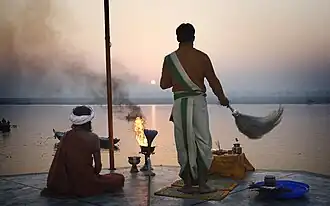
Evening Ganga Aarti — the elaborate fire ritual performed nightly at Dashashwamedh Ghat (and a smaller, more intimate version at Assi Ghat) by priests with brass lamps, chanting and incense; watch from the steps or from a boat.
Walk the ghats and old city — a slow exploration of all 80-odd ghats and the lanes behind them is the best way to absorb the city.
Subah-e-Banaras at Assi Ghat — the early-morning cultural programme of music, yoga and aarti.
Music and culture — Varanasi is a centre of Hindustani classical music and the Banarasi gharana; look out for concerts and performances.
Day trip to Sarnath — about 10 km away, where the Buddha gave his first sermon (autorickshaw round trip roughly ₹300–500).
Planning Varanasi? Want these on a customised itinerary?
Ask on WhatsAppWhere to eat?
Varanasi has a rich, almost entirely vegetarian street-food culture, deeply tied to its temples and lanes. Signature dishes include kachori-sabzi for breakfast, tamatar chaat, chooda matar, baati-chokha, the rich winter sweet-froth malaiyo, the layered milk sweet launglata, and famously thick, creamy lassi. Banarasi paan is an institution eaten after meals.
- Kashi Chaat Bhandar (Godowlia) — a celebrated old chaat shop, the place for tamatar chaat and palak chaat.
- Blue Lassi — a tiny, much-loved lassi shop in the old-city lanes, serving thick clay-cup lassi in many flavours.
- Deena Chaat Bhandar — a long-running favourite for street chaat near the central area.
- Pizzeria Vaatika Café (Assi Ghat) — a relaxed riverside café popular with travellers for wood-fired pizza and Ganges views.
- Ramnagar / market kachori stalls — for an authentic morning kachori-sabzi-jalebi breakfast.
Food is overwhelmingly pure vegetarian, especially near the temples; meat is harder to find and best sought in dedicated restaurants or hotels. Hygiene varies, so choose busy stalls with high turnover.
Where to drink?
Varanasi runs on chai, sold from countless stalls in small clay cups (kulhads), and on its legendary lassi. Cooling thandai — a spiced milk drink with nuts — is a local specialty, sometimes available in a bhang (cannabis-infused) version associated with Shiva worship; the latter is a traditional but intoxicating drink, so approach with caution. Fresh sugarcane and seasonal fruit juices are widely sold. As a sacred city, Varanasi is conservative about alcohol; licensed bars exist mainly in larger hotels rather than as a street scene. Drink only bottled or properly filtered water, never tap water, and be cautious with ice and untreated juice — and never drink the river water, however sacred.
Planning Varanasi? We’ll book the stays and dining for you.
Ask on WhatsAppWhere to stay?
- Budget: The old-city ghat area is full of inexpensive guesthouses and backpacker hostels — Stops Hostel Varanasi and the long-running guesthouses around Assi Ghat and Pandey Ghat offer dorm beds and simple rooms from roughly ₹400–1,200, many with rooftop river views.
- Mid-range: Hotel Ganges Grand and Hotel Surya in the Cantonment area, and various heritage-style guesthouses near the ghats, typically run ₹2,500–5,000 with restaurants and reliable amenities.
- Upscale / heritage: BrijRama Palace (a restored riverside palace on Darbhanga Ghat) and Taj Ganges offer the city's most luxurious stays, generally ₹10,000 and well upwards; Suryauday Haveli at Shivala Ghat is a refined heritage option.
What should you buy?
Varanasi's most famous product is the Banarasi silk sari — opulent hand-woven silk with intricate gold and silver zari brocade, traditionally made in the city's weaving quarters. Buy from reputable shops to avoid power-loom imitations sold as handloom; the lanes around Vishwanath Gali, Godowlia and Thatheri Bazaar are the traditional shopping areas. Also look for brassware, wooden toys and lacquerware, beads and rudraksha, religious items, and Banarasi paan ingredients. Bargaining is expected in the bazaars; take your time and compare prices, and be wary of touts and rickshaw drivers who deliver you to commission-paying showrooms.
Where to go next?
- Sarnath (~10 km, ~30 minutes) — the deer park where the Buddha delivered his first sermon, with stupas, a museum and monasteries.
- Prayagraj (~120 km, ~3 hours) — the holy city at the Ganges–Yamuna confluence and site of the Kumbh Mela.
- Bodh Gaya (~250 km, ~6–7 hours) — the site of the Buddha's enlightenment, the most important Buddhist pilgrimage centre, in neighbouring Bihar.
- Chunar (~40 km, ~1.5 hours) — a historic riverside fort town overlooking the Ganges.
- Vindhyachal (~70 km, ~2 hours) — a revered Shakti Peeth temple town near Mirzapur.
- Lucknow (~300 km, ~5–6 hours by train) — the elegant Nawabi capital of Uttar Pradesh, known for monuments and cuisine.
Nearby in Uttar Pradesh
More places to explore around Varanasi.


Guide content as of May 2026. Portions adapted from Wikivoyage, CC BY-SA 4.0.

Contact Us
Get in touch with us.
Get in touch
Contact Us
Tell us where you'd like to go and how you like to travel. A real Tripcuro planner — not a bot — will craft an itinerary around you.
- Personalised, hassle-free planning end-to-end
- Transparent pricing, no hidden costs
- 24/7 support for complete peace of mind