
Dudhwa National Park
Uttar Pradesh, India
Why visit Dudhwa National Park?
Dudhwa National Park sits in the Lakhimpur-Kheri district of Uttar Pradesh, pressed up against the Nepal border in the Terai belt at the foot of the Himalayas. Together with the adjacent Kishanpur and Katerniaghat wildlife sanctuaries, it forms the larger Dudhwa Tiger Reserve, protected under Project Tiger. The reserve preserves some of the finest surviving Terai forest and grassland in the state — a mosaic of tall sal forests, swamps and seas of yellow grass — and is the last viable stronghold of the Royal Bengal Tiger in Uttar Pradesh.
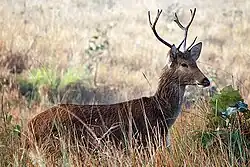
This is a low-key, non-commercial park, far quieter than India's famous reserves like Corbett or Kaziranga, which is precisely its appeal for serious wildlife watchers and birders who want nature without crowds. Dudhwa's signature species is the swamp deer (barasingha) — a large share of the world's population lives here — alongside reintroduced one-horned rhinoceros (brought from Assam and Nepal in the mid-1980s and now thriving), tigers, leopards, elephants, hog deer, sambar and an exceptional bird list running into the hundreds, including the Great Hornbill. The Geruwa river within the wider reserve is reported to harbour the Gangetic dolphin. The park owes its existence largely to the conservationist 'Billy' Arjan Singh, whose campaigning led to national park status in 1977.
The reserve is closed to visitors during the monsoon — roughly mid-June to mid-November — when much of the Terai floods. The best time to visit is the cool, dry season from late November to March, when wildlife concentrates near water and migratory birds arrive; winter mornings can drop near 2°C, so bring warm layers. By April–June the heat builds towards 45°C but sightings near taals (shallow lakes) can be rewarding for those who can bear it.
Planning Dudhwa National Park? Tell us your dates and we’ll tailor the trip.
Ask on WhatsAppHow do you get there?
By Plane
The nearest major airport is Lucknow (LKO), Chaudhary Charan Singh International Airport, about 245 km away — a drive of roughly 6 hours. There is no convenient air access closer on the Indian side; Dhangadhi airport across the border in Nepal is geographically near but not a practical entry route for most travellers. From Lucknow, hire a car or taxi for the onward journey to the park.
By Train
The closest railway halts are small Terai stations: Dudhwa itself (about 4 km from the park), Palia Kalan (about 10 km) and Mailani (about 37 km), reached by metre-gauge trains. Many visitors instead take a broad-gauge train to a larger station such as Shahjahanpur and drive the remaining stretch (around 3 hours). Onward connections from Lucknow's Aishbagh station reach Palia Kalan via Sitapur, Gola Gokarannath and Mailani. Check current schedules carefully, as metre-gauge services are limited.
By Car / Road
Most visitors arrive by road. The drive from Delhi takes roughly 8–9 hours; from Lucknow it is about 245 km and 6 hours; from Shahjahanpur about 3 hours. Palia Kalan, the gateway town about 10 km from the park, has the nearest cluster of services and is connected by state and private bus to regional towns. Roads through the Terai are generally adequate but can be slow; the park is reached via a bridge across the Sharda river.
There is no public transport inside the reserve — movement is by safari vehicle only, and a certified forest guide is mandatory on every visit. Open jeeps (and sometimes mini-buses) can be hired through the park office for the morning and afternoon safari slots; private vehicles meeting park standards may also be permitted with a guide aboard. From a designated point inside the park, elephant safaris run morning and afternoon, and the mahouts double as guides — this is the best way to see rhino in the tall grass. Arrange jeeps, guides and elephant rides in advance through the park office or your lodge. Beyond the gates, the gateway town of Palia Kalan is small enough to cover on foot or by cycle rickshaw.
What are the things to do?
Dudhwa is about landscapes and wildlife rather than monuments. Highlights to seek out:
The grasslands and swamp deer — vast stretches of tall Terai grass where large herds of barasingha graze; Dudhwa's defining sight.
The taals (shallow lakes) — Banke Taal, Kakraha Taal and Amaha are prime vantage points, drawing deer, rhino, waterbirds and, in winter, migratory species. Visiting the taals is considered an essential part of any trip.
Rhino reintroduction area — the rewilded one-horned rhinoceros are best viewed from elephant-back through the grasslands.
Sal forests — dense, tall stands of sal (Shorea robusta) make up most of the park's woodland, home to leopard, sambar and a rich bird community.
Kishanpur Wildlife Sanctuary — a separate core of the Tiger Reserve about 15 km away, known for swamp deer and tiger, well worth pairing with Dudhwa.
Katerniaghat Wildlife Sanctuary — another part of the reserve, notable for the Geruwa river, gharial, and reported Gangetic dolphin.
Chandan Chowki — a drive along the park to the Nepal border, an interesting excursion through the Terai.
Jeep safaris — the standard way to explore, on morning and afternoon drives along the park's forest and grassland routes with a guide.
Elephant safaris — short rides into the grassland, the most reliable way to approach rhino and the most distinctive Dudhwa experience.
Birdwatching — with several hundred recorded species and strong winter migration, Dudhwa is one of northern India's finest, least-crowded birding destinations.
Wildlife photography — the open grasslands, taals and varied fauna reward patient photographers.
Sanctuary-hopping — combine Dudhwa with Kishanpur and Katerniaghat for a fuller picture of the Terai ecosystem.
Planning Dudhwa National Park? Want these on a customised itinerary?
Ask on WhatsAppWhere to eat?
Dining options are very limited and centred on the park and lodges rather than restaurants. The park's canteen at the Main Office serves reasonable-quality vegetarian food at moderate prices — orders generally need to be placed in advance from the menu. Forest lodges and tented camps arrange meals for their guests, typically simple, wholesome vegetarian fare including dals, vegetables, rice and rotis. The reserve operates a strict zero-pollution, vegetarian-only policy in its premises. For more variety, Palia Kalan town has a few basic eateries (dhabas). Carry your own snacks if you have specific dietary needs.
Where to drink?
There is no bar or café scene at Dudhwa — this is a quiet, conservation-focused reserve. Expect chai and simple soft drinks at the canteen and lodges; bottled water is the safe choice and should be carried on safaris. Tap and well water in the Terai is not reliable for drinking, so stick to sealed bottled or properly filtered water. Alcohol is not part of the park experience and is best not assumed to be available; some private lodges may permit guests their own, but the reserve emphasises a low-impact, undisturbed environment.
Planning Dudhwa National Park? We’ll book the stays and dining for you.
Ask on WhatsAppWhere to stay?
- Budget: The Forest Rest Houses and dormitory accommodation run by the UP Forest Department inside and around the park offer the cheapest beds — simple huts, rooms and dorm spaces at modest tariffs. These must be booked well in advance through the Chief Wildlife Warden's office in Lucknow.
- Mid-range: The park's own Tharu Huts and rooms at Dudhwa and Kishanpur, including a limited number of better-appointed (and one air-conditioned) rooms, provide comfortable forest-edge stays at moderate rates.
- Upscale / tented: Private operators run jungle tented camps near the reserve, with spacious canvas tents, attached toilet tents and arranged meals — a comfortable way to experience the Terai. Names and tariffs vary season to season.
What should you buy?
Shopping is minimal — this is a wilderness destination, not a market town. A small shop near the park entrance sells simple mementos such as caps and T-shirts. For everyday purchases, the nearby town of Palia Kalan (about 10 km away) has ordinary local shops and is the practical place to stock up. There are no significant craft markets or bargaining culture to speak of; buy essentials before arriving.
Where to go next?
- Kishanpur Wildlife Sanctuary (~15 km) — a quieter core of the Tiger Reserve, excellent for swamp deer and tiger.
- Katerniaghat Wildlife Sanctuary (~part of the reserve, further west) — gharial, the Geruwa river and reported Gangetic dolphin.
- Palia Kalan (~10 km) — the gateway town, practical for supplies and transport links.
- Lucknow (~245 km, ~6 hours) — the Nawabi capital of Uttar Pradesh, rich in monuments and cuisine.
- Pilibhit Tiger Reserve (~within the Terai belt, a few hours' drive) — another Terai tiger habitat for those continuing a wildlife circuit.
- Lakhimpur (~district headquarters town) — the nearest larger town with broader services.
Nearby in Uttar Pradesh
More places to explore around Dudhwa National Park.
Guide content as of May 2026. Portions adapted from Wikivoyage, CC BY-SA 4.0.

Contact Us
Get in touch with us.
Get in touch
Contact Us
Tell us where you'd like to go and how you like to travel. A real Tripcuro planner — not a bot — will craft an itinerary around you.
- Personalised, hassle-free planning end-to-end
- Transparent pricing, no hidden costs
- 24/7 support for complete peace of mind