
Xingyi
Guizhou Sheng, China
Why visit Xingyi?
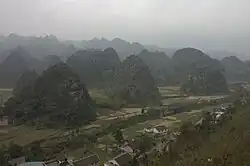
Xingyi (兴义) is the prefecture-level seat of the Qianxinan Buyei and Miao Autonomous Prefecture in southwestern Guizhou, set at the seam where the province meets Yunnan to the west and Guangxi to the south. The city sits on the eastern edge of the Yunnan-Guizhou Plateau at roughly 1,200 m elevation, which gives it a mild subtropical highland climate and a year-round green countryside of karst peaks, sinkholes, and gorges. Historically, Xingyi was an Ming–Qing trading and garrison town on the routes between Yunnan, Sichuan, and Guangdong; today it is best known as the gateway to the Wanfenglin "Forest of Ten Thousand Peaks" and the Maling River Canyon, two of southwest China's most photogenic karst landscapes. The Buyei (Bouyei) and Miao peoples make up a large share of the local population, and their villages, festivals, and cuisine are a defining part of the experience.
The climate is subtropical humid monsoon, mild and wet, with an annual mean around 15 °C. Summers (June–August) are warm (25–28 °C) but coincide with the heaviest rains — roughly 600 mm fall in those three months alone, and the karst trails turn slippery. Winters are cool (5–10 °C) and largely dry; frost is rare but mornings can be misty. The most rewarding windows are late March to mid-May, when canola fields blaze yellow across the Wanfenglin valley floor, and September to early November, when the rains ease and the rice terraces turn gold.
The city itself is compact. The administrative and shopping core is around Huangcaoba (the old downtown) and the newer Xiawutun / Dingxiao districts to the south, where you'll find most hotels and the bus stations. The major scenic areas — Wanfenglin, Maling River Canyon, Wanfeng Lake — all lie 10–40 km outside the urban area and are reached by car or scenic-area shuttle.
Planning Xingyi? Tell us your dates and we’ll tailor the trip.
Ask on WhatsAppHow do you get there?
By Plane
Xingyi Wanfeng Airport (IATA: ACX) sits about 10 km northeast of downtown. It's a small regional airport with daily flights from Guiyang, Kunming, Chongqing, Guangzhou, Shanghai (Hongqiao), Beijing (Daxing), and seasonal links to Shenzhen and Hangzhou; schedules are thin, so confirm before booking onward connections. A taxi to the city centre takes 20–30 minutes and costs roughly ¥40–60 on the meter. An airport shuttle bus runs to the downtown ticket office for ¥15.
By Train
Xingyi is served by Xingyi Station (兴义站) on the Nanning–Kunming line, with conventional (non-high-speed) trains to Kunming (~4 hours), Nanning (~6–7 hours), and Guiyang (overnight via Liupanshui). For high-speed access, transfer at Pan Zhou Station (盘州站, ~2 hours by bus from Xingyi) on the Shanghai–Kunming HSR, or at Guiyang North and continue by bus. Book through 12306.cn or the Trip.com app; foreign passport holders can collect tickets from the station window or use e-ticket entry with a passport scan.
By Car / Road
Highways are good and the drives are scenic. From Guiyang: ~360 km via the G60/S55, about 4–4.5 hours. From Kunming: ~370 km via the G78, about 4.5–5 hours. From Nanning: ~520 km, 6–7 hours. From Chongqing: ~700 km, 8–9 hours.
Long-distance buses run frequently from the Xingyi Bus Terminal (兴义客è¿?东站) to Guiyang (¥130–160, 4–5 hours), Kunming (¥140, ~5 hours), Anshun (¥80, ~3 hours, the jump-off for Huangguoshu Falls), and Xingren / Anlong within the prefecture. Buses to Wanfenglin and Maling River Canyon also depart from here.
Xingyi is small enough that the urban core is walkable end-to-end in 30 minutes. Taxis are easy to flag and use the meter — flagfall is ¥7 for the first 2 km, then ¥1.6/km. Didi (滴滴出行) works reliably and is usually 10–20% cheaper than street taxis. A typical cross-town ride is ¥10–20; downtown to the airport runs ¥40–60; downtown to the Wanfenglin viewpoint at Najhui (纳ç?°) is around ¥60–80 one way.
City buses (¥1–2 flat fare, exact change or WeChat Pay) cover the main avenues but are slow and don't reach the scenic areas directly. For Wanfenglin, take bus #5 or #305 from the city centre to the scenic area entrance, then connect to internal sightseeing shuttles (included with the area ticket). Maling River Canyon has its own dedicated tourist coach from the downtown ticket centre.
Car rental (eHi, Shenzhou Zuche) is the most flexible option for combining Wanfenglin, Maling, Wanfeng Lake and Bouyei villages in one or two days; expect ¥200–350/day for a compact car, plus a Chinese or valid IDP licence. Bicycles and e-bikes are rented at the Najhui village entrance to Wanfenglin (¥30–60/day) and are the nicest way to ride the valley loop.
Mobile payment (Alipay / WeChat Pay, both now accepting foreign cards) is universal — even small noodle stalls prefer it to cash.
What are the things to do?
Karst landscapes
- Wanfenglin Scenic Area (万峰林风景区) — The "Forest of Ten Thousand Peaks", a 200 km² spread of conical karst hills rising out of a flat farming valley patchworked with canola, rice, and Bouyei villages. Recognised as one of China's three great karst landscapes alongside Guilin and Yunnan's Stone Forest. Two viewing loops: the East Peak Forest (the classic photo viewpoints) and the West Peak Forest (quieter, walks among villages). Open 08:00–18:00; ticket ¥80, internal shuttle ¥60. About 8 km south of downtown.
- Maling River Canyon (马岭河峡谷) — A 74-km gash through the plateau with sheer 200–400 m walls, hanging waterfalls, and travertine curtains. Walk the cliff-side plank trail and footbridges across the gorge, or raft the lower section. Open 08:30–17:30; ticket ¥80, plus ¥20 for the elevator that drops you into the canyon. 6 km northeast of the city.
- Wanfeng Lake (万峰湖) — A vast reservoir on the Nanpan River ringed by submerged karst peaks; boat cruises depart from Hongkeng Pier. Cruise tickets ¥120–180.
- Tiansheng Bridge (天生桥, "Born Bridge") — A natural stone arch carved by a karst river, with a clear stream running beneath.
- Nidang Stone Forest (泥凼石林) — A maze of weathered limestone pinnacles in Nidang township, ~40 km south. Less crowded than Yunnan's Stone Forest. Ticket around ¥40.
History and culture
Liu's Manor (刘æ°?庄园) — The largest surviving "Tunbao"-style fortified landlord estate in China, the former residence of Republican-era warlord Liu Xianqian. Thirteen courtyard houses blending Chinese and Western elements, 360 m × 130 m in plan. Open 09:00–17:00; ticket ¥30. In Xiawutun, southern Xingyi.
Xingyi Museum (兴义å?šç‰©é¦†) — Compact museum covering Bouyei and Miao ethnography, regional archaeology, and the famous Guizhou dragon (Keichousaurus) Triassic marine reptile fossils excavated nearby. Open 09:00–17:00, closed Mondays; free with passport. Downtown.
Guizhou Dragon Fossil Group (贵州龙化石群) — In situ fossil display at Wushuo, ~30 km from the city, where Triassic-era marine reptile fossils are preserved in the original rock beds.
Hejiawan / Bouyei villages around Wanfenglin (Najhui 纳ç?°æ?‘, Shangnaceng 上纳ç?°) — traditional stone-walled hamlets you can walk through freely; no ticket.
Cycle the Wanfenglin valley loop — Rent a bike at Najhui village and ride the ~15 km flat loop through canola fields, between the peaks, stopping at Bouyei farmhouses for tea. Best in March–April when the canola is in bloom.
Raft the Maling River — The lower canyon hosts commercial rafting from May to October (it hosted the first China International Kayak Rafting Competition in 1998). Half-day trips around ¥260–350; bookings via the scenic area office.
Hot-air balloon over Wanfenglin — Several operators run sunrise flights above the karst peaks from a launch field near Najhui; ¥800–1,200 per person, weather-dependent. Book a day ahead through your hotel.
Visit a Bouyei village on market day — Bazi (巴结) and Nanlong (å?—é¾™å?¤å¯¨) hold periodic markets; Nanlong is also notable for an 800-year-old "Bouyei village in the sky" of stilted wooden houses on a hilltop.
Time a trip to a festival — The Bouyei "Sanyuesan" Festival (3rd day of the 3rd lunar month) brings ancestral rites, antiphonal singing parties, glutinous rice feasts, and bullfighting. The Miao "Tiaohua Jie" (Flower-Jumping Festival) falls in the first lunar month with lusheng pipe dances and courtship songs. The Miao Sister Rice Festival (15th of the 3rd lunar month) and the Bouyei "Liuyueliu" (6th day of the 6th lunar month) are also worth planning around.
Day trip to Huangguoshu Falls — China's largest waterfall, 77.8 m high, lies ~3 hours north near Anshun. Doable in a long day by car or bus.
Planning Xingyi? Want these on a customised itinerary?
Ask on WhatsAppWhere to eat?
Xingyi food draws from Guizhou's sour-spicy tradition with strong Bouyei and Miao accents — fermented chillies, pickled greens, zhe'ergen (fishy-mint root), and a heavy hand with Sichuan peppercorn. The signature local dish is Xingyi rice-noodle bowl (兴义羊肉粉), thin rice noodles in a clear mutton broth, eaten for breakfast at almost every street corner; ¥10–15 a bowl. Other things to try: dao xiao mian (knife-shaved noodles in chilli-oil broth), Bouyei wuse fan (五色饭, glutinous rice steamed in five natural plant dyes), jizong jun (rare wild "termite mushrooms" in late summer), and suan tang yu (sour-soup fish, the Guizhou regional dish).
- Nie Er Yang Rou Fen (è?‚耳羊肉粉), Xinglong South Road — the most famous mutton noodle counter in town, queues from 06:30. ¥12 large bowl. Cash or WeChat.
- Lao Difang Suan Tang Yu (è€?地方酸汤鱼), Pan Jiang East Road — solid mid-range Miao sour-soup fish house; a 2-kg fresh river fish hotpot for two costs ¥120–160.
- Wanfenglin Bouyei Nong Jia (纳ç?°æ?‘农家ä¹?, multiple along the Najhui valley road) — village farmhouse restaurants serving five-colour rice, stir-fried mountain greens, and free-range chicken; budget ¥80–120/person.
- Xingyi Fan Dian Restaurant (兴义饭店中é¤?厅), Panjiang Road — classic local hotel banquet kitchen, good for trying gong bao ji ding and Xingyi-style braised pork in a comfortable setting; ¥150–250/person.
- Wanfeng Lake Fish Village (万峰湖鱼庄), Hongkeng Pier — reservoir-fish hotpots cooked at lakeside tables. Market price by weight; budget ¥200/person.
- Vegetarian / halal: a Hui-Muslim lamian quarter clusters around Xinglong Road with halal beef-noodle shops; vegetarian-only restaurants are scarce but most Bouyei farmhouses will cook a meat-free meal on request.
Where to drink?
Locally, the spirit of choice is Anjiu (安酒), a sorghum baijiu distilled in nearby Anshun, and small-batch Bouyei rice wines (米酒) — sweet, low-strength, and often poured at village meals from a shared gourd. Tea is the daily drink; try the local Qingshui green tea at any downtown teahouse for ¥30–60 a pot. Coffee culture has arrived in the form of Luckin and a handful of independents along Hong Kong Road.
For a night out, the bar strip on Pan Jiang East Road has a cluster of music bars and KTV lounges; Helen's and a few craft-beer pubs cater to a younger crowd. Most close by 02:00.
Tap water is not drinkable. Stick to bottled water (¥2 for 550 ml at any convenience store) or boiled water from your hotel kettle. Ice in mid-range and upscale venues is generally made from filtered water; be more cautious at street stalls.
Planning Xingyi? We’ll book the stays and dining for you.
Ask on WhatsAppWhere to stay?
Budget
- Xingyi Wanfenglin Youth Hostel (兴义万峰林é?’å¹´æ—…èˆ?), Najhui village — Bouyei courtyard guesthouse at the edge of the scenic area, dorm beds ¥60–80, private rooms ¥180.
- 7 Days Inn Xingyi Pan Jiang Road (7天酒店), downtown — reliable budget chain, doubles ¥150–200.
Mid-range
- Vienna International Hotel Xingyi (维也纳国际酒店), Dingxiao district — comfortable rooms, breakfast included, doubles ¥350–450.
- Wanfenglin Buyi Inn Cluster (万峰林布ä¾?客栈), Najhui — restored stone farmhouses converted to boutique inns; doubles ¥400–600 with countryside views.
Upscale / heritage
- Sheraton Xingyi Wanfenglin Resort (兴义万峰林喜æ?¥ç™»å¤§é…’店) — full-service international resort at the foot of the East Peak Forest, with peak-view rooms, two restaurants, and an indoor pool; doubles from ¥900, suites ¥1,500+.
- Wanfeng Lake Resort Hotel (万峰湖度å?‡é…’店), lakeside — resort property with private boat dock and lake-view villas; doubles from ¥800.
What should you buy?
Xingyi is a working market town rather than a souvenir destination, but a few things are worth taking home:
- Bouyei indigo batik (蜡染) and brocade — Hand-dyed cloth, table runners, and shoulder bags from village cooperatives around Wanfenglin. Bargaining is expected; expect to settle 20–40% below the opening price for non-cooperative stalls.
- Miao silver jewellery — Heavy stamped neckpieces, hairpins, and earrings; check that pieces are stamped 925 if you want assurance of silver content.
- Local tea — Qingming pre-rains green teas from Qingshui River and Pu'an County, sold loose at downtown tea shops.
- Yelang ceramics and lacquerware — From workshops in nearby Anlong county.
- Food souvenirs — Vacuum-packed dao xiao mian sauce, cong huang baba (yellow scallion cakes), and chilli-bean condiments from the Hong Kong Road wet market.
The main shopping streets are around Hong Kong Road (香港路) and Pan Jiang East Road (盘江东路) downtown; the Min Zu Feng Qing Yi Tiao Jie (æ°‘æ—?风情一æ?¡è¡—) near the museum concentrates ethnic-craft shops.
Where to go next?
- Huangguoshu Falls / Anshun — 200 km / ~3 hours north. China's largest waterfall, plus the Tianxingqiao karst park and the Tunbao stone villages.
- Luoping (Yunnan) — 90 km / ~1.5 hours west. Sister karst landscape famous for its February–March canola flower bloom — pair with Wanfenglin in early spring.
- Liupanshui — 220 km / ~3 hours northeast. China's "Cool Capital" summer escape, gateway to the Wumeng Grasslands and Niangniang Mountain.
- Kunming (Yunnan) — 370 km / ~4.5 hours by road or ~4 hours by train. Yunnan's capital and onward jumping-off point for the Stone Forest, Dali, and Lijiang.
- Guiyang — 360 km / ~4 hours by road. Guizhou's capital, with Qianling Park, Jiaxiu Pavilion, and the spicy-sour street food of Erqi Road.
- Xingren and Zhenfeng — 60–90 km / 1–1.5 hours within the prefecture. Quieter Bouyei and Miao villages, terraced fields, and the dramatic Sanchahe rock formations.
Nearby in Guizhou Sheng
More places to explore around Xingyi.
Guide content as of May 2026. Portions adapted from Wikivoyage, CC BY-SA 4.0.

Contact Us
Get in touch with us.
Get in touch
Contact Us
Tell us where you'd like to go and how you like to travel. A real Tripcuro planner — not a bot — will craft an itinerary around you.
- Personalised, hassle-free planning end-to-end
- Transparent pricing, no hidden costs
- 24/7 support for complete peace of mind