
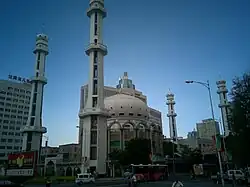
Lanzhou
Gansu Sheng, China
Why visit Lanzhou?
Lanzhou (兰州) is the capital of Gansu province and one of northwest China's most strategically important cities — a long, narrow industrial metropolis of around 4.5 million people squeezed for nearly 40 km along the upper Yellow River between steep loess hills. For two thousand years it was the great pivot of the Silk Road: caravans from Xi'an crossed the river here before fanning out toward Dunhuang, Central Asia and the Tibetan plateau. Once known as the "Golden City," it took its present name during the Qing in 1656 and, until the late 19th century, was the only place travellers could cross the Yellow River by a permanent structure — the famous floating bridge of chained boats. Today the Silk Road romance is mostly buried under apartment blocks and chemical plants, but it survives in the museums, the mosques of the Hui Muslim quarter, and above all in the city's signature culinary export, beef noodles.
Lanzhou's reputation as one of China's most polluted cities has eased considerably in the last decade, though winter inversions still trap smog in the river valley. The setting itself is dramatic: a thin green strip of riverside parks running between bare ochre hillsides at 1,520-1,570 m elevation. Summers (June-August) are warm rather than hot, with daytime highs around 28-30°C and the year's heaviest rains; winters (December-February) are dry, dusty and bitter, with January averages well below freezing. Late May through early October is the comfortable window, with September especially pleasant. Avoid late winter and early spring, when dust storms blow in from the Gobi.
The city is laid out east-west along the south bank of the river. Chengguan District is the historic and commercial centre — Zhongshan Bridge, the mosques, most hotels, and Lanzhou Railway Station are all here. Qilihe District to the west holds the Provincial Museum and Lanzhou West Railway Station (the high-speed rail hub). North of the river, White Pagoda Mountain rises directly above downtown.
Planning Lanzhou? Tell us your dates and we’ll tailor the trip.
Ask on WhatsAppHow do you get there?
By Plane
Lanzhou Zhongchuan International Airport (LHW) sits about 75 km north of the city in Yongdeng County — far enough that planning the transfer matters more than the flight itself. It has daily domestic connections to all major Chinese hubs including Beijing, Shanghai, Guangzhou, Chengdu, Xi'an, Kunming, Ürümqi, Dunhuang and Jiayuguan, plus seasonal international flights.
Three transfer options:
- Airport shuttle bus: ¥30 per person, around 70 minutes, terminating at the Tianshui South Road / Donggang West Road intersection in central Chengguan.
- Airport commuter train: the most reliable choice. Trains run roughly hourly between the airport, Lanzhou West Railway Station and Lanzhou (main) Railway Station; the airport-to-main-station run is 50-55 min. Buy at the station ticket window or through 12306.
By Train
Lanzhou is a major node on China's high-speed rail network and trains are almost always the smartest way in.
- Lanzhou West Railway Station (兰州西站) handles essentially all long-distance high-speed services. Sample times: Xining 1 h 15 min, Xi'an ~4 h, Jiayuguan 4 h 30 min, Ürümqi ~12 h, plus through services to Wuhan and Beijing.
- Lanzhou Railway Station (兰州站), the older terminus on Pingliang Lu at the south end of Tianshui Lu, still handles conventional sleeper trains, a handful of high-speed services, and the airport commuter train.
Book through 12306 (China Railways' official app/site) or Trip.com a few days ahead for popular routes; sleeper berths to Dunhuang and Ürümqi sell out fastest in summer.
By Car / Road
Driving distances from Lanzhou (via expressway):
- Xining: ~220 km, 2.5-3 h on the G6 expressway.
- Xi'an: ~680 km, 7-8 h on the G30. Almost no one drives this — the high-speed train is faster.
- Yinchuan: ~470 km, 5-6 h.
Long-distance buses still serve places the trains don't reach well:
- East Long-Distance Bus Station (Pingliang Lu): Dunhuang (24 h), Jiayuguan (17 h), Tianshui (4 h), Pingliang (5 h), Xi'an (15 h), Yinchuan (12 h), Zhangye (12 h), Ürümqi (38 h).
- West Long-Distance Bus Station (Xijin Xilu): Linxia (3 h), Liujiaxia (2 h, for Bingling Si), Xining (5 h), Hezuo (5 h).
- South Long-Distance Bus Station: Xiahe (6 h) — the gateway to Labrang Monastery.
Lanzhou is long, thin and crowded; you will not walk it end to end.
- Metro: two lines so far. Line 1 (blue) runs east-west across the city and is the line you'll actually use — it links Lanzhou West Railway Station, Xiguan (for the mosque), Xiaoxihu, Qiliheqiao (closest stop for the Provincial Museum, alight at Xishanshizi) and onward through downtown. Line 2 (red) is shorter. Additional lines linking the main railway station were under construction as of 2024. Fares ¥2-4. Pay with WeChat/Alipay QR, the local transit card, or coins at machines.
- Bus: dense and cheap (¥2-3). Bus #1 is the workhorse — it runs from Lanzhou Railway Station past Lanzhou Hotel, Qingyang Lu, Xihu Park and Qiliheqiao to Lanzhou West Railway Station, and conveniently connects the train station to the airport shuttle bus stop.
- Taxi and ride-hailing: metered taxis are abundant and cheap. DiDi (滴滴) works well across the city; expect short cross-town rides for ¥15-30. Few drivers speak English — have your destination in Chinese characters ready.
- Bike share: Meituan, HelloBike and similar yellow/blue bikes are scattered around downtown. Best for the riverside Binhe Lu green corridor; less fun in traffic.
- On foot: the Binhe Lu riverside park running for kilometres along the south bank is the one stretch where walking is genuinely pleasant.
Watch-outs: the airport is far enough that "I'll grab a taxi when I land" can cost dearly — always plan the train or shuttle in advance. Bus ticket touts at the long-distance stations occasionally try to push private vans at inflated prices for Xiahe and Liujiaxia routes; stick with the official counter.
What are the things to do?
Museums
- Gansu Provincial Museum (甘肃省博物馆), Xijin Dong Lu — the single must-see in Lanzhou. The Silk Road in one building: Neolithic painted pottery, Han-dynasty bamboo writing slips, Buddhist grotto fragments, and the museum's icon, the bronze Galloping Horse of Wuwei (Eastern Han, excavated 1969) — a horse in full flight with one hoof balanced on a swallow's back. Tu-Su 09:00-17:00. Free, but you must reserve via the museum's WeChat mini-program a day or two ahead. Metro Line 1 to Xishanshizi, or bus 1, 18, 31, 50, 53, 58, 59 or 71 to Qilihe Qiao.
- Gansu Sanmu Bicycle Museum (甘肃三木自行车博物馆), 1 Nanbinhe East Road, Chengguan — a private collection of antique bicycles from around the world, surprisingly engaging. Daily 09:00-17:00 (last entry 16:30), closed Mon. Free. Bus 36.
Bridges, parks and viewpoints
- Zhongshan Bridge (中山桥), at the foot of Zhongshan Lu — Lanzhou's emblem. Completed in 1909 by a German firm, it was the first permanent bridge across the Yellow River anywhere in China. The metal trellis is functional rather than picturesque, but the river churning beneath is the real spectacle. Pedestrianised. Always open, free. The natural launch point for White Pagoda Mountain on the north bank.
- White Pagoda Mountain Park (Baitashan) (白塔山公园), No. 1 Baitashan, North Binhe Middle Road — wooded hillside park climbing the north bank, threaded with paths up to the White Pagoda Temple at the summit. The pagoda itself was closed in 2021 (status uncertain as of 2026), but the views over the river and city are excellent. Cable car from the south bank if you don't want to walk. Free.
- Waterwheel Garden (水车博览园), Nanbinhe Dong Lu — riverside park showcasing the giant traditional wooden waterwheels once used to lift Yellow River water onto Lanzhou's terraced fields. Free.
- Yantan Park (雁滩公园) — a long ribbon of greenery and walking paths along a reclaimed river backwater in the east of the city. Pleasant for an evening stroll.
- Five-Spring Mountain Park (五泉山公园, Wuquanshan) — temples and pavilions on a hillside south of the centre, mixed in with a rather dated amusement park. Worth an hour if you have time.
- Xiaoxihu Park (小西湖公园) — a modest "miniature West Lake" downtown. Metro Line 1 Xiaoxihu Stn. Free.
- Gaolan Mountain (皋兰山) — the green ridge south of the city, a refuge from summer heat with sweeping views back over Lanzhou.
Religious sites
- Xiguan Mosque (西关清真大寺), Cuiyingmen — modern green-domed mosque in the Hui quarter. Metro Line 1 Xiguan Stn. ¥10.
- Qiaomenjie (Bridge Gate) Mosque (桥门清真寺), Zhongshan Road — historic Chinese-style mosque just south of Zhongshan Bridge in a Hui neighbourhood, with traditional pitched-roof prayer hall.
- Nanguan Grand Mosque (兰州南关清真大寺) — one of the six great Lanzhou mosques, originally founded in the early Ming (1368-1398) and rebuilt in 1986.
- White Cloud Temple (白云观, Baiyun Guan), 987 Nanbinhe East Road — Daoist temple dedicated to Lü Dongbin, on the south bank one block west of Zhongshan Bridge. Quiet, atmospheric, the best-preserved religious site in central Lanzhou. 07:00-18:00, free.
- Solemn Temple (庄严寺) — small Tang-era Buddhist temple in the old town, notable for its mural of Guanyin.
Outside the city
Bingling Temple / Bingling Si (炳灵寺) — a remote cliffside Buddhist grotto complex on a Yellow River reservoir, with ~180 caves carved over 1,600 years and a 27 m Maitreya Buddha. Reachable from Liujiaxia (2 h bus from Lanzhou West Bus Terminal, six morning buses from 09:00) plus a fast ferry across the reservoir (~1 h each way, around ¥170 return) or a taxi (¥200-300 per car return). Site entry ¥50, with extra fees of ¥80-200 for select premium caves. A long but rewarding day trip.
Lanzhou Shuimo Danxia National Park (兰州水墨丹霞国家公园), Yongdeng County — striped sandstone "ink-painting Danxia" mountains, smaller and far less crowded than Zhangye's famous Rainbow Mountains but a fraction of the trip. Direct buses depart the Lanzhou Transit Center at 09:00 and the Journey to the West Sculpture at 09:20; book via the 小兰约车 WeChat mini-program.
Tianxu Sand Palace Geopark (天斧砂宫地质公园), Gaolan County — eroded red-sandstone Danxia formations in Longfeng Gorge east of Renshou Mountain.
Walk the Yellow River. The Binhe Lu green corridor runs for kilometres along the south bank, threading the Waterwheel Garden, the Zhongshan Bridge approaches and the Mother River sculpture. Best at sunset, when the river glows ochre and the city's grandparents come out to dance.
Sculptures of the Mother River (黄河母亲像), Nanbinhe Middle Road, Qilihe District — the city's most photographed monument, a 6 m granite mother-and-child by sculptor He E. A standard stop on any riverside walk.
Cross to White Pagoda Mountain on foot, descend by cable car (or vice versa) for a half-day's exercise with the city laid out below.
Eat beef noodles for breakfast in a working-class noodle shop. This isn't a tourist activity in Lanzhou — it's how the city wakes up. (See Eat.)
Sheepskin raft ride on the Yellow River — inflated whole-sheepskin rafts (羊皮筏子) used to ferry goods across the Yellow River for centuries; short tourist rides depart from the Waterwheel Garden area in season.
Day-trip to Bingling Si for grottoes and reservoir scenery (full day, see See).
Day-trip to Xiahe / Labrang Monastery — one of the six great Gelugpa monasteries of Tibetan Buddhism, ~6 h south by bus from the South Bus Station. Ideally an overnight rather than a day-trip.
Nightlife centres on Zhangye Lu pedestrian street and the Zhengning Road night market area, with KTV, beer halls and casual bars. Lanzhou is not a clubbing city — the action is street food and beer rather than nightclubs.
Planning Lanzhou? Want these on a customised itinerary?
Ask on WhatsAppWhere to eat?
Lanzhou's culinary identity is overwhelmingly Hui Muslim — halal, beef-and-mutton-driven, wheat-noodle-based — with an undercurrent of Han northwestern home cooking. The signature dish, Lanzhou beef noodles (兰州牛肉面 / Lanzhou niurou mian), is served at thousands of small shops across China but is famously best at source: hand-pulled wheat noodles in a clear, slow-simmered beef broth with chili oil, white radish, coriander and slivers of beef. Eaten for breakfast. Order by noodle thickness (毛细 maoxi hair-thin → 大宽 dakuan belt-wide).
Other northwest staples to try: niangpi (酿皮, cold wheat-gluten noodles in vinegar-chili sauce), shouzhua yangrou (手抓羊肉, hand-grabbed boiled lamb), roujia mo (肉夹馍, flatbread stuffed with stewed meat), dapanji (大盘鸡, "big plate chicken" with potatoes and noodles, more Xinjiang than Gansu but ubiquitous), niang pi zi and the local sweet sanpaotai (三泡台, eight-treasure tea — see Drink).
Recommendations across price tiers:
- Budget — beef noodles: any branch of Mazilu Beef Noodles (马子禄牛肉面) is the safe bet for the canonical bowl. Original branch on Dazhong Lane (大众巷). Around ¥10-15 a bowl. Get there before 11:00 — they often sell out by lunchtime.
- Budget — beef noodles, alt: Wumule Beef Noodles (伍穆勒牛肉面) and Zhanmali (占马里) are the local rivals to Mazilu, similar pricing.
- Budget — night market: Zhengning Road Night Market for grilled lamb skewers (yangrou chuan), niangpi, hand-pulled noodles, milk-and-egg pudding and stinkier experiments. ¥30-60 fills you up.
- Mid-range — Hui home cooking: the area around Dazhong Lane (大众巷) off Zhangye Lu is dense with halal restaurants serving lamb hot pot, hand-grabbed mutton and noodle dishes. ¥80-150 per person.
- Mid-range — hot pot: Haidilao (海底捞) has multiple Lanzhou branches — reliable, halal-friendly options on the menu, around ¥120-180 per head.
- Upscale: dining rooms in the Crowne Plaza Lanzhou and Legend Hotel Lanzhou offer the most polished Chinese and international meals in town, ¥250-500 per head. Lanzhou is not a fine-dining destination — the city's best food is firmly mid-range and below.
Dietary notes: halal is everywhere — the Hui presence makes Lanzhou one of the easiest cities in China for Muslim travellers. Vegetarians have a harder time: Hui cooking is meat-centric, and "no meat" often gets you noodles in oil. Look for Buddhist vegetarian (素食 sushi) restaurants near temples, or order vegetable side dishes (素菜) at any sit-down place. Gluten-free is genuinely difficult — wheat noodles and bread are the foundation of the local diet.
Where to drink?
- Sanpaotai (三泡台) — Lanzhou's distinctive "eight-treasure" tea: green tea brewed in a covered gaiwan with rock sugar, dried longan, jujubes, raisins, goji berries, dried apple and dried chrysanthemum. Served in any teahouse and most Hui restaurants.
- Yellow River beer — local lager brand poured everywhere; pleasant enough with a plate of skewers. Snow (雪花) and Tsingtao are also ubiquitous.
- Coffee culture is modest but growing — Luckin and Manner branches throughout the centre, plus a smattering of independent third-wave cafés around Zhangye Lu.
- Bars: Lanzhou doesn't have a defined bar district. Hotel bars in the Crowne Plaza, Legend and Sheraton are reliable for a quiet drink; a handful of beer halls and craft-beer bars cluster off Zhangye Road.
- Teahouses: the most local experience. Baiyun Guan (White Cloud Temple) has a courtyard teahouse, and several teahouses operate along the Binhe Road riverside in summer.
Water: do not drink tap water in Lanzhou — boiling or bottled only. Bottled water is cheap (¥2-3 per 500 ml) and sold everywhere; hotel rooms supply complimentary bottles and an electric kettle. Ice in drinks at street stalls is best avoided.
Planning Lanzhou? We’ll book the stays and dining for you.
Ask on WhatsAppWhere to stay?
Budget
- Lanzhou Lazy Bones Hostel (兰州懒骨头国际青年旅舍) — long-running backpacker standby in the city centre, dorm beds and basic privates, English-speaking staff and useful Bingling Si / Xiahe trip info. Dorms around ¥60-90, privates around ¥180-250.
- Hanting / Home Inn / 7 Days Inn — the major Chinese budget chains have multiple branches near both railway stations, ¥150-250 for a clean en-suite double. Reliable if uninspiring.
Mid-range
- Ji Hotel Lanzhou (兰州桔子酒店) — design-led mid-range chain, several central locations, ¥350-500 a night, good wifi and clean modern rooms.
- Lanzhou Hotel (兰州饭店), Donggang West Road — old-school state-run high-rise on the bus #1 route, central location, fading but functional. ¥350-550.
Upscale / heritage
- Crowne Plaza Lanzhou (兰州皇冠假日酒店), Donggang West Road — the long-standing international-brand benchmark in the city centre, well-located for the railway station and downtown. ¥700-1,200.
- The Legend Hotel Lanzhou (兰州飞天大酒店) — large, established business hotel with a good restaurant floor and pool, central Chengguan. ¥600-1,000.
- Sheraton Lanzhou Anning — newer Marriott-group property in the western Anning university district, convenient for Lanzhou West Railway Station. ¥750-1,200.
Lanzhou has no genuine heritage hotels — the Silk Road era left no preserved caravanserais or courtyard inns of the kind you find in Pingyao or Xi'an.
What should you buy?
Lanzhou is more a transit city than a shopping destination, but a few things are genuinely worth carrying home.
- Zhengning Road Night Market (正宁路夜市) — the city's headline market: a few packed blocks of food stalls and a smattering of souvenir hawkers, kicking off around dusk. Come for snacks more than shopping.
- Zhangye Road Pedestrian Street (张掖路步行街) — central downtown shopping strip with department stores, sportswear and Chinese chain brands.
- Local specialties to look for:
- Lanzhou lily bulbs (兰州百合) — sweet, edible white lily bulbs grown in nearby Qilihe; sold dried for cooking and tea.
- Yellow River stones (黄河石) — polished river pebbles with natural patterns, sold as desk ornaments.
- Gansu dried fruits and nuts — apricots, dates, walnuts and goji berries from the province's oases.
- Painted pottery replicas of Majiayao Neolithic ware from the Gansu Provincial Museum gift shop, including small replicas of the Galloping Horse (around ¥500 for a quality cast).
- Hui Muslim caps and prayer rugs in the Xiguan/Qiaomenjie mosque district.
- Bargaining: expected at street markets and tourist stalls (start at 30-50% of ask), not in department stores or chain shops.
Where to go next?
- Xiahe (Labrang Monastery) — ~6 h south by bus from Lanzhou's South Bus Station. One of the six great Gelugpa monasteries; ethnically and atmospherically a piece of Amdo Tibet. The single best onward trip from Lanzhou.
- Xining — 1 h 15 min by high-speed train. Capital of Qinghai, gateway to Qinghai Lake, Ta'er (Kumbum) Monastery and the Tibetan plateau.
- Tianshui — 1-2 h by high-speed train. Site of the Maijishan Grottoes, one of China's four great Buddhist cave complexes, sculpted into a sandstone cliff.
- Linxia — 3 h by bus from the West Bus Station. Historic Hui Muslim trading town with distinctive mosques and architecture; a good half-stop on the way to Xiahe.
- Jiayuguan — 4 h 30 min by high-speed train. The western end of the Ming-dynasty Great Wall, with its restored fort guarding the desert pass — the symbolic limit of imperial China.
- Dunhuang — overnight sleeper train or a long high-speed run via Jiayuguan. The Mogao Grottoes, Crescent Lake and the Mingsha singing-sand dunes — one of the great Silk Road set-pieces and the natural climax of any Gansu trip.
Nearby in Gansu Sheng
More places to explore around Lanzhou.
Guide content as of July 2026. Portions adapted from Wikivoyage, CC BY-SA 4.0.

Contact Us
Get in touch with us.
Get in touch
Contact Us
Tell us where you'd like to go and how you like to travel. A real Tripcuro planner — not a bot — will craft an itinerary around you.
- Personalised, hassle-free planning end-to-end
- Transparent pricing, no hidden costs
- 24/7 support for complete peace of mind