
Longxi
Gansu Sheng, China
Why visit Longxi?
Longxi (隴西) is a small county seat in the central uplands of Gansu Province, administratively part of the prefecture-level city of Dingxi. Sitting in the loess hill country south of the Wei River, it is one of those quietly historic Chinese towns that most foreign travellers pass straight through on the rail line between Lanzhou and Tianshui — and which rewards the few who stop. The county seat itself is the town of Gongchang (巩昌鎮), a compact grid of low-rise streets where almost all the visitor sights are clustered within walking or short-bus distance of each other.
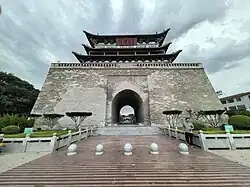
Longxi's claim to fame is genealogical. It is the recognised ancestral home (jùnwàng, 郡望) of the Li (李) clan — one of the great surnames of Chinese history and the imperial house of the Tang Dynasty (618–907). Pilgrims with the Li surname still travel here from across China and the Chinese diaspora to pay respects at the Li Family Dragon Palace. Beyond the Li heritage, Longxi has a long frontier history: it was a fortified outpost facing the Tibetan and later Tangut borderlands, and traces of that role survive in the 950-year-old Weiyuan Tower in the heart of town. The county is also a noted producer of Chinese medicinal herbs — Longxi is one of the major dāngguī (Angelica sinensis) markets in China — and the herb trade still gives the town a distinctive smell and rhythm.
The climate is harsh continental: bitterly cold, dry winters (sub-zero nights from November through February) and warm, short summers with a monsoon-influenced wet spell from July to early September. The most comfortable months are May–June and September–early October, when daytime temperatures sit in the high teens to mid-20s °C and the loess hills are at their greenest. Avoid the depths of winter unless you are passing through, and avoid late July/August if you dislike sudden heavy showers on unpaved village roads.
Planning Longxi? Tell us your dates and we’ll tailor the trip.
Ask on WhatsAppHow do you get there?
By Train
Longxi Railway Station (隴西站), Jiaotong Road, Wenfeng Town, is the main rail gateway and is well connected on the Lanzhou–Baoji corridor, giving frequent services to Lanzhou (around 2 hours), Tianshui (about 1½ hours) and Baoji, with onward connections to Xi'an. The station is reached on city bus nos. 1, 2, 3, 4, 6 (Yongji and Zhaojiamen routes), 15, 61, 301 and 302.
Booking tip: Longxi sits on a busy through-route, so for the most convenient daytime departures buy tickets a few days in advance via the 12306 app (China Railway's official booking platform) or Trip.com. Bring your passport — it is the ID used for ticketing and station entry. Sleeper trains running this corridor often pass Longxi at inconvenient small-hours times; daytime D-series and K-series trains are more comfortable for short hops.
By Car / Road
Longxi Bus Station (隴西客运站) at the intersection of Wanshou Street and Nan'an Avenue in Gongchang Town (☎ +86 932 6624051) is the county's main coach hub, with services to Lanzhou, Dingxi, Tianshui, Linxia and surrounding county towns. It is on city bus routes 1, 3, 4, 8, 10, 12, 301, 302, 701 and 702.
By road, Longxi is connected to the national expressway network via the G30 Lianyungang–Khorgas Expressway (Lian-Huo Expressway) corridor and the G75 spur:
- Lanzhou → Longxi: ~230 km, around 3 hours on the expressway.
- Tianshui → Longxi: ~150 km, around 2 hours.
- Dingxi (prefecture seat) → Longxi: ~80 km, around 1¼ hours.
Roads are paved expressway or good provincial highway for these legs; mountain side-roads in the county can be rough after heavy summer rain.
Gongchang Town is small enough that most sights are walkable from a central hotel — the Weiyuan Tower, Li Family Dragon Palace and County Museum are all within the town grid. For longer hops between the railway station and the bus station, or out to the Li Family complex, city buses are the easy option: a flat fare of around ¥1–2, paid in cash or with WeChat/Alipay QR. Routes 1, 2, 3 and 4 form the backbone of the network and stop near most points of interest.
Taxis are metered and cheap — typical short crosstown rides run ¥6–15. Ride-hailing through Didi Chuxing (滴滴出行) works in Longxi but with a thinner driver pool than in big cities, so waits can be longer in the evenings. Walking is pleasant in the old centre around Xida Street; pavements are uneven in places and pedestrian crossings are advisory at best, so cross with the locals.
Scams are not a real issue here — Longxi sees very few foreign visitors and is a low-pressure town. The usual China-wide cautions apply: agree on a price before getting into an unmetered car, and stick to official taxis or Didi rather than touts at the railway station forecourt.
What are the things to do?
Li Family Dragon Palace (李家龙宫) — Yixin Village, Gongchang Town (bus 62; ☎ +86 932 6622266). The reason most outside visitors come to Longxi: a sprawling complex of halls and temples honouring the ancestors of the Li clan, including Li Shimin (Emperor Taizong), the second Tang emperor. Atmospheric for anyone interested in Chinese genealogy and Tang-era history. Open 08:15–18:00 (no entry after 17:00). Free.
Longxi County Museum (隴西縣博物馆) — east side of Li Family Dragon Palace Square, directly opposite the Dragon Palace (☎ +86 932 5932758 bookings, +86 932 6622006 enquiries; [email protected]). A compact but well-curated overview of the county's history, with a dedicated exhibition on the Li Family that pairs nicely with a visit to the Dragon Palace. Open 09:00–17:30 (no entry after 17:00), closed Mondays. Free.
Weiyuan Tower (威远楼) — 78 Xida Street, Gongchang Town (buses 1, 2, 3, 4, 9, 12, 62, 301, 302; ☎ +86 932 6622490). A handsome timber-and-brick defensive tower originally built over 950 years ago during the Northern Song Dynasty and rebuilt in the first year of the Ming (1368). It anchors the old town and is a fine sunset photography spot from the surrounding street. Open Sat–Sun 09:00–12:00 and 14:30–17:00, closed weekdays. Free.
Walk the old town grid. A loop from Weiyuan Tower along Xida Street and out to the Dragon Palace square takes 1–2 hours and gives you most of Longxi's historic fabric in one go. Mornings are best for photographs, when the loess light is soft.
Time a visit to a Li-clan commemoration. The Dragon Palace hosts ceremonies and family-association gatherings through the year, especially around Qingming (early April) and other ancestor-veneration festivals. If your trip is flexible, ask at the museum (☎ +86 932 6622006) what is scheduled.
Browse the Chinese-medicine trade. Longxi is one of Gansu's main hubs for dāngguī (Angelica sinensis), astragalus and other medicinal herbs. Even casual wandering through the wholesale and retail herb streets in Gongchang gives a strong sense of the trade that shapes the local economy.
Day trip to the loess countryside. The villages and terraced hills surrounding Gongchang are characteristic Gansu loess-plateau landscape — best explored by chartered taxi for a half day. Negotiate around ¥300–500 for a half-day hire.
Planning Longxi? Want these on a customised itinerary?
Ask on WhatsAppWhere to eat?
Longxi cooking is squarely in the Gansu noodle-and-wheat tradition: hand-pulled noodles, hearty mutton and beef broths, and the dry-frosted flavours of the loess plateau. Halal (清真, qīngzhēn) options are widespread thanks to the local Hui Muslim community, and beef noodle shops are everywhere. Vegetarians can usually order plain noodle soups, suàn liáng fěn (cold mung-bean jelly), tomato-and-egg dishes and stir-fried greens, but strict vegans will find the broth-based soups challenging.
Signature things to try:
- Lanzhou-style beef noodles (蘭州牛肉麵) — the Gansu staple, served at any halal noodle shop in town for around ¥10–15 a bowl.
- Dāngguī mutton soup (當歸羊肉湯) — a local speciality leaning on Longxi's herb production; warming and slightly bitter-sweet.
- Hand-pulled noodles with stewed beef (燴麵 / 拉条子) — thick, chewy noodles in a tomato-and-beef sauce.
- Niàng pí zi (釀皮子) — cold wheat-gluten "skin" noodles with chilli oil and vinegar; a summer favourite.
Where to drink?
Tea is the everyday drink. Look for sānpàotái (三炮台), the Gansu/Hui-style covered-bowl tea served with rock sugar, longan, red dates and goji berries — a small ritual in itself, and a good antidote to a cold loess afternoon. Locally produced goji-and-jujube infusions are sold in every supermarket. For something stronger, Gansu is baijiu country: regional brands such as Hexi-corridor and Longnan distilleries appear on most restaurant tables, typically poured in tiny cups alongside a meal.
Dedicated bars and Western-style cafés are limited; most evening drinking happens at restaurants or at simple night-market beer-and-skewer stalls (烤串, kǎochuàn) along the streets near the bus station. Coffee culture is thin but growing — expect a handful of small chain coffee shops in the centre of Gongchang.
Water safety: do not drink tap water. Stick to bottled water (¥2–3 for 550 ml in any shop) or boiled water — the flask of hot water in your hotel room is the standard local solution and entirely safe.
Planning Longxi? We’ll book the stays and dining for you.
Ask on WhatsAppWhere to stay?
- Budget (¥80–150 / night): Family-run bīnguǎn (賓館) and zhāodàisuǒ clustered around the Longxi Bus Station and the railway station. Rooms are basic but clean; expect shared or minimal en-suite bathrooms at the lower end.
- Mid-range (¥180–350 / night): Domestic chain business hotels — look for branches of Hanting (漢庭), 7 Days Inn (7天連鎖酒店) and Jinjiang Inn (錦江之星) in Gongchang. These are the most reliable choice for foreign passports and online booking.
- Upscale (¥400–700 / night): Longxi is not really an upscale destination, but a handful of larger four-star-style city hotels operate near the centre of Gongchang Town aimed at business travellers and herb-trade visitors. For genuinely upscale or heritage-style stays, base yourself in Lanzhou or Tianshui and visit Longxi as a day trip.
What should you buy?
Longxi's signature buy is Chinese medicinal herbs, above all dāngguī (當歸) and huángqí (astragalus, 黃芪) — both grown in the surrounding hills and traded here in bulk. Look for sealed, graded packs in legitimate pharmacies or specialist herb shops rather than loose bundles from unknown stalls; quality varies hugely. Other practical buys include local buckwheat and grain products, handmade noodles sold dried, and small Tang-themed souvenirs (rubbings, ink prints, calligraphy items) sold near the Li Family Dragon Palace.
The main shopping area is the grid of streets around Xida Street and the bus station, where you'll find a mix of supermarkets, herb wholesalers and small department stores. Bargaining is normal at market stalls and tourist-facing souvenir shops (expect to settle around 20–30% off the opening price), but fixed prices apply in supermarkets, chain pharmacies and any shop with marked tags.
Where to go next?
- Tianshui (~150 km / 1½–2 hours by train or car) — home to the Maijishan Grottoes, one of China's four great Buddhist cave-temple complexes; an essential next stop heading east.
- Lanzhou (~230 km / 2–3 hours by train) — Gansu's capital, the Yellow River, the Gansu Provincial Museum and the launchpad for the Hexi Corridor and Silk Road routes.
- Linxia (~200 km / 4 hours by road) — a major Hui Muslim cultural centre with distinctive mosques, brick carving and sānpàotái tea culture.
- Dingxi (~80 km / 1¼ hours by road or train) — the prefecture seat, useful as a transit point and for further exploration of central Gansu's loess landscapes.
- Lintao (Linyao) (~100 km west) — Majiayao Neolithic painted-pottery culture sites and museum, of strong interest to anyone following Chinese prehistory.
- Xiahe / Labrang Monastery (~350 km / 6+ hours via Linxia) — one of the great Tibetan Gelug monasteries outside Tibet itself; worth the longer haul if you have a few days.
Nearby in Gansu Sheng
More places to explore around Longxi.
Guide content as of July 2026. Portions adapted from Wikivoyage, CC BY-SA 4.0.

Contact Us
Get in touch with us.
Get in touch
Contact Us
Tell us where you'd like to go and how you like to travel. A real Tripcuro planner — not a bot — will craft an itinerary around you.
- Personalised, hassle-free planning end-to-end
- Transparent pricing, no hidden costs
- 24/7 support for complete peace of mind