
Banlung
Rotanak Kiri, Cambodia
Why visit Banlung?
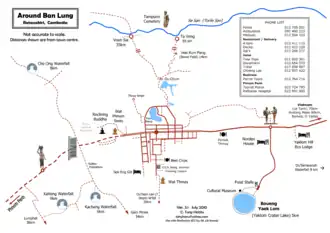
Banlung (បានលុង) is the small but steadily growing capital of Ratanakiri Province in remote northeastern Cambodia. Far from the well-trodden tourist circuit of Angkor and the southern coast, it sits at the edge of a heavily forested upland of red-earth roads, rubber and cashew plantations, crater lakes, and indigenous villages. The province is home to twelve ethnic minority groups — collectively the Khmer Loeu, or "upland Khmer" — whose animist traditions, longhouse villages, and forest cemeteries give the region a frontier feel that has largely vanished from the rest of the country. Banlung itself is functional rather than picturesque: a low-rise grid of guesthouses, gem dealers, motorbike shops, and Khmer eateries fanning out from a central roundabout. The town exists to organize trips into the surrounding landscape — waterfalls, the Yeak Laom volcanic lake, Virachey National Park — rather than to be a destination in itself.
The climate is tropical monsoon with two distinct seasons. The dry season (November–April) brings the most reliable road conditions and the easiest access to remote villages and the national park, but waterfalls run thin and the landscape can look dusty by March. The wet season (May–October) is when the falls are at their best and the jungle is lush, though some park areas become inaccessible and red-earth tracks turn to deep mud. Late November through February — drier, cooler, post-monsoon green — is generally the most comfortable window. Banlung is compact enough to walk across in 20 minutes; orient yourself by the central roundabout (where Highway 78 meets the road south) and Phsar Banlung, the town market, just east of it. Most guesthouses, restaurants, and tour operators are within a few hundred metres of either.
Planning Banlung? Tell us your dates and we’ll tailor the trip.
Ask on WhatsAppHow do you get there?
By Plane
Banlung has an airfield but no scheduled commercial service — the runway is still gravel and all carriers have withdrawn. Medivacs and charters are available from Helicopters Cambodia. In practice, foreign visitors fly into Phnom Penh International Airport (PNH), roughly 580 km southwest, and continue overland by bus or shared minivan (8–10 hours). A US$6 departure tax may be levied at Phnom Penh airport.
By Car / Road
Road access has improved dramatically over the last decade. Note that buses and minivans are often advertised under the province name "Ratanakiri" rather than "Banlung" — Cambodians from elsewhere recognise the province name from school.
- From Phnom Penh (≈ 580 km, 8–10 hr). Four large bus operators — Sorya, Rithmony, Hy Long, and GST — run the route for around 39,000 riel (US$9.70). Numerous minivans cover it for about 40,000 riel (US$10); they are faster on the highway but free pickup/dropoff can add 2–3 hours. Most departures leave between 06:00 and 07:30. The newer routing south of Kratie via Chhlong saves about 100 km over the older alignment.
- From Kratie (≈ 5–6 hr, US$8). Either a shared minibus departing around 08:00 (cramped — three seats per row of three) or the Phnom Penh Sorya Transport bus passing through at 13:00 with a long lunch stop just outside Kratie (so latecomers can often catch up at the lunch halt).
- From Stung Treng (3–5 hr). Several afternoon departures; the road from the Stung Treng junction to Banlung is fully sealed.
- From Laos / Si Phan Don (Four Thousand Islands). No direct service; combined tickets (US$14–18) include three buses with changes at Stung Treng and at the border, plus a boat. Officials on both sides often demand inflated "processing fees" for stamps and visa-on-arrival.
- From Vietnam. The O Yadaw / Le Thanh border crossing connects Banlung with Pleiku (Gia Lai) and Quy Nhon. Banlung travel agents book a 06:00 cross-border bus to Pleiku. Important: Vietnamese e-visas are not accepted at this crossing — you need either visa-free eligibility or a physical Vietnamese visa already in your passport. Cambodian visas are issued at the border in the other direction. From Pleiku, public van (2 hr, around US$10) or taxi (1½ hr) reaches the border; the Cambodian post is isolated and onward transport from there typically means bargaining with whatever taxi or motorbike the immigration police can summon (around US$80 for a whole car, US$30 for a moto with driver). Highway 78 on the Cambodian side is now one of the country's better roads.
A private taxi from Phnom Penh runs around US$120 — about 5–6 hours to the Stung Treng junction and another 2–4 hours to Banlung. Most Phnom Penh hotels can connect you with drivers who specialise in the run.
Minivan tip: vans are often late but occasionally leave early if they're ahead of schedule, and they will not always wait. Be at your pickup point 15 minutes before departure, and if you change vans en route, do not wander far from the drop-off — drivers who don't see you may simply leave.
The town centre is walkable — most guesthouses, restaurants, and the market are within a 10–15 minute stroll of the roundabout. For anything beyond town, you'll want wheels.
- Motodops (motorcycle taxis) are everywhere around the roundabout and the market. They're the cheapest way to reach nearby waterfalls and Yeak Laom; agree on a price before setting off, and expect to negotiate.
- Motorbike rental is the most flexible option for independent travellers. A 125cc semi-automatic runs US$5–7/day; a 250cc trail bike around US$10/day. Try the shop on the highway just west of the roundabout, the Ratanak Hotel, the shop near Tribal Hotel, Reggae Bar and Restaurant (street 25 with 46, US$6–8/day), or your guesthouse. Roads to the main waterfalls and Yeak Laom are paved or gently red-earth and manageable for confident riders; deeper village routes can be challenging in the wet.
- Bicycles are available at Bona Tours (just southeast of the roundabout — Mr. Bona is friendly and speaks English) and at Banlung Balcony (formerly Lakeview Lodge) for around US$1/day. A shop near the roundabout also rents bikes but is strict about taking passports as deposit, which Bona Tours and Banlung Balcony do not require.
- 4×4 / car with driver. US$30–50/day for a truck or 4×4; a Landcruiser with driver/guide for up to eight people can be arranged through Dutch Co & Co or Terres Rouges Lodge — pricier but useful for groups or wet-season trips.
- Guides. Almost no one in the surrounding villages speaks English, and arriving unannounced at an indigenous village can cause genuine offence (especially during ceremonies). Hiring a guide through your guesthouse, Parrot Tours, or Bona Tours is strongly recommended for village visits. Most guesthouse-arranged guides are well reviewed.
Ride-hailing apps (Grab, PassApp) do not operate meaningfully in Banlung; arrangements are face-to-face. Standard scam awareness applies — fix prices in advance, count change, and be wary of "package" deals that bundle entry fees you've already paid.
What are the things to do?
Yeak Laom Volcanic Lake (Yaklom Commune Protected Area, ~5 km east of town). A near-perfectly circular crater lake roughly 700,000 years old, ringed by jungle and considered sacred by local tribes. There are docks for swimming, picnic spots, and a hiking trail that loops the rim past a small visitor centre with hill-tribe ethnographic displays. Entry 8,000 riel (US$2).
Cha Ong Waterfall. The most visited fall in the area, 18 m high, with an eroded rock chamber that lets you walk behind the curtain of water. 2,000 riel entry. Best in the wet season.
Ka Tieng Waterfall. A 10 m fall in jungle setting with a swimmable pool. Notable as the working partner site of the Airavata Elephant Foundation, where you may swim alongside rescued elephants. 2,000 riel entry.
Kan Chang Waterfall. Around 7 m high, emptying into a large pool that's good for swimming. 2,000 riel entry.
Ou'Sean Lair Waterfall (about 26 km SE). Four-tiered fall, less visited, worth the trip in the rains.
Ou'Sensranoh Waterfall (about 9 km SE). 18 m high.
Veal Rum Plan stone field (about 14 km N). Open expanse of weathered stone — unusual landscape feature in the area.
Wat Rahtanharahm (~1 km out of town, base of Eisey Patamak Mountain). Buddhist temple complex; about half a kilometre uphill past the wat is a large reclining Buddha with a sweeping view over the surrounding country.
Virachey National Park (~37 km NE; bordering Laos and Vietnam). One of Cambodia's largest and least-explored protected areas — dense jungle, mountains, rare wildlife. Multi-day jungle treks with a park ranger and community guide are arranged through the Ministry of Environment's Biodiversity and Protected Areas Management Project office near the Banlung centre. Many areas are inaccessible in the wet season.
Phsar Banlung (town market, just east of the roundabout). Early-morning visits catch Khmer Loeu villagers bringing in fruits, vegetables, and forest products — among the most photogenic moments in town. Ask before photographing people.
Bokeo gem mines / Mining tour (~36 km from town). Working zircon and gem mines; tours are arranged through guesthouses and combine well with a market visit to see the rough stones for sale.
Rubber plantations. Several large plantations line the road out to the waterfalls — worth the stop if you're already passing.
Jungle trek in Virachey National Park. Multi-day ranger-guided treks ranging from two-day forest walks to longer expeditions deeper into the park. Book through the park office in Banlung; rates depend on group size and trek length.
Swim with elephants at Ka Tieng via the Airavata Elephant Foundation — an ethical sanctuary for retired working elephants in Ratanakiri, with no riding involved.
Hill-tribe village visits with a local guide. Cemeteries with carved totems, longhouse villages, and seven-tier waterfalls feature on most itineraries. Smaller groups pay disproportionately more — pairs and solo travellers should consider joining a larger group through Parrot Tours or Dutch Co & Co.
Rafting and river trips on the Tonle San and other waterways are arranged seasonally through guesthouses.
Motorbike loop of the waterfalls (Cha Ong–Kan Chang–Ka Tieng) — a half-day self-drive that takes in all three of the close-in falls and a stretch of plantation country.
Yeak Laom rim hike — about 2.5 km around the lake, mostly flat and shaded.
Respecting local customs. Most surrounding ethnic minorities are animist. Watch for fresh tree leaves hung in front of a village gate or house — these mark a closed ceremony or sacrifice, and outsiders should not enter. Always ask permission before photographing people or shrines; you may be fined for breaches. If unsure, do not enter a village without a knowledgeable guide.
Planning Banlung? Want these on a customised itinerary?
Ask on WhatsAppWhere to eat?
Banlung's food scene is functionally a smaller, less varied version of any provincial Cambodian town's: rice and noodle staples, grilled meats, soups, and a few traveller-oriented kitchens around the roundabout. The vast majority of restaurants are Cambodian-owned and -run. Eat responsibly — avoid wildlife and bushmeat dishes, which directly fund poaching pressure on Virachey and surrounding forests. Vegetarian options are limited but possible; ask for saht aut nham (no meat) or order vegetable stir-fries and noodle soups without meat broth.
Signature dishes worth trying include Khmer-style amok (steamed fish curry in banana leaf), lok lak (stir-fried beef with pepper-lime sauce, often using local Kampot or upland pepper), bai sach chrouk (grilled pork over broken rice — the classic breakfast), and num banh chok (rice noodles with fish-based green curry, sold at market stalls in the morning).
- Phsar Banlung food stalls (budget; town market). The cheapest and most authentic option — noodle soups, rice dishes, grilled skewers from around 4,000–10,000 riel.
- Reggae Bar and Restaurant (budget–mid; street 25 with 46). Long-running traveller hangout serving Khmer and Western dishes; also rents motorbikes (US$6–8/day).
- Café Alee / town-centre cafés near the roundabout (mid). Western breakfasts, sandwiches, and Khmer mains in the US$3–6 range.
- Terres Rouges Lodge restaurant (mid–upscale; lakeside). The most polished dining in town, set in a colonial-era villa garden — French-inflected Khmer menu, mains roughly US$7–12.
Where to drink?
Cambodian beer is the local default — Angkor, Cambodia, and Anchor are universally available, typically US$0.75–1.50 a draught and US$1–2 for a bottle. Sombai infused rice wine and other rice spirits show up in some restaurants; in villages, you may be offered home-fermented rice wine (sraa) drunk through long bamboo straws from a communal jar — accepting is a friendly gesture if shared respectfully.
For non-alcoholic options, iced Khmer coffee with sweetened condensed milk (kafe tek doh ko teuk kork) is excellent and widely available; fresh sugarcane juice and coconut water are sold from street carts; and locally grown cashew-and-fruit shakes appear on most café menus. Tap water is not safe to drink — stick to sealed bottled water (1,500–2,000 riel for 1.5 L) or use your own filter/UV system. Ice in established restaurants is generally factory-made and safe; be more cautious at remote village stalls.
Nightlife is low-key. Reggae Bar is the de facto traveller meeting point. Terres Rouges Lodge has a quiet, atmospheric bar suited to a slower drink. Most other venues are simple Khmer beer gardens that wind down by 22:00.
Planning Banlung? We’ll book the stays and dining for you.
Ask on WhatsAppWhere to stay?
Budget
- Banlung Balcony (formerly Lakeview Lodge) — long-running backpacker favourite with simple rooms, a sociable common area, bicycle rental, and tour bookings. Roughly US$6–12 per night.
- Tree Top Eco-Lodge — wooden bungalows on stilts overlooking a forested gully, ten minutes' walk from the centre; popular for atmosphere on a budget. Roughly US$10–18.
Mid-range
- Tribal Hotel — solid Khmer-run hotel near the centre with reliable rooms, AC, and hot water. Roughly US$20–35.
- Ratanak Hotel — central, on the highway just west of the roundabout; doubles as a motorbike rental point, useful if you want to arrange transport on arrival. Roughly US$20–30.
Upscale / heritage
- Terres Rouges Lodge — Banlung's standout property, set in a restored 1960s governor's residence on the edge of Boeng Kan Seng Lake, with antique-furnished rooms, gardens, a pool, and the best restaurant in town. Roughly US$80–150.
What should you buy?
Banlung's commerce centres on Phsar Banlung, the town market, where you'll find the standard Cambodian mix of household goods, dry goods, fresh produce, and ready-cooked food, plus forest products brought in by Khmer Loeu villagers in the early morning. It's better as a window into local life than a craft-shopping destination.
Ratanakiri is one of Cambodia's main gemstone regions, particularly for blue zircon mined at Bokeo. Banlung has a number of small gem dealers around the market and main roads where you can see rough and cut stones; quality and authenticity vary widely, so buy only if you know what you're looking at, and bargain firmly. Cashews and locally produced rubber goods are also worth a look.
Bargaining is standard at the market and with motodops/tour operators; in restaurants and proper shops, prices are generally fixed. A good opening counter is roughly 60–70% of the asking price for general goods.
Banks and money. Acleda Bank (pronounced "A.C. leader") was historically the main bank in town — its ATM accepts Visa but not Cirrus or Mastercard, and charges around US$2 for overseas cards. Canadia Bank has a branch with a 24-hour ATM accepting a wider range of cards on the street west of the market. Both US dollars and Cambodian riel are used interchangeably (small change is usually given in riel). Carry enough cash for your stay and onward travel — ATMs can be unreliable and guesthouse traveller's-cheque rates are poor.
Where to go next?
- Stung Treng (~140 km W, 3–5 hr by bus). Mekong river town and the gateway to the Ramsar wetlands and rare Irrawaddy dolphins north of Kratie.
- Kratie (~210 km SW, 5–6 hr). The country's best base for spotting Mekong Irrawaddy dolphins at Kampi, plus the river island of Koh Trong.
- Sen Monorom (Mondulkiri) (~250 km S via Snuol, 7–9 hr). Cambodia's other "wild east" highland town — rolling pine country and the Elephant Valley Project sanctuary.
- Si Phan Don / Four Thousand Islands, Laos (combined bus–boat, full day). Sleepy river-island archipelago with hammocks, waterfalls at Khone Phapheng, and kayaking among Irrawaddy dolphins on the Lao side.
- Pleiku, Vietnam (~70 km E to border, ~4–5 hr to Pleiku). Central-highlands gateway to the Vietnamese coffee country and onward to Quy Nhon — note the physical-visa requirement at the O Yadaw / Le Thanh crossing.
- Phnom Penh (~580 km SW, 8–10 hr). Cambodia's capital — Royal Palace, National Museum, riverfront, and the sobering Tuol Sleng and Choeung Ek memorials.
Nearby in Rotanak Kiri
More places to explore around Banlung.
Guide content as of May 2026. Portions adapted from Wikivoyage, CC BY-SA 4.0.

Contact Us
Get in touch with us.
Get in touch
Contact Us
Tell us where you'd like to go and how you like to travel. A real Tripcuro planner — not a bot — will craft an itinerary around you.
- Personalised, hassle-free planning end-to-end
- Transparent pricing, no hidden costs
- 24/7 support for complete peace of mind