
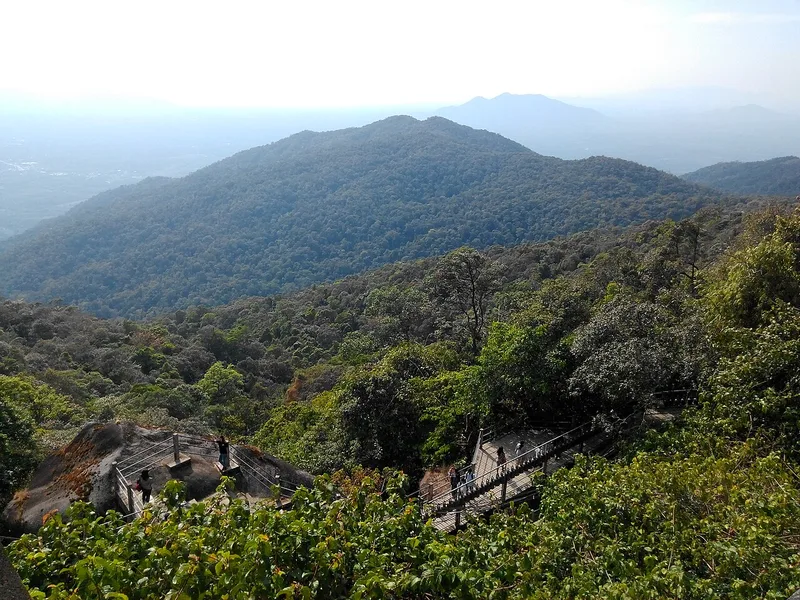
Cardamom Mountains
Kaoh Kong, Cambodia
Why visit Cardamom Mountains?
The Cardamom Mountains (Phnom Krâvanh) sweep across southwest Cambodia from the Thai border to the edge of the Mekong lowlands, forming one of the largest contiguous tracts of rainforest left in mainland Southeast Asia. Within Kaoh Kong (Koh Kong) province, the range rises sharply from the Gulf of Thailand coastline into a tangle of mist-shrouded peaks, river valleys and lowland evergreen forest. The mountains shelter Asian elephants, sun bears, pileated gibbons, clouded leopards, Siamese crocodiles in the upper Areng River and one of the region's last viable populations of Indochinese tigers' former range — though tigers themselves are now considered functionally extinct here. Conservation NGOs (Wildlife Alliance, Fauna & Flora, Conservation International) work alongside the government across a network of protected areas including Botum Sakor National Park, Central Cardamoms Protected Forest and the Southern Cardamom National Park.
The Cardamoms were among the last redoubts of the Khmer Rouge, and the resulting decades of isolation are paradoxically what preserved the forest. Infrastructure remains thin, leeches are a fact of life in the wet months, and unexploded ordnance still scars some old logging tracks — stay on marked paths. The region's character is wild rather than polished: this is the place to come for rivers and rainforest, not nightlife. Most visitors base themselves around the Tatai River (a 30-minute drive east of Koh Kong town), the community ecotourism village of Chi Phat in the southeastern foothills, or the coastal-edge gateway of Koh Kong town itself.
Climate is monsoonal and notoriously wet — the Cardamoms are among the rainiest places in Southeast Asia, with some western slopes recording over 5,000 mm annually. The dry season (November–April) is the practical window for trekking and wildlife trips; rivers are still flowing, leeches are fewer, and roads are passable. May–October brings dramatic waterfalls but also washed-out tracks, cancelled boat trips and persistent rain. February–March offers the most reliable weather.
Planning Cardamom Mountains? Tell us your dates and we’ll tailor the trip.
Ask on WhatsAppHow do you get there?
By Plane
There are no airports inside the Cardamoms. The two practical options are Phnom Penh International (PNH), about 5–6 hours by road, or Sihanoukville International (KOS), about 3–4 hours by road to the Tatai/Koh Kong gateway. From either airport, most lodges arrange private transfers (typically US$120–180 from Phnom Penh, US$80–120 from Sihanoukville).
By Car / Road
National Highway 48 is the spine of access in Kaoh Kong province, running from the Thai border crossing at Hat Lek/Cham Yeam through Koh Kong town and over the Cardamoms to join National Highway 4 north of Sihanoukville. The highway is paved and generally in good condition, with several long bridges over the coastal estuaries (Tatai, Andoung Tuek, Trapeang Roung).
- Phnom Penh to Tatai/Koh Kong: ~270 km, 5–6 hours via NH4 + NH48.
- Sihanoukville to Tatai: ~150 km, 3 hours via NH4 + NH48.
- Bangkok to Koh Kong: Cross at Hat Lek (4–5 hours from Bangkok by bus to Trat, then minivan to the border).
Buses and minivans serve Koh Kong town from Phnom Penh and Sihanoukville (Virak Buntham, Olympic, Larryta operate the routes; tickets roughly US$10–15). For Chi Phat, take any Koh Kong–Phnom Penh bus and ask to be dropped at Andoung Tuek, where boats and motos meet incoming buses for the 90-minute river/road journey to the village.
There is no public transport inside the protected areas. Most travel happens by longtail boat (on the Tatai and Preak Piphot rivers), moto-taxi along forest tracks, or as part of guided lodge programmes. Tuk-tuks are common in Koh Kong town (US$2–4 for a short hop, US$15–20 for a half day) but rare outside it.
For the Tatai area, lodges run scheduled boat shuttles from the NH48 bridge down to their riverside locations. Independent travellers can hire boats at the bridge for around US$10–15 each way. In Chi Phat, the Community-Based Ecotourism (CBET) office in the village centre is the single point for arranging guides, mountain bikes (US$5/day), kayaks and treks — booking through CBET, rather than freelancers, ensures fees support the village conservation fund.
A 4WD or trail bike is essential for any independent forest exploration; standard rental cars cannot handle the interior. Bring cash — there are no ATMs once you leave Koh Kong town or the NH48 corridor.
What are the things to do?
Rivers and waterfalls
- Tatai Waterfall — A wide, multi-tiered cascade on the Tatai River, most dramatic in the wet season but swimmable year-round in the lower pools. Reached by a short boat ride or via a marked turnoff on NH48. Entry around 4,000 KHR (~US$1).
- Tatai River and mangrove estuary — Best seen by kayak or longtail at sunset; the brackish lower river is rich in kingfishers, hornbills and (rarely) Irrawaddy dolphins near the mouth.
- Areng Valley — A remote forested valley west of Chi Phat, home to one of the world's last populations of wild Siamese crocodiles. Visits arranged through Wildlife Alliance partner programmes only.
Protected areas and viewpoints
Southern Cardamom National Park — Cambodia's largest protected forest, encompassing most of the southern range. Access via Chi Phat or via lodge programmes from Tatai.
Botum Sakor National Park — A coastal-cordillera park stretching south from NH48 to the sea. Significant portions have been damaged by concession development, but the northern interior still holds wildlife.
Phnom Aural — Cambodia's highest peak (1,813 m), on the eastern fringe of the range in Kampong Speu province. Multi-day expedition only.
Peam Krasaop Wildlife Sanctuary — Just outside Koh Kong town, a protected mangrove forest with a 600 m elevated boardwalk and observation tower. Entry 5,000 KHR.
Multi-day jungle treks from Chi Phat — The signature experience. CBET offers 1–4 day guided treks staying in hammock camps; expect river crossings, waterfall swims, leech socks and night-time wildlife sounds. Around US$35–55 per person per day inclusive of guide, porter, food and gear.
Kayaking the Tatai River — Half-day paddles upstream from the lodges into narrow forested tributaries; full-day options reach the base of Tatai Waterfall. Most lodges include kayaks for guests.
Wildlife and birdwatching boat trips — Dawn and dusk boat trips from Tatai or Trapeang Roung yield kingfishers, sea eagles, macaques along the bank, and (in season) hornbills.
Mountain biking from Chi Phat — A network of single-track and old logging roads leads to nearby waterfalls (O'Malu, Stung Proat) and bat caves. Day rentals from CBET.
Visit the Wildlife Alliance Wildlife Release Station — Conservation programme partner visits can sometimes be arranged through Shinta Mani Wild and Cardamom Tented Camp; this is hands-off observation, not a "petting" experience.
Mangrove walks at Peam Krasaop — A relaxed half-day from Koh Kong town.
Snorkel and beach day trips — Boat charters from Koh Kong town reach the offshore islands of Koh Kong Krao (largest island in Cambodia, mostly uninhabited) and Koh Por. Around US$25–35 per person on a shared boat.
Planning Cardamom Mountains? Want these on a customised itinerary?
Ask on WhatsAppWhere to eat?
Kaoh Kong's food blends Khmer staples with strong Thai influences from the nearby border and a coastal seafood tradition. Look for kdam chaa (stir-fried Kampot pepper crab — sourced from neighbouring Kampot province but on every Koh Kong menu), amok trei (steamed fish curry in banana leaf), grilled river fish with green-mango salad, and somlar machu (sour soup) made with forest vegetables. Vegetarians will find options at most lodge restaurants but should expect limited choice in village eateries.
- Crab Shack, Koh Kong town — Beachside seafood shack on Koh Yor Beach; fresh grilled fish and crab by the kilo. Mains 25,000–60,000 KHR.
- Café Laurent, Koh Kong — Riverside French-Khmer bistro on the Kah Bpow River; reliable for a proper meal in town. Mains US$6–14.
- Chi Phat CBET community kitchen — Set Khmer meals served at the visitor centre; hearty and inexpensive (US$3–5).
- 4 Rivers Floating Lodge restaurant — Open to non-guests by reservation; modern Khmer cooking on a floating deck above the Tatai. Mains US$10–18.
- Cardamom Tented Camp dining — All-inclusive for guests; evening meals around the fire are part of the experience.
- Shinta Mani Wild's Landing Zone restaurant — Wild-river dining at the foot of the property's signature zip-line arrival. Guests only; meals included in the all-inclusive rate.
Where to drink?
Local drinks lean lightly: Angkor and Cambodia lagers are the standard beers; Tonle Sap Hard Seltzer has appeared more recently. Sombai, a Cambodian rice-spirit infusion (banana, lemongrass-tamarind, anise-coffee) is a popular souvenir bottle; some lodges stock it on the bar. Fresh sugarcane juice (tek ompow) and iced coconut are sold at roadside stalls. Tap water is not potable anywhere in the region — stick to bottled or filtered water; reputable lodges provide refillable filtered water as a single-use-plastic alternative.
For a proper drink, the bars at 4 Rivers, Cardamom Tented Camp and Shinta Mani Wild are the most atmospheric, all set over the river. In Koh Kong town, Café Laurent and a handful of riverside bars on the Kah Bpow promenade are the social hubs.
Planning Cardamom Mountains? We’ll book the stays and dining for you.
Ask on WhatsAppWhere to stay?
Budget
- Chi Phat CBET homestays and guesthouses — Village rooms with shared or private bathroom, booked centrally through the CBET office. Around US$7–15 per night; meals extra. Proceeds support village conservation work.
- Koh Kong City Hotel / Asean Hotel, Koh Kong town — Functional in-town options for travellers transiting to Tatai or the Thai border. Around US$15–25 per night.
Mid-range
- Rainbow Lodge, Tatai River — Small ecolodge with simple river-facing bungalows, family-run with a strong sustainability ethos; rates typically include all meals and boat transfers. Around US$110–160 per night full board.
- Neptune Adventure Lodge, Tatai — Riverside bungalows with a slightly more rustic feel and good value for solo travellers. From around US$60–90 per night.
Upscale / heritage
- 4 Rivers Floating Lodge, Tatai — Floating safari-style tents on the Tatai with private decks; the most established higher-end option in the area. From around US$250–350 per night including meals and boat transfers.
- Cardamom Tented Camp, Botum Sakor — A nine-tent eco-camp run in partnership with Wildlife Alliance deep in the protected forest; rates fund a ranger station. From around US$320–450 per person per night, all-inclusive.
- Shinta Mani Wild, Southern Cardamoms — Bill Bensley-designed luxury tented camp accessed by zip-line over a waterfall; one of Asia's most distinctive properties. From around US$2,600 per tent per night, all-inclusive.
What should you buy?
The Cardamoms are not a shopping destination. Koh Kong town's central market (Psar Leu) is the main place to pick up sarongs, kramas (the chequered Khmer scarf), forest honey from Cardamom community producers, dried peppercorns and small handicrafts. The Chi Phat CBET shop sells locally-made bamboo crafts and rattan baskets where proceeds go to the conservation fund. Bargaining is expected at markets but not in shops; start at around 60–70% of the asking price and meet in the middle. Bring small US-dollar notes and riel — credit cards are accepted only at upscale lodges.
Where to go next?
- Koh Kong Town (~30 min from Tatai) — Provincial capital, gateway to the Hat Lek border with Thailand and to the offshore islands; useful base for a final night.
- Sihanoukville and the southern islands — Koh Rong, Koh Rong Sanloem (~3 hours by road to Sihanoukville, then 45 min by ferry) — White-sand beaches and clear water for a coastal counterpoint to the rainforest.
- Kampot (~4 hours via NH48 + NH3) — Riverside colonial town, pepper plantations, and a relaxed café scene.
- Kep (~4.5 hours) — Quiet seaside retreat famous for its crab market and the colonial-era ruins of Kep National Park.
- Bokor National Park (~4 hours) — A mist-shrouded plateau above Kampot with the eerie ruins of a 1920s French hill station.
- Phnom Penh (~5–6 hours) — Cambodia's capital, with the Royal Palace, National Museum and the sobering Tuol Sleng and Choeung Ek memorials.
Nearby in Kaoh Kong
More places to explore around Cardamom Mountains.
Guide content as of May 2026. Portions adapted from Wikivoyage, CC BY-SA 4.0.

Contact Us
Get in touch with us.
Get in touch
Contact Us
Tell us where you'd like to go and how you like to travel. A real Tripcuro planner — not a bot — will craft an itinerary around you.
- Personalised, hassle-free planning end-to-end
- Transparent pricing, no hidden costs
- 24/7 support for complete peace of mind