
Banteay Chhmar
Banteay Mean Choăy, Cambodia
Why visit Banteay Chhmar?
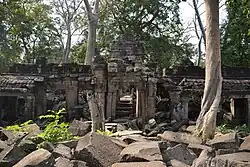
Banteay Chhmar is a small village in the remote northwest of Cambodia, set amid rice fields and scrubland roughly 65 km north of Sisophon and a short distance from the Thai frontier. Its draw is overwhelmingly singular: the sprawling 12th-century temple complex of the same name, built by King Jayavarman VII at the height of the Angkorian empire. Banteay Chhmar Temple and its nine satellites form one of the largest temple ensembles of the era and — alongside the Bayon at Angkor Thom — one of only a handful of sites adorned with the empire's enigmatic four-faced towers. The temple has endured centuries of decay and, in the late 20th century, severe looting; what remains today is a tumbled, jungle-shrouded ruin currently being stabilised under a long-running Global Heritage Fund conservation programme, with Cambodian authorities pushing for UNESCO World Heritage inscription.
What sets Banteay Chhmar apart is the near-total absence of crowds. Fewer than a thousand visitors a year reach the site, and you are very likely to have the bas-reliefs of marching armies, courtly life and the celebrated multi-armed Avalokiteshvara figures of the western gallery entirely to yourself. The village itself is tiny — a market, a moat, a handful of homestays clustered around the temple's outer enclosure — and life here moves to the rhythm of the rice harvest. The Banteay Chhmar Community-Based Tourism (CBT) initiative, run by local villagers, manages almost every aspect of a visitor's stay, from guides and homestays to ox-cart rides and dinners served by candlelight inside the temple itself. In 2010 it won the "Hidden Treasures Cambodia" destination award.
The best time to visit is the cool dry season, roughly November to February, when temperatures are bearable and the road from Sisophon is straightforward. March to May is hot and dusty; the wet season (June–October) brings green countryside but also muddy tracks that complicate trips to outlying temples and the Pol Pot Baray. Important: as of late 2025, border skirmishes have resumed along the Cambodian–Thai frontier, with reports of artillery shelling on civilian facilities. Travellers are advised to avoid all travel within 50 km of the border — a zone that includes Banteay Chhmar. Check your government's current advisory before committing to a trip.
Planning Banteay Chhmar? Tell us your dates and we’ll tailor the trip.
Ask on WhatsAppHow do you get there?
By Car / Road
Banteay Chhmar is most easily reached from Sisophon (Serei Saophoan), 65 km to the south. Sisophon sits at the junction of National Highways 5 and 6 and is a major transit hub linking Siem Reap, Battambang, Phnom Penh and the Thai border at Poipet, so frequent buses and taxis run there throughout the day.
From Sisophon, taxis are the only practical option onward. Find them at Psaar Thmei (New Market) on Highway 56, the road north to Banteay Chhmar; CBT-affiliated taxis bear the CBT logo at this stand.
- Shared taxi: US$5 per person (six passengers — four in back, two in front, plus driver). Pay for two seats if you want extra space.
- Private taxi: US$25.
- Drive time: roughly 1 hour in the dry season; longer in the rains, though the road is rarely closed completely.
If the Sisophon road is impassable, an alternative approach is via Samraong, about 50 km north — a longer but better-surfaced route that also serves the O'Smach/Chong Chom border crossing with Thailand.
Other options from Sisophon:
- Self-drive motorbikes from Golden Crown Guesthouse: US$10/day.
- Motodop (motorbike taxi with driver): US$10–12 — uncomfortable for the distance.
- Tuk-tuk: US$30/day — also not recommended for the journey.
Private taxis and minibuses for groups can be arranged in advance through tour operators or guesthouses in Siem Reap or Phnom Penh; the CBT (☏ +855 97 516 5533 / +855 12 435 660) can advise on these and on onward transport when you leave.
There are no buses to Banteay Chhmar.
Distances are tiny. The village, the main temple and all the homestays are within easy walking distance of one another. Most of the satellite temples can also be reached on foot.
- Bicycles: rented through the CBT for US$1.50/day — perfect for Ta Prohm, Samnang Tasok and the Mebon Baray (600 m from the CBT office).
- Motos with a CBT driver: US$5–10. The CBT does not rent motorbikes directly to visitors, but you can ride pillion with a CBT member — useful for the Pol Pot Baray (3 km north) and Chinchem Trey Temple, both of which are awkward to reach on foot.
- Kuyon (powered farm tractor): hired through the CBT for trips to the barays or out to Banteay Torp Temple — US$15 per group of 10.
- Ox-cart: a 1-hour village circuit, US$10 per group of 4 (more an experience than transport).
There is no ride-hailing app coverage and no metered transport. Prices are fixed by the CBT and posted, so haggling is unnecessary.
What are the things to do?
Temples
- 🛕 Banteay Chhmar Temple — the headline attraction and one of Cambodia's most important Angkorian sites. Built by Jayavarman VII in the late 12th century, it may originally have boasted more than 50 towers within its main enclosure; what remains today is a vast, jungle-clasped ruin with extraordinary bas-reliefs of Khmer domestic and military life. The two surviving multi-armed Avalokiteshvara reliefs on the west gallery are the standouts. Entrance US$5 per person, valid multi-day for all satellite temples and Banteay Torp; children under 12 free.
- 🛕 Ta Prohm Temple — an easy walk just south of the main temple, notable for an excellent four-sided Bayon-style face tower.
- 🛕 Samnang Tasok Temple — about 1 km west of the main temple; reachable on foot or by bicycle. A sizeable satellite, also bearing Bayon-style face towers and almost completely smothered in vines and jungle.
- 🛕 Chinchem Trey Temple — just over 1 km north of Banteay Chhmar Temple; said to look like a "walking giant." Best reached by bicycle or motorbike, and difficult in the rainy season.
Reservoirs (Barays)
- 💧 Mebon Baray — a roughly 1,000 × 1,500 m reservoir built at the same time as the temple to supply the city's inhabitants. Now a protected wetland with good birdlife and a small temple on the central island, reachable in the dry season. 600 m from the CBT office; walk or cycle.
- 💧 Pol Pot Baray (Boeung Cheung Kru) — a sobering counterpoint, dug under brutal forced labour during the Khmer Rouge regime and still a vital water source today. About 3 km north of the village; best by moto, with cycling possible in the dry season.
Crafts and community
🧵 Soieries du Mékong Silk Centre — on Highway 56, about ¾ km from the CBT office. M–F 08:30–12:00 and 13:30–17:00. A working silk-weaving atelier that has trained young women from the area since 2001; products are sold in Siem Reap, Phnom Penh and France. Tours cover the full silk-making process; you can try weaving and buy direct. The affiliated Enfants du Mékong School is next door.
🧭 Temple tour with English-speaking guide — arranged through the CBT and the single best investment of your visit, given how little signage exists on site. US$15 per group (note: source also lists "US$5 per group of 5" — confirm tier when booking).
🎶 Traditional Khmer music performance — a group of local musicians on traditional instruments, often performed inside the temple at night during dinner (weather permitting). US$20 per group.
🌾 Rice flattening — a hands-on demonstration of a traditional preparation technique used for special occasions; you help pound and then taste the result. US$15 per group.
🐂 Ox-cart village tour — a 1-hour amble around Banteay Chhmar village with stops at points of local interest. US$10 per group of 4.
🚜 Kuyon excursion — hire a powered farm tractor for picnics out to the barays or to Banteay Torp Temple. US$15 per group of 10.
🍽️ Dinner inside the temple — arranged through the CBT for a supplement on top of the standard meal price; an unforgettable evening among the ruins, often paired with the traditional music performance.
Planning Banteay Chhmar? Want these on a customised itinerary?
Ask on WhatsAppWhere to eat?
Dining options in Banteay Chhmar are limited by the village's remoteness — whatever the market has that day is what gets cooked. Don't come expecting variety; come expecting honest, home-style Khmer food. The market starts winding down around 17:00, so eat early if you're going it alone, or arrange an evening meal in advance.
- 🍚 CBT Restaurant — the easy default and easily the safest bet. Cooks are trained in food safety and hygiene, and the kitchen handles regular meals as well as picnics and dinners served inside the temple (extra supplement depending on group size, location and transport). Breakfast US$2; lunch and dinner US$4.
- 🍲 Chan Rom Restaurant — in the market area under the big tree across from the moat and taxi stand. No menu — just look in the pots. Basic, generally clean Khmer cooking. US$1.00–2.50. Useful tip: ask Chan Rom to prepare a meal for you to eat later if you'll be out past closing time.
- 🌽 Market stalls — bobor (rice congee), cane juice, grilled corn, Khmer sweets and the more adventurous local snacks (fried crickets, anyone?). Hygiene is variable; portions are tiny and cheap. US$0.50–2.
Where to drink?
There are no bars, nightclubs or karaoke joints in Banteay Chhmar — this is a village that goes to bed soon after the lights go out. Beer (around US$0.50 a can) and soft drinks can be bought at various small shops, and a couple of ice sellers in the market will sell you a block to keep your beverages cold through the evening.
Tap water should not be drunk; bottled water is widely available at the market and from the CBT.
Planning Banteay Chhmar? We’ll book the stays and dining for you.
Ask on WhatsAppWhere to stay?
All accommodation in Banteay Chhmar is booked through the CBT. There are no walk-in hotels or independent guesthouses to compare — reservations are allocated on a rotating basis so that each host gets a fair share of visitors. Electricity runs only 18:00–23:00; flashlights and candles are provided, and there is no air-conditioning anywhere in the village.
Budget
- 🛏️ CBT Homestays — eight family-run homestays with 19 rooms total, each with one double bed, cotton sheets, blankets, pillows and mosquito nets. Six homestays have Western-style toilets and shower heads. A CBT member will accompany you to your assigned house, since none of the host families speak English. US$8–16 per night.
Mid-range
- 🏠 CBT Guesthouses — as of 2025, two guesthouses with a combined 12 rooms operate alongside the homestays, offering a slightly more conventional stay (still booked through the CBT). US$13–20 per room.
Upscale / heritage
- ⛺ Tent in the Temple Compound — the most memorable bed in the village and arguably one of the most singular sleeping experiences in Cambodia: a tent pitched within the Banteay Chhmar Temple compound itself, with lunch, dinner, breakfast and a temple tour included. US$92 per night, booked through the CBT.
What should you buy?
There is no ATM in Banteay Chhmar — the nearest is in Sisophon, so bring cash. US dollars, Thai baht and Khmer riel are all accepted in the market and by the CBT.
The CBT office stocks a small selection of wooden handicrafts (sculptures, candlesticks and the like) made by local villagers; ask if you'd like to see the pieces or visit the craftsmen at their homes and workshops.
The Soieries du Mékong centre on Highway 56 is the best place in town for serious shopping — high-quality handwoven silk scarves and accessories at fair prices, with the proceeds supporting the women's training programme.
The small village market carries everyday necessities — toothpaste, soap, shampoo, very basic medicines — but is not a souvenir destination.
Bargaining is gentle and not really expected at CBT-fixed rates; in the market a polite back-and-forth is normal but prices are already low.
Where to go next?
- 🛕 Banteay Torp Temple — ~12 km south; a smaller, atmospheric Jayavarman VII–era temple covered by your Banteay Chhmar entrance ticket. Easily combined with a kuyon picnic.
- 🚦 Sisophon (Serei Saophoan) — 65 km south, ~1 hour by taxi; the regional transport hub and your gateway in any direction.
- 🛕 Siem Reap & Angkor Archaeological Park — ~170 km southeast via Sisophon; the obvious counterpoint to Banteay Chhmar, with the temples that made the Khmer empire's architecture famous.
- 🏛️ Battambang — ~110 km south of Sisophon; Cambodia's atmospheric "second city," known for its colonial-era shophouses, art scene and bamboo train.
- 🌾 Samraong (Oddar Meanchey) — ~50 km north; quiet provincial capital and an alternative jumping-off point for the O'Smach/Chong Chom border crossing with Thailand.
- 🇹🇭 Poipet (Thai border) — ~50 km west of Sisophon; the busiest land crossing into Thailand, useful if you're continuing to Aranyaprathet and onward to Bangkok. Note: heed current border-region advisories before travelling this way.
Nearby in Banteay Mean Choăy
More places to explore around Banteay Chhmar.
Guide content as of May 2026. Portions adapted from Wikivoyage, CC BY-SA 4.0.

Contact Us
Get in touch with us.
Get in touch
Contact Us
Tell us where you'd like to go and how you like to travel. A real Tripcuro planner — not a bot — will craft an itinerary around you.
- Personalised, hassle-free planning end-to-end
- Transparent pricing, no hidden costs
- 24/7 support for complete peace of mind