
Port Arthur
Tasmania, Australia
Why visit Port Arthur?
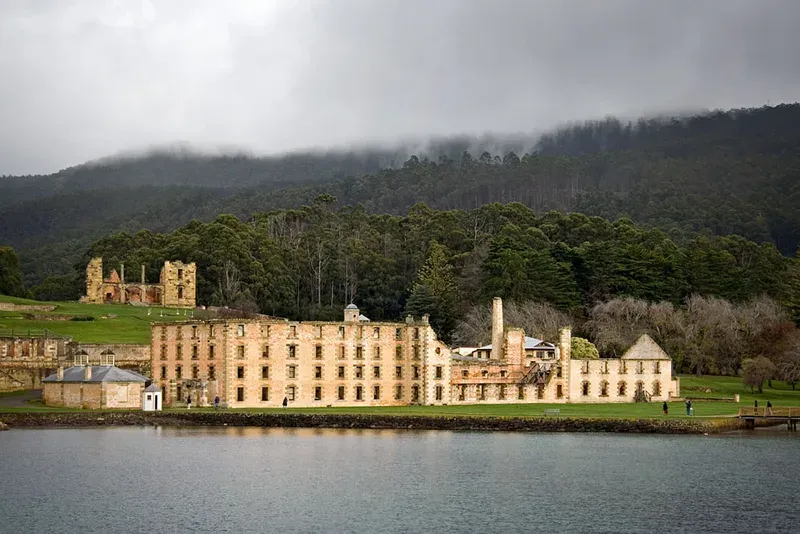
Port Arthur sits at the southern end of the Tasman Peninsula, about 95 km southeast of Hobart, and is one of Australia's most significant — and most haunting — heritage destinations. Between 1830 and 1877 it operated as a secondary penal settlement for British convicts who had reoffended after transportation, and the surviving sandstone ruins, prison block, hospital, church, and Separate Prison make up the Port Arthur Historic Site, inscribed on the UNESCO World Heritage List in 2010 as part of the Australian Convict Sites. The site is also remembered as the location of the April 1996 mass shooting, after which Australia overhauled its firearms laws; a quiet memorial garden marks the former Broad Arrow Café.
Beyond the historic site, Port Arthur is a tiny settlement of a few hundred residents surrounded by dramatic coastline, eucalypt forest, and the sheltered waters of Carnarvon Bay and Mason Cove. The pace is slow, the buildings are low, and most visitors arrive as day-trippers from Hobart — though staying overnight rewards you with quieter ruins late in the afternoon and the option of an evening Ghost Tour.
Climate is cool-temperate maritime. Summer (December–February) is the best window, with long daylight, milder temperatures, and most tours operating; winter (June–August) is cold, wet, and often windy, but the site is open year-round and far less crowded. Bring layers in any season — weather on the peninsula can flip from sun to squall within an hour.
Planning Port Arthur? Tell us your dates and we’ll tailor the trip.
Ask on WhatsAppHow do you get there?
By Plane
The nearest airport is Hobart International Airport (HBA), near Cambridge, about 75 km (roughly a 1-hour drive) northwest of Port Arthur. Hobart has direct flights from Melbourne, Sydney, Brisbane, and seasonally other Australian capitals. From the airport, the practical options are hire car (all major rental desks on site) or a pre-booked shuttle/tour transfer; there is no scheduled public bus from the airport directly to Port Arthur.
By Car / Road
Driving is by far the most common way in. From Hobart, take the Tasman Highway (A3) east, then the Arthur Highway (A9) south through Sorell, Dunalley, and Eaglehawk Neck to Port Arthur — about 95 km and 1 hr 30 min in normal conditions on sealed two-lane highway. From Launceston, allow around 3 hr 30 min (roughly 300 km) via the Midland Highway (1) and Hobart.
The drive itself is part of the experience: the Arthur Highway crosses the narrow Eaglehawk Neck isthmus, with worthwhile short detours to the Tessellated Pavement, Tasmans Arch, Devils Kitchen, and the Blowhole. Watch for wildlife (wallabies, pademelons, and Tasmanian devils) on the road around dawn and dusk, and refuel in Sorell or Nubeena rather than relying on Port Arthur itself.
Scheduled coach services from Hobart to Port Arthur are operated by tour and shuttle companies; day-tour bus packages that include site admission are widely available from Hobart hotels.
Port Arthur township is tiny and walkable — the historic site itself is essentially the destination, and within its grounds you walk between ruins (allow a full half-day minimum). For visiting outlying sights on the Tasman Peninsula (Eaglehawk Neck, Remarkable Cave, Tasman National Park trailheads, Coal Mines Historic Site), you really need a car: there is no local bus network, and ride-hailing apps (Uber, DiDi) do not operate on the peninsula.
Taxis exist but are limited and should be pre-booked. Roads are sealed and generally easy driving, though some short side roads to lookouts (e.g. the road to Remarkable Cave) are narrow. There are no autorickshaws or tuk-tuks; this is regional Australia, not Southeast Asia. Fuel up before leaving Sorell if you can.
What are the things to do?
Port Arthur Historic Site — the main event. More than 30 buildings, ruins, and restored homes spread across a landscaped harbourside site, including the Penitentiary, Separate Prison, Convict Church, Commandant's House, and Government Cottage. Standard admission includes a guided introductory walking tour and a short harbour cruise past the Isle of the Dead and Point Puer boys' prison. Plan a minimum of 4–5 hours; tickets are valid for two consecutive days. Memorial Garden for the 1996 victims is on-site and treated with quiet respect — photography of the memorial is discouraged.
Isle of the Dead — small island in the harbour used as the settlement's cemetery; more than 1,000 convicts, soldiers, and free people are buried here. Visited only on guided tours that depart from the Port Arthur jetty as an add-on to standard admission.
Point Puer Boys' Prison — across the bay, the first purpose-built juvenile reformatory in the British Empire (1834–1849). Also visited on a separate guided tour.
Coal Mines Historic Site — Plunkett Point, about 35 km north of Port Arthur via Premaydena. The peninsula's other (and earlier) penal punishment station, set in haunting bushland ruins. Free entry, self-guided, much quieter than the main site.
Tessellated Pavement — Lufra, Eaglehawk Neck. A flat coastal rock platform fractured into a near-perfect grid by natural weathering. Best at low tide. Free.
Tasmans Arch, Devils Kitchen, and the Blowhole — three dramatic sea-cliff formations clustered near Eaglehawk Neck, all reachable from short, signposted car parks. Free.
Remarkable Cave — south of Port Arthur near Safety Cove. A sea cave with a double-mouth shaped, depending who you ask, like Tasmania itself. Wooden staircase down from the car park; free.
Port Arthur Ghost Tour — lantern-lit evening walking tour through the ruins, run nightly by the Historic Site. Genuinely atmospheric; book ahead, especially in peak season. Around 90 minutes.
Harbour cruise — the short cruise included with general admission is fine; longer specialist cruises occasionally run for sunset and photography.
Three Capes Track — a multi-day, hut-based walk (around 48 km, 4 days/3 nights) operated by Tasmania Parks and Wildlife Service across Tasman National Park, with cliff-top views from Cape Pillar and Cape Hauy. Highly popular, capped numbers, and must be booked well in advance.
Short walks in Tasman National Park — day options include Cape Hauy (from Fortescue Bay, around 4 hr return) and Waterfall Bay clifftop walks.
Tasman Island Cruises — three-hour eco-cruise along the towering dolerite sea cliffs between Eaglehawk Neck and Tasman Island, with chances to see seals, dolphins, albatross, and occasionally migrating whales. Departs Eaglehawk Neck (Pirates Bay).
Tahune-style scenic flights and sea-kayaking — small operators run on the peninsula seasonally.
Unzoo (Tasmanian Devil Unzoo), Taranna — open-range native wildlife sanctuary about 12 km north of Port Arthur, focused on Tasmanian devils, quolls, and birds, with conservation programmes for devil facial tumour disease.
Planning Port Arthur? Want these on a customised itinerary?
Ask on WhatsAppWhere to eat?
Tasmanian food culture leans hard on local produce: cool-climate seafood (especially oysters, scallops, abalone, Atlantic salmon, and rock lobster), grass-fed beef and lamb, berries, apples, and an outsized craft food and drink scene for the population. On the peninsula itself, options are limited — most sit-down meals are at the Historic Site, on-site lodges, or in Nubeena. Vegetarian options are standard at most venues; ask ahead for gluten-free and strict dietary requirements as some smaller kitchens have limited substitutions.
- Felons Bistro & Bar (Port Arthur Historic Site) — modern Tasmanian menu using peninsula and Tasmanian produce; the most convenient sit-down dinner if you're staying nearby or on a Ghost Tour. Mid-range.
- 1830 Restaurant & Bar (Port Arthur Historic Site) — casual all-day café-style menu by the visitor centre. Budget to mid-range.
- Lucky Ducks Café, Nubeena — relaxed café for breakfast, lunch, and coffee in the peninsula's main town. Budget.
- The Cubed Espresso Bar, Eaglehawk Neck — coffee, light meals, and a useful stop on the drive in or out. Budget.
- Doo-lishus, Eaglehawk Neck — long-running food caravan near the Blowhole famous for fish and chips and scallop pies. Budget.
- Bangor Vineyard Shed, Dunalley — about 35 km north of Port Arthur, a working vineyard and oyster farm with a casual restaurant serving estate wines, Dunalley Bay oysters, and platters. Mid-range; book ahead in summer.
Where to drink?
Tasmania punches far above its weight on drinks. The state is internationally regarded for cool-climate Pinot Noir, Chardonnay, sparkling, and Riesling, and for a craft whisky scene that began with Lark Distillery in Hobart and now includes dozens of producers. Local craft beer, cider (Tasmania grows a large share of Australia's apples), and gin are easy to find on most menus. Coffee is taken seriously — even small cafés on the peninsula pull respectable espresso.
On the peninsula, the two bars at the Port Arthur Historic Site (Felons and the 1830 bar) are the obvious evening options if you're not driving back to Hobart. McHenry Distillery, near Port Arthur, is Australia's southernmost whisky and gin distillery and runs tastings — call ahead. For wine, Bangor Vineyard Shed in Dunalley is the closest cellar door.
Tap water is safe to drink throughout Tasmania, including Port Arthur, and is generally excellent. There is no need for bottled water on health grounds.
Planning Port Arthur? We’ll book the stays and dining for you.
Ask on WhatsAppWhere to stay?
- Budget
- NRMA Port Arthur Holiday Park, Garden Point — powered and unpowered campsites, cabins, and basic units a short drive from the Historic Site; popular with families and road-trippers. Approx. AUD 35–60 for an unpowered site, AUD 130+ for a basic cabin in peak season.
- Roseview Cottage / B&Bs around Nubeena and Taranna — small owner-run guesthouses, often the cheapest non-camping option. From around AUD 130–170 a night.
- Mid-range
- Stewarts Bay Lodge — self-contained timber cabins set in bush right on Stewarts Bay, a short walk from the Historic Site. Typically AUD 200–320 a night depending on cabin and season.
- Port Arthur Motor Inn — straightforward motel rooms above the Historic Site with views over the ruins and bay. Typically AUD 180–260 a night.
- Upscale / heritage
- Lufra Hotel, Eaglehawk Neck — historic 1880s hotel above Pirates Bay, refurbished, with restaurant and bar; the closest thing to a heritage stay on the peninsula. Typically AUD 250–400 a night.
- Cascades Colonial Accommodation, Koonya — restored 1840s convict-station cottages converted to self-contained heritage stays, north of Port Arthur. Typically AUD 250–350 a night.
What should you buy?
Port Arthur is not a shopping destination. The Historic Site's visitor centre has a well-stocked bookshop covering Australian convict history, biographies of named prisoners, and Tasmanian natural history, plus the usual souvenirs (Tasmanian devil plush, prints, postcards). For groceries, fuel, and basics, the nearest small supermarket and general stores are in Nubeena (about 20 km west, the largest town on the peninsula) and Sorell on the way back toward Hobart.
For Tasmanian specialty produce — leatherwood honey, Tasmanian whisky, cool-climate wines, woollens, Huon pine and sassafras woodcraft — you'll find a better selection in Hobart's Salamanca Market (Saturdays) than on the peninsula itself. Prices are fixed; bargaining is not part of Australian retail culture.
Where to go next?
- Hobart (95 km / 1 hr 30 min northwest) — Tasmania's capital; Salamanca Market, MONA, Mount Wellington/kunanyi, and the gateway for onward travel.
- Eaglehawk Neck (20 km / 20 min north) — Tessellated Pavement, Tasmans Arch, Devils Kitchen, the Blowhole, and the launch point for Tasman Island Cruises; easy half-day on the way back to Hobart.
- Tasman National Park / Fortescue Bay (about 40 km / 50 min by road) — base for the Cape Hauy day walk and the multi-day Three Capes Track.
- Maria Island (ferry from Triabunna, about 2 hr 30 min drive north of Port Arthur) — car-free former convict probation station turned national park, famous for wombats, Cape Barren geese, and the Painted Cliffs.
- Bruny Island (around 2 hr 30 min via Hobart and the Kettering ferry) — wildlife cruises, oysters, cheese, whisky, and dramatic coastal scenery.
- Freycinet National Park / Wineglass Bay (about 3 hr 30 min north) — pink-granite peaks, white-sand beaches, and one of Tasmania's iconic coastal walks; better as part of an east-coast loop than a day trip.
Nearby in Tasmania
More places to explore around Port Arthur.
Guide content as of May 2026. Portions adapted from Wikivoyage, CC BY-SA 4.0.

Contact Us
Get in touch with us.
Get in touch
Contact Us
Tell us where you'd like to go and how you like to travel. A real Tripcuro planner — not a bot — will craft an itinerary around you.
- Personalised, hassle-free planning end-to-end
- Transparent pricing, no hidden costs
- 24/7 support for complete peace of mind