
Richmond
Tasmania, Australia
Why visit Richmond?
Richmond is a small Georgian-era village about 25 km northeast of Hobart, set in the rolling Coal River Valley of southeastern Tasmania. With a population of roughly 900, it feels less like a town than a remarkably preserved colonial streetscape: sandstone cottages, weatherboard shopfronts, and a working farm-and-vineyard hinterland that has changed slowly since the 1830s. Founded in 1824 as a strategic military post and convict station on the route between Hobart and Port Arthur, Richmond was for a time the colony's third-largest settlement. When the causeway across the Derwent at Sorell was completed in 1872 the through-traffic vanished overnight, and the town was effectively pickled — which is why so much of its early architecture survives intact today.
The headline attractions are old, stone, and convict-built. Richmond Bridge (1823–1825) is the oldest stone arch bridge still in use in Australia. Richmond Gaol (1825) predates Port Arthur and is the oldest intact gaol in the country. St John's Catholic Church (1837) is reckoned to be the oldest Catholic church still in continuous use in Australia. Around them, a tight grid of antique shops, bakeries, galleries, and tearooms has grown up to serve the day-trip trade out of Hobart, while the surrounding Coal River Valley has emerged in the last two decades as one of Tasmania's most respected cool-climate wine regions, producing especially fine Pinot Noir, Chardonnay, and Riesling.
Climate is cool-temperate maritime. Summer (December–February) is the peak, with daytime highs typically 20–25 °C, long evenings, and cellar doors at full tilt — book accommodation well ahead. Autumn (March–May) is arguably the loveliest season: cool, golden, and aligned with the wine harvest. Winter (June–August) is crisp and quiet, with frosts, occasional clear-sky highs around 10–12 °C, and many properties keeping shorter hours. Spring (September–November) is changeable but green. Rain is light and spread across the year; Richmond sits in one of the drier pockets of southern Tasmania.
Planning Richmond? Tell us your dates and we’ll tailor the trip.
Ask on WhatsAppHow do you get there?
By Plane
The nearest airport is Hobart Airport (HBA) at Cambridge, only about 15 km south of Richmond — closer to the village than Hobart's city centre is. It is served by Qantas, Virgin Australia, Jetstar, and Rex from Melbourne, Sydney, Brisbane, and (seasonally) Adelaide and the Gold Coast. There is no direct public bus from the airport to Richmond; the practical options are:
- Taxi or rideshare (Uber operates in Hobart): roughly 15–20 minutes to Richmond, expect around AUD $40–55.
- Hire car: all major rental desks (Hertz, Avis, Budget, Europcar, Thrifty) are at the terminal. A car is by far the most useful way to explore Richmond and the Coal River Valley.
Hobart's CBD is about 25 km southwest of Richmond, roughly a 30-minute drive via the Tasman Highway and Cambridge Road.
By Car / Road
Driving is the standard way to reach Richmond.
- From Hobart CBD: ~25 km, 30 minutes via the Tasman Highway (A3) and Cambridge Road (B31). The route is sealed dual-carriageway as far as Cambridge, then a pleasant rural two-lane road.
- From Hobart Airport: ~15 km, 15–20 minutes via Cambridge and the B31.
- From Port Arthur: ~85 km, around 1 hour 15 minutes via the Arthur Highway (A9) and Sorell.
- From Launceston: ~175 km, about 2 hours 15 minutes via the Midland Highway (1) and Brighton.
The roads are well-maintained and signposted; watch for wildlife (especially wallabies and pademelons) at dawn and dusk, and for cyclists on the rural stretches.
Bus: Tassielink and Derwent Valley Link historically run limited weekday services from Hobart to Richmond via Cambridge. Frequencies are low (typically a couple of services per day, weekdays only) and timetables shift seasonally — check the current Transport Tasmania timetable before relying on this option. Several Hobart-based operators (Gray Line, Under Down Under, Tours Tasmania) also run half-day Richmond coach tours.
Richmond's historic core is genuinely compact: from Richmond Bridge at the south end of Bridge Street to St John's Church and the Gaol you are walking maybe ten minutes end to end, on flat ground. Most visitors park once (free roadside parking is generally available on Bridge Street and the side streets, with a small public car park beside the bridge) and explore on foot.
For the surrounding wine country, however, you will want a car or a tour. The Coal River Valley cellar doors are spread across 10–20 km of country roads, and there is no public transport between them. Options:
- Self-drive with a designated driver — straightforward but limits tasting.
- Wine tours from Hobart: operators such as Drink Tasmania, Tours Tasmania, and Pennicott Wilderness Journeys' Coal River Valley day trips include pickup, several cellar doors, and lunch (typically AUD $180–280 per person).
- Taxi / rideshare: Uber coverage out to Richmond is patchy and surcharged; pre-book a Hobart taxi for round trips.
Cycling the Coal River Valley is increasingly popular — the terrain is gentle and the roads quiet — and a couple of Hobart operators rent bikes and run guided rides.
What are the things to do?
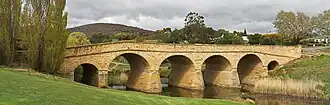
Richmond Bridge — The oldest stone arch bridge still in use in Australia, completed by convict labour in 1825 from sandstone quarried locally. Six graceful arches spanning the Coal River, photogenic from the parkland on either bank. Open: always; free.
Richmond Gaol — 37 Bathurst St. The oldest intact gaol in Australia, built 1825 and preceding Port Arthur by five years. Self-guided tour through cells, the women's room, the solitary cells, and the flogging yard, with strong interpretive panels on convict life. Open daily 9am–5pm; adult entry around AUD $15.
St John the Evangelist Catholic Church — St Johns Circle. Consecrated 1837 and considered the oldest Catholic church still in continuous use in Australia. Quietly beautiful sandstone interior; usually open during daylight hours, free (donations welcomed).
Old Hobart Town Historic Model Village — 21A Bridge St. A 1:16 scale outdoor model of Hobart Town as it stood in the 1820s, painstakingly built from local materials. More charming than it sounds — children love it. Open daily; adult entry around AUD $17.
Richmond Maze — 13 Bridge St. A hedge maze and tearoom in the centre of the village, popular with families. Open most days; small entry fee.
Pooley Wines — 1431 Richmond Rd. Cellar door set in a beautifully restored 1830s sandstone homestead (Belmont House); one of Tasmania's benchmark Pinot Noir and Riesling producers. Open daily 10am–5pm; tasting fee redeemable on purchase.
Frogmore Creek Wines — 20 Denholms Rd, Cambridge. Large modern cellar door and restaurant overlooking vineyards on the way back toward Hobart; reliable Pinot, Chardonnay, and a notable botrytis Riesling. Open daily for tastings and lunch.
Bonorong Wildlife Sanctuary — 593 Briggs Rd, Brighton (about 15 minutes north of Richmond). Tasmania's leading wildlife rescue and rehabilitation centre, with Tasmanian devils, wombats, quolls, and free-range kangaroos. Open daily 9am–5pm; adult entry around AUD $39.50.
ZooDoo Zoofari — 620 Middle Tea Tree Rd, Tea Tree (about 15 minutes from Richmond). Family-oriented wildlife park with a safari bus tour through paddocks of camels, zebras, deer, and ostriches, plus Tasmanian devils. Open daily 9am–5pm; adult entry around AUD $42.
Walk the village heritage circuit. A self-guided 1–2 hour loop links the Bridge, the Gaol, St John's, the Catholic and Anglican cemeteries, the Courthouse (1825), the Postmaster's Residence, and the Bridge Inn. The Richmond Visitor Centre on Bridge Street stocks a free heritage walk map.
Cellar-door crawl through the Coal River Valley. The valley's calling card. Beyond Pooley and Frogmore Creek, look for Puddleduck Vineyard (relaxed family-run cellar door with picnic platters), Domaine A (long-respected cool-climate Cabernet and Sauvignon Blanc), Craigow (Riesling specialist), and Stefano Lubiana (biodynamic, on the Derwent — slightly further afield but exceptional). Plan four cellar doors maximum in a day; many close around 4–5pm.
Coal River Valley produce loop. Combine wine with Coal River Farm (handmade chocolate, cheese, and a hilltop café), Wicked Cheese Company at Cambridge (artisan cheese tastings), and seasonal pick-your-own at one of the valley's berry farms.
Picnic by Richmond Bridge. The grassed banks of the Coal River on either side of the bridge are made for a slow lunch with a bottle of local Pinot. Watch for the resident platypus colony at dawn or dusk in the river immediately upstream of the bridge — patience required, but sightings are not unusual.
Day-trip to the Tasman Peninsula. With an early start, Richmond is a workable base for Port Arthur Historic Site, the Tessellated Pavement at Eaglehawk Neck, and the dolerite sea cliffs at Cape Raoul (about 1 hour to Port Arthur each way).
Antiques and galleries on Bridge Street. Half a dozen shops along the main street trade in colonial furniture, Tasmanian art, prints, and oddments. Pleasant browsing on a wet afternoon.
Planning Richmond? Want these on a customised itinerary?
Ask on WhatsAppWhere to eat?
Richmond's eating scene is unmistakably a tourist-village one — heavy on cafés, tearooms, and pub lunches — but it is genuinely good, leaning on the produce of the surrounding farms, dairies, and vineyards. Tasmanian seafood (oysters from nearby Pittwater, Atlantic salmon, scallops), grass-fed Coal River Valley lamb and beef, and locally grown berries appear on most menus in season. Vegetarian options are standard; gluten-free is widely catered for; halal and kosher certification is rare and best not assumed.
- Richmond Bakery — 50 Bridge St. The institution: scallop pies, curried scallop pies, sausage rolls, sourdough, and a constant queue at lunchtime. Cash-and-card, around AUD $7–12 for a pie and a coffee. Open daily from early morning.
- Czegs Café — 51 Bridge St. Big breakfasts, generous brunches, good coffee, and friendly staff. Mains around AUD $20–28.
- Ashmore on Bridge Street — café and tearoom in a heritage cottage with a courtyard garden; good for cake and a pot of tea after the Gaol visit.
- Richmond Arms Hotel — 42 Bridge St. The classic country pub option: schnitzels, Tasmanian steaks, fish and chips, local beers on tap. Mains around AUD $26–38. Book on weekends.
- Frogmore Creek Restaurant — 20 Denholms Rd, Cambridge (10 minutes from Richmond). Vineyard restaurant with a daily-changing menu built around Coal River Valley produce; one of the better lunch experiences near Hobart. Two courses around AUD $80–95; book ahead.
- Pooley Wines tasting platters — 1431 Richmond Rd. Cheese and charcuterie boards in the historic homestead; pairs naturally with a flight of their Rieslings and Pinots.
Where to drink?
Coal River Valley wines are the obvious headline — Pinot Noir, Chardonnay, Riesling, and increasingly fine sparkling and Pinot Gris — and the easiest way to drink them is at the cellar doors, where tasting fees of AUD $5–15 are typically waived with purchase. Belgrove Distillery (3 Bushy Park Rd, Kempton, about 30 minutes from Richmond) is one of Australia's pioneer paddock-to-bottle rye whisky makers and worth the detour for whisky people; tastings by appointment. Coal Valley Brewing Co. at Cambridge produces Tasmanian craft beer and runs a small taproom.
In the village itself, the Richmond Arms Hotel is the natural evening anchor — a sandstone country pub (1888) with Cascade and Boag's on tap, plus a rotating handful of Tasmanian craft beers. The bar at the Prospect House Private Hotel (a Georgian manor on the village edge) is a quieter, more old-fashioned alternative for a glass of Tasmanian Pinot before dinner.
Tasmanian tap water is excellent and safe to drink everywhere in and around Richmond. Coffee culture is strong; expect Melbourne-standard espresso at any of the village cafés.
Planning Richmond? We’ll book the stays and dining for you.
Ask on WhatsAppWhere to stay?
Richmond punches well above its weight for boutique and heritage accommodation, much of it in restored 1830s–1840s sandstone cottages. Book months ahead for summer, especially weekends.
Budget
- Richmond Cabin & Tourist Park — Middle Tea Tree Rd. Self-contained cabins and powered sites about 5 minutes from the village. Cabins from around AUD $130–170 per night.
Mid-range
- Richmond Arms Hotel accommodation — 42 Bridge St. Comfortable pub-style rooms above and behind the hotel, in the centre of the village. Doubles typically AUD $160–220 per night.
- Richmond Colonial Accommodation — a portfolio of restored 1830s self-contained cottages (including Hatcher's Manor and Daisy Bank Cottages) scattered around the village. Doubles typically AUD $200–290 per night, often with breakfast provisions provided.
Upscale / heritage
- Prospect House Private Hotel — 1384 Richmond Rd. A two-storey 1830s Georgian manor on the edge of the village, set in landscaped gardens, with individually decorated rooms and a well-regarded restaurant. Doubles typically AUD $260–380 per night.
- Red Brier Cottage and Mrs Currie's House — among the most polished of the Richmond heritage cottage stays, both fully self-contained sandstone properties in the village core. Typically AUD $280–400 per night.
What should you buy?
Bridge Street and a few of its tributaries are the entire shopping district, and that is the appeal. Look for:
- Tasmanian wine straight from the cellar door — lighter to carry home than you think, and many producers will arrange interstate or international shipping.
- Tasmanian cheese, honey, leatherwood honey, and chocolate from Coal River Farm and Wicked Cheese.
- Sourdough and pies from Richmond Bakery — buy for the picnic, not the suitcase.
- Tasmanian-made woollens and sheepskin — several gift shops along Bridge Street stock pieces from local makers.
- Antiques and colonial-era prints — small but genuine specialist shops; prices reflect a tourist village, so haggling is unusual but politely asking about a "best price" on larger items is fine.
- Tasmanian whisky — a couple of Bridge Street bottle shops and providores carry releases from Sullivans Cove, Lark, Overeem, and the Coal River Valley's own Belgrove Distillery (rye whisky, 4 km from the village).
ATMs are limited; cards are universally accepted. Most shops keep tourist hours (roughly 10am–5pm), and many close one day a week — typically Tuesday or Wednesday.
Where to go next?
- Hobart — 25 km / 30 minutes. Tasmania's capital: MONA, Salamanca Market (Saturdays), Battery Point, kunanyi/Mount Wellington.
- Port Arthur Historic Site — 85 km / 1 hour 15 minutes. The most evocative convict site in Australia, on the Tasman Peninsula; a natural pairing with Richmond's gaol.
- Tasman Peninsula coastline — 75–95 km / 1 to 1.5 hours. Tessellated Pavement, Tasman Arch, Devils Kitchen, and the spectacular dolerite cliffs at Cape Raoul and Cape Hauy.
- Maria Island National Park — Triabunna ferry terminal is 60 km / 50 minutes; ferry crossing 30 minutes. Car-free island of wombats, painted cliffs, and convict ruins at Darlington.
- Freycinet National Park (Wineglass Bay) — 175 km / 2 hours 30 minutes. Pink-granite peninsula and one of the most photographed beaches in Australia; an early start makes it a long day trip, an overnight is better.
- Bothwell and the Central Highlands — 75 km / 1 hour. Historic Georgian village, Australia's oldest golf course, and the gateway to the Highland Lakes trout fishery.
Nearby in Tasmania
More places to explore around Richmond.

Guide content as of May 2026. Portions adapted from Wikivoyage, CC BY-SA 4.0.

Contact Us
Get in touch with us.
Get in touch
Contact Us
Tell us where you'd like to go and how you like to travel. A real Tripcuro planner — not a bot — will craft an itinerary around you.
- Personalised, hassle-free planning end-to-end
- Transparent pricing, no hidden costs
- 24/7 support for complete peace of mind