
Devonport
Tasmania, Australia
Why visit Devonport?
Devonport is Tasmania's third-largest city and the daily landing point for the Spirit of Tasmania ferry from Geelong, which gives this town of around 25,000 people an outsized role in the state's tourism economy. Most visitors pass through on their way to Cradle Mountain or Launceston, but the town itself rewards a day or two: a working port wrapped around the Mersey River, with the basalt headland of Mersey Bluff and its red-and-white striped lighthouse anchoring a string of beaches, bush reserves and a walkable colonial-era centre. The town splits neatly into West Devonport (the CBD, sitting between the Don and Mersey rivers, where almost everything you'd want to see or eat is located) and East Devonport (where the ferry terminal is — a long road-bridge walk from town, so plan transport if you arrive on foot).
Devonport sits on Tasmania's North West coast and, together with Ulverstone, Latrobe, Wynyard and Burnie, forms the "Cradle Coast" region. The climate is cool-temperate and maritime: summers (Dec-Feb) are mild and the most reliable time to visit, with long evenings ideal for the Bluff and the beaches; winters (Jun-Aug) are wet, windy and cold but rarely freezing at sea level, and ferry crossings can be rough across the Bass Strait. Shoulder seasons (Oct-Nov, Mar-Apr) are quieter but cheaper, with the trade-off that some attractions cut their hours.
The town's character is unpretentious — a port and farming-service town that happens to be a gateway — and that's part of the appeal: you get genuine Tasmanian seafood, a relaxed CBD you can cross on foot in fifteen minutes, and quick access (under 90 minutes by car) to one of Australia's most-photographed wilderness areas at Cradle Mountain-Lake St Clair National Park.
Planning Devonport? Tell us your dates and we’ll tailor the trip.
Ask on WhatsAppHow do you get there?
By Plane
Devonport Airport (DPO) sits 8 km east of the town centre. It's a small regional facility served principally by QantasLink, with up to six daily flights connecting via Melbourne's Tullamarine Airport. Local operator Tasair runs passenger and cargo services to King Island.
- Taxi to the CBD: approximately A$20.
- Taste the Tiers Tours runs a shuttle between airport and town centre from A$10 per person one-way.
- Major car rental agencies have desks at the airport — often the most practical option given onward travel to Cradle Mountain.
By Car / Road
Devonport is on the Bass Highway along Tasmania's north coast, with good sealed roads in all directions.
- Launceston — 100 km / about 1 hr via the Bass Hwy.
- Burnie — 46 km / about 30 min.
- Cradle Mountain — 88 km / about 1 hr 20 min.
- Hobart — 277 km / about 3 hr via the Midland Hwy (the standard route); the Lake Hwy alternative is 251 km / 3½ hr but includes gravel sections and can ice over in winter.
- Strahan (West Coast) — 208 km / about 3 hr.
- Freycinet National Park — 254 km / about 3 hr.
- Port Arthur — 335 km / about 4½ hr.
By bus: Tassielink runs a Mon-Sat coach from Hobart via Launceston. Kinetic (formerly Redline Coaches) operates roughly twice-daily services from Hobart.
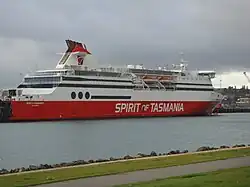
By ship: the Spirit of Tasmania I and II sail the Geelong-Devonport route nightly year-round (depart 8 PM, arrive 7 AM), with additional daytime sailings (9 AM-6 PM) and overnight crossings (9 PM-6 AM) during peak season. Boarding closes 45 minutes before departure. Cars cost around A$65 each way (federally subsidised), motorbikes A$45, bicycles A$7. A seat runs A$120-180 depending on season; the cheapest cabin A$170-280 per person. There are buffet and à-la-carte restaurants, bars, a cinema, summer live music, an onboard shop and a working phone. Telstra is the only mobile/data network at sea. The ferry docks in East Devonport — during weekdays 7 AM-5:30 PM and Saturday 9 AM-5 PM, the small Torquay Ferry crosses directly to the CBD for A$3 (as of Feb 2019); outside those hours plan on a taxi or the long road-bridge walk.
The CBD is small and flat — walking is the best way to see it. The bluff and lighthouse are a pleasant 30-minute walk from the centre along the foreshore.
- Merseylink runs a more comprehensive bus network than you'd expect for a town this size, including a route to East Devonport roughly every two hours on weekdays — but it doesn't directly serve the ferry terminal, so check timetables in advance. It's not a turn-up-and-go service.
- Cycling: an off-road cycleway follows the waterfront out to the lighthouse. The catch is that the East Devonport section is cut off from the West Devonport section now that the passenger ferry no longer connects them — to link the two you'd need to ride the narrow path beside the freeway bridge.
- Rental cars are available at the ferry wharf and the airport; this is the most practical option if you're continuing to Cradle Mountain or anywhere off the Bass Highway.
- Taxis are easy to phone for and reasonably priced — figure on A$20 for most cross-town trips, more for the airport.
What are the things to do?
Mersey Bluff Lighthouse — Devonport's signature view, a red-and-white striped lighthouse atop a basalt headland with sweeping Bass Strait panoramas. The headland is also a penguin-viewing area (best near dusk in the warmer months). Free; open access.
Bass Strait Maritime Centre, 6 Gloucester Avenue — Tells the story of Bass Strait through European exploration, shipwrecks, settlement and trade. Daily 10 AM-5 PM (closed Christmas Day and Good Friday). Adults A$10, concession A$8, children A$5, family A$25.
Tiagarra Aboriginal Cultural Centre — Museum of Tasmanian Aboriginal history with a short nature trail leading to rock formations (long mistakenly identified as carvings) near the bluff.
Don Village and Don River Railway — Vintage steam-train rides and a pioneer-era museum just west of town. A nostalgic stop and the closest thing Tasmania has to a working passenger train.
Mersey Bluff and the beaches — The headland fronts a chain of pleasant swimming and walking beaches. The foreshore cycleway/walking path connects most of them to the CBD.
Walk to the Bluff — The foreshore path from the CBD to Mersey Bluff Lighthouse (30+ min one way) is the local rite of passage, taking in beaches, the Don Reserve and views across the river mouth.
The Tasmanian Arboretum, 46 Old Tramway Rd, Eugenana (off C146 Melrose Rd), tel +61 3 6427 2690 — 66 ha of trees from the world's temperate regions, plus water birds, platypus (early morning or dusk is best for sightings) and quiet walking trails. Open 9 AM to sunset. The Tree Park Kiosk serves light refreshments Oct-May, 11 AM-4 PM. Coin BBQs (2× A$1). Suggested donation A$5 adults; children free.
Penguin watching at Mersey Bluff — Little penguins come ashore at dusk in the warmer months. Stay on the marked viewing area; no torches or flash photography.
Beach time — Coles Beach and the beaches around the Bluff are sheltered enough for a swim in summer.
Cradle Mountain day trip — At 1 hr 20 min by car, Cradle Mountain-Lake St Clair National Park is the headline day-trip from Devonport. Dove Lake Circuit (a 6 km, 2-3 hr loop) is the iconic short walk.
Don River Railway rides — Heritage steam and diesel rail journeys departing the Don.
Planning Devonport? Want these on a customised itinerary?
Ask on WhatsAppWhere to eat?
Devonport's food scene leans heavily on what Tasmania's north coast does best: seafood straight off the boats (especially flathead, trevalla, scallops and rock lobster in season), dairy from the surrounding Cradle Coast farms, and berries and stone fruit in summer. Most cafés open from breakfast and close mid-afternoon; pubs and a handful of restaurants cover dinner.
- Strait Off The Boat, 17 Forbes St, tel +61 3 6423 2397 — Where locals go for seafood: a fish-and-chip takeaway and wet-fish shop. Fish and chips from A$8.90. Budget.
- Molly Malone's, 34 Best St — Irish pub serving dinner until 8 PM. Reliable counter-meal pub food. Mid-range.
- The Tasmanian Arboretum's Tree Park Kiosk, Eugenana — Light refreshments Oct-May, 11 AM-4 PM. A pleasant lunch stop if you're walking the gardens.
Most pubs and larger cafés handle vegetarian options; vegan and gluten-free options are common at newer cafés but not universal — call ahead in winter when menus shrink.
Where to drink?
Tasmania punches well above its weight on craft beer, single-malt whisky, cider and cool-climate wine — Cascade and James Boag's are the big-name local lagers, but look for Seven Sheds, Two Metre Tall and Iron House breweries from around the north of the state. Local whisky (Lark, Sullivans Cove, Hellyers Road in nearby Burnie) is internationally award-winning and worth seeking out by the dram.
- Molly Malone's, 34 Best St — The biggest beer-on-tap selection in town and a busy weekend bar, attached to an Irish-style pub with rooms upstairs.
Tap water is safe to drink everywhere in Devonport and across Tasmania.
Planning Devonport? We’ll book the stays and dining for you.
Ask on WhatsAppWhere to stay?
The daily ferry keeps a steady volume of beds turning over in Devonport, and you can reserve a room from on board the ship. Book ahead on weekends year-round and at any time December-February — at peak summer, every bed in town can be pre-sold. The Edgewater and Sunrise Devonport sit at the convenient end of the mid-range; backpackers cluster around the CBD and East Devonport.
Budget
- Molly Malone's rooms, 34 Best St — Pub rooms upstairs from around A$15/night for the most basic; a double with en-suite around A$50.
- Devonport backpackers' hostel (behind the old Devonport Hospital) — Dorm beds from around A$13.
Mid-range
- Edgewater, 4 Thomas Street, East Devonport, tel +61 3 6427 8441, [email protected] — Right next to the Spirit of Tasmania terminal, the obvious pick if you're catching an early ferry.
- Sunrise Devonport, 140 North Fenton Street, tel +61 3 6424 8411, [email protected] — Standard motel-style rooms with free Wi-Fi, Foxtel and reverse-cycle air-conditioning.
What should you buy?
Devonport is more about the practicalities of provisioning before a Cradle Mountain trip than about destination shopping. The CBD around Rooke Street (much of it pedestrianised) holds the bulk of the town's shops, including outdoor and camping outfitters useful before heading inland. Devonport Showground markets and several roadside farm stalls in the surrounding countryside are good for north-west Tasmanian produce — berries, stone fruit, cheese, honey, smoked salmon. Tasmania is a serious cool-climate wine and whisky region, and bottle shops in town stock local Pipers Brook, Tamar Valley and Cradle Mountain-area wines as well as Tasmanian single malts. Prices are fixed; bargaining is not part of Australian retail culture.
Where to go next?
- Cradle Mountain-Lake St Clair National Park — 88 km / 1 hr 20 min south. The World Heritage-listed centrepiece of Tasmania's wilderness and the single biggest reason most travellers land in Devonport.
- Launceston — 100 km / 1 hr east on the Bass Hwy. Tasmania's second city, with the Cataract Gorge, Tamar Valley wineries and a strong food scene.
- Burnie — 46 km / 30 min west. Working port and gateway to the far north-west; Hellyers Road whisky distillery is here.
- Ulverstone & Penguin — 21 km / 20 min and 39 km / 35 min west respectively. Pretty coastal towns along the Bass Hwy, with the giant fibreglass penguin at Penguin worth the photo stop.
- Latrobe — 10 km / 12 min east. Historic platypus-watching town on the Mersey River; House of Anvers chocolate factory is between Latrobe and Devonport.
- Strahan & the West Coast — 208 km / about 3 hr south-west. Old mining and timber country, with Gordon River cruises out of Strahan into the Franklin-Gordon Wild Rivers wilderness.
Nearby in Tasmania
More places to explore around Devonport.
Guide content as of May 2026. Portions adapted from Wikivoyage, CC BY-SA 4.0.

Contact Us
Get in touch with us.
Get in touch
Contact Us
Tell us where you'd like to go and how you like to travel. A real Tripcuro planner — not a bot — will craft an itinerary around you.
- Personalised, hassle-free planning end-to-end
- Transparent pricing, no hidden costs
- 24/7 support for complete peace of mind