
Wollongong
New South Wales, Australia
Why visit Wollongong?
Wollongong is the third-largest city in New South Wales, wedged on a narrow coastal plain between the steep, forested Illawarra Escarpment and the Pacific Ocean. Pronounced Wool-un-gong — an Aboriginal Dharawal word of uncertain meaning — the city has reinvented itself from a coal-and-steel town (the BlueScope steelworks at Port Kembla still dominates the southern skyline) into a university city with a fast-growing financial services, IT and tourism economy. Locals call it "the Gong" and are quietly proud that it has refused to settle for being just an outer Sydney commuter suburb, even though it sits at the southern end of Sydney's commuter belt.
The geography defines the visit. Wollongong is rarely more than 6 km wide but stretches more than 40 km along the coast, so the city is really a chain of beach suburbs strung along the escarpment — Stanwell Park, Coalcliff, Scarborough, Austinmer, Thirroul and Bulli to the north; the CBD, North Wollongong and the harbour in the middle; Port Kembla, Windang and Lake Illawarra to the south. Post-war migration brought large Mediterranean, Indian and Asian communities, which show up on the menus of Crown Street Mall and Keira Street. The University of Wollongong adds a young, international layer to the city's mix.
Climate is mild maritime: warm but rarely scorching summers (December–February, 20–26°C, ideal for beaches and the Sea Cliff Bridge), pleasant autumns, cool but sunny winters (June–August, 8–17°C — too cold to swim but excellent for whale-watching and bushwalks on the escarpment) and a wetter, humid spring. The big risk is east-coast lows that can dump heavy rain and close coastal walks; check the forecast before driving the Grand Pacific Drive.
Planning Wollongong? Tell us your dates and we’ll tailor the trip.
Ask on WhatsAppHow do you get there?
By Plane
Wollongong has no major commercial airport of its own. The primary gateway is Sydney Kingsford Smith Airport (SYD), about 85 km north of the CBD — roughly 60–75 minutes by car down the A1 Princes Highway and M1 Princes Motorway, longer in Sydney peak traffic. By train, take a T8 Airport Line service one or two stops to Wolli Creek and change for a South Coast Line train to Wollongong; alternatively ride T8 into Central and pick up the South Coast Line there, which is often a better bet for getting a seat at peak. Door-to-door shuttles such as Wollongong City Shuttle (+61 2 4261 7393) connect SYD to addresses across the Illawarra.
Shellharbour Airport (WOL IATA, also called Illawarra Regional Airport), about 20 minutes south of the Wollongong CBD at Albion Park Rail, handles a small number of domestic flights — Link Airways operates Saab 340B services to Melbourne's Essendon Airport and Brisbane. It's only marginally closer than Sydney for most travellers and is best treated as a niche option.
By Train
Wollongong Station sits right in the CBD and is the natural arrival point. NSW TrainLink runs the South Coast Line from Sydney Central via Sutherland and the Royal National Park, with services every 15–30 minutes on weekdays and roughly hourly on weekends; the limited-stops journey takes about 90 minutes. There's no seat booking — tap on with an Opal card, a single-trip Opal ticket, or a contactless credit/debit card at the gates. Each four-car set has two quiet carriages and an accessible toilet. For the best views, sit upstairs on the left side coming from Sydney (right side going back) to catch the ocean and rainforest stretches through Royal National Park. Northern beach suburbs have their own stations — Stanwell Park, Austinmer, Coledale, Wombarra and Bulli are the most useful for beach access — with hourly services.
By Car / Road
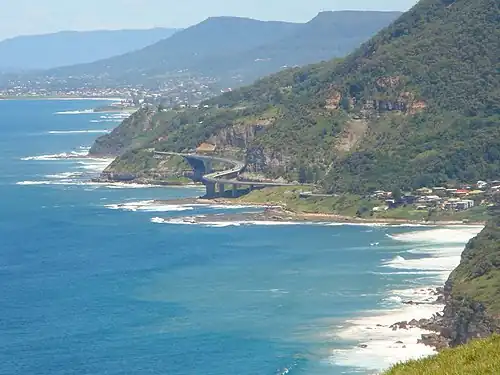
From Sydney, the fastest route is the A1/M1 Princes Motorway south: roughly 50 minutes to greater Wollongong and another 20 minutes into the CBD, longer in afternoon peak. Add about 10 minutes to detour down the dramatic Bulli Pass and along the northern beaches. The scenic option is the Grand Pacific Drive — exit the motorway at Helensburgh, drop down through Stanwell Park, and follow the coast via the Sea Cliff Bridge between Coalcliff and Scarborough; well signposted to Wollongong and one of the great short drives in NSW.
From the south, follow the Princes Highway (A1) north. From Canberra or Melbourne, choose between the faster, straighter Picton Road (B88) or the slower, scenic Illawarra Highway (A48) with its waterfalls and picnic stops; from the Hume (M31) take the second Wollongong exit at Picton/Cataract for Picton Road.
By bus, the 887 runs from Campbelltown to Wollongong Station via Appin and the University, with around eighteen services per weekday and three per day on weekends and public holidays — handy if you're coming from south-western Sydney.
Wollongong's bus network is part of the Greater Sydney Opal system, so a reloadable Opal card or contactless credit/debit card works everywhere — tap on and off so the correct fare is charged. Most routes run every 30–60 minutes. Premier Illawarra covers Bellambi south to Kiama, Dions Bus Service runs the northern suburbs as far as Austinmer, and Premier Coaches (Green's Northern) connects Wollongong with Stanwell Park and Helensburgh.
The free Gong Shuttle (routes 55A and 55C) is the local cheat code: bright-green buses looping the CBD, Wollongong Station, the hospital, Burelli Street, the University of Wollongong and its Innovation Campus (plus North Wollongong station on weekends). Every 10 minutes peak (7AM–6PM weekdays), every 20 minutes off-peak. It only stops at marked green Gong Shuttle signs — ordinary bus stops won't do. The navy-blue UOW shuttles (NG and GK) are also free.
A car is the most flexible way to range up and down the coast. Multi-storey CBD car parks cost under A$2/hour to a$15 daily max, beach and foreshore parking is free, and all Sunday parking is free. Avis, Europcar and Hertz cluster on Flinders Street just north of the CBD.
Cycling is excellent if you stick to the coast: the dedicated path runs 10 km north from the CBD to Thirroul and a similar distance south to Windang and Lake Illawarra, mostly flat and uncrowded. The full Bulli–Kiama coastal ride is around 60 km, mostly off-road, and you can put the bike on a train for the return. Hire from Wollongong Bike Hire, 337 Keira St (+61 2 4228 7366) or Steel City Cycle, 365 Lawrence Hargrave Drive, Thirroul (+61 2 4267 1747), both around A$40/day. Cycling through Crown Street Mall is technically not allowed.
Taxis are run by Illawarra Taxi Network (formerly Radio Cabs) and 13cabs; the main rank is on Church Street next to the Greater Union cinemas. Uber operates citywide. Wollongong is genuinely walkable in the centre — the station to City Beach is about a 30-minute walk — and grey-and-orange wayfinding signs point to the CBD, Arts Precinct, station and harbour. Watch for the steep escarpment streets west of the CBD if you're walking with luggage.
What are the things to do?
Coast and harbour
- Wollongong Head & Belmore Basin — the working fishing harbour with two heritage lighthouses (the 1872 Breakwater Lighthouse on the harbour wall and the 1936 Wollongong Head Lighthouse on Flagstaff Hill), pelicans on the wharf and the morning fishing-fleet auction. Free, always open. CBD.
- Flagstaff Hill & Fort Drummond — grassy headland between City Beach and the harbour with remnants of a 19th-century coastal battery and the best panorama of the city. Free.
- Sea Cliff Bridge — the 665-metre cantilevered bridge that swings out over the ocean between Coalcliff and Clifton on the Grand Pacific Drive. Pedestrian walkway on the seaward side. Free, ~25 km north of the CBD.
- Wollongong City Beach, North Beach and Austinmer Beach — patrolled surf beaches; Austinmer's twin ocean pools are a local institution. Free.
Culture and gardens
- Nan Tien Temple, Berkeley Road, Berkeley — the largest Buddhist temple in the Southern Hemisphere, run by the Fo Guang Shan order. Pagoda, meditation hall, vegetarian dining, and short cultural tours. Generally open Tue–Sun, closed Mondays; donation entry. About 10 km south of the CBD.
- Wollongong Botanic Garden, Northfields Avenue, Keiraville — 27 hectares of themed gardens at the foot of Mount Keira. Free; daily.
- Wollongong Art Gallery, cnr Kembla & Burelli Streets — strong holdings of Aboriginal, Asian and colonial Australian art. Free; closed Mondays.
- Illawarra Museum, 11 Market Street — local social and industrial history in a former post office.
Escarpment and lookouts
- Mount Keira Summit Park — 464 m lookout reached by a winding road from Keiraville; sweeping views from Royal National Park to Lake Illawarra. Free.
- Sublime Point Lookout, above Austinmer — heart-stopping cliff-edge platform with views down the coast; reached by car from the Princes Highway or a steep walking track up the escarpment.
- Bald Hill Lookout, Stanwell Park — the launch point for hang-gliders and the postcard view of the Sea Cliff Bridge curving south. Free.
Industrial / aviation
Historical Aircraft Restoration Society (HARS) Aviation Museum, Shellharbour Airport, Albion Park Rail — flying warbirds and a retired Qantas 747. Paid entry; opening days vary, so check ahead.
Drive the Grand Pacific Drive — the 140 km signposted route from the Royal National Park through Stanwell Park, Sea Cliff Bridge, the Gong and on to Kiama and Berry. Half a day minimum; a full day with stops.
Surf or swim the northern beaches — Austinmer, Thirroul, Sandon Point and Sharkies (Sharky Beach) all have reliable breaks; lessons are easy to arrange in summer from operators around North Beach and Thirroul.
Hang-glide or tandem paraglide from Bald Hill — Stanwell Park's Bald Hill is one of Australia's premier coastal launch sites; several school operate tandem flights for first-timers (book ahead, weather-dependent).
Walk the escarpment — the Mount Keira Ring Track (~5 km, moderate), the Sublime Point Track up from Austinmer (steep, chains and ladders), and sections of the Illawarra Escarpment State Conservation Area give serious rainforest walking within sight of the city.
Ride the coastal cycleway — hire a bike and ride Thirroul to Wollongong (or beyond) for the most efficient sightseeing day in the region.
Watch whales (June–November) — humpbacks pass close inshore; Flagstaff Hill, Bald Hill and Sublime Point are reliable land-based vantage points, and seasonal boat tours run from Belmore Basin.
Catch a Hawks or Dragons game — the Illawarra Hawks (NBL basketball) play at WIN Entertainment Centre and the St George Illawarra Dragons (NRL) host occasional home games at WIN Stadium.
Eat your way down Crown Street Mall — a slow afternoon of cafes, dumpling bars and Mediterranean delis is its own activity.
Planning Wollongong? Want these on a customised itinerary?
Ask on WhatsAppWhere to eat?
Wollongong eats like a much bigger city, thanks to post-war Italian, Greek, Macedonian, Lebanese, Indian and East/Southeast Asian communities and a hungry student population. The CBD's main eating strips are Crown Street (and the mall), Keira Street and Globe Lane, with a separate cluster of cafes and seafood places at Belmore Basin and North Beach. Signature local moves: a fish-and-chips dinner at the harbour, yum cha or hot pot off Keira Street, a long Italian lunch in the suburbs, and a cooked breakfast at a beachfront cafe.
- Levendi's Restaurant (Globe Lane, CBD) — modern Greek that locals send visitors to; a mid-range splash-out (mains roughly A$30–45).
- His Boy Elroy (Crown Street) — burger-and-craft-beer joint, dependable for a casual A$25 dinner.
- Diggies (1 Cliff Road, North Wollongong) — beachfront cafe in a converted Surf Life Saving club; breakfast and brunch around A$18–28.
- Lee & Me (87 Crown Street) — wholefoods cafe with strong vegetarian, vegan and gluten-free offerings; brunch under A$25.
- Samaras Restaurant (Wollongong CBD) — long-running Lebanese banquet specialist; share plates A$50–70/head for the full spread.
- Nan Tien Temple Dining Hall — entirely vegetarian Buddhist canteen attached to the temple, very affordable, no alcohol.
Halal options are easy to find in the Lebanese and Turkish places around Crown Street; the student strip near the university has the broadest cheap-eat range.
Where to drink?
Local drinking centres on a tight cluster of small bars and pubs in the CBD — Howlin' Wolf Bar, His Boy Elroy and the lanes around Globe Lane for cocktails and craft beer; the Illawarra Brewing Company (Five Islands Brewery) for locally brewed beer; and traditional surf-and-rugby pubs such as the Illawarra Hotel and North Wollongong Hotel (the "Novo") for live music and a beer garden. The university precinct has its own student bar scene.
Coffee culture is taken seriously — single-origin specialty roasters and Italian-style espresso bars sit side by side along Crown and Keira Streets and out at Thirroul, where cafes like Earth Walker & Co and North Bondi Trattoria-style breakfast spots draw weekenders down from Sydney. Tea-wise, the Nan Tien Temple's tea room is a quiet alternative to the cafe circuit.
Tap water in Wollongong is safe to drink everywhere and meets full Australian drinking water standards; carry a refillable bottle, particularly on escarpment walks. Australia's licensing law is strict: you must be 18 to buy or drink alcohol, ID is checked routinely, and bottle shops (off-licences) close earlier than bars.
Planning Wollongong? We’ll book the stays and dining for you.
Ask on WhatsAppWhere to stay?
Budget
- Keiraleagh House Backpackers, 60 Kembla Street — long-running CBD hostel in a converted heritage house, dorms typically A$35–45, private rooms from around A$80.
- Sage Hotel Wollongong (budget rooms) or local pub stays such as the Illawarra Hotel offer simple rooms from roughly A$100 in shoulder season.
Mid-range
- Novotel Wollongong Northbeach, 2–14 Cliff Road — beachfront mid-scale hotel directly opposite North Beach; rates typically A$220–320 depending on season and view.
- Mantra Wollongong, 167 Keira Street — apartment-style hotel close to the station and CBD, studios and one-bedroom apartments from around A$200.
Upscale / boutique
- Sage Hotel Wollongong, 60–62 Harbour Street — the city's most polished business-and-leisure hotel, walking distance to Crown Street Mall; superior rooms typically A$260–360.
- Headlands Hotel Austinmer, 1 Headland Avenue, Austinmer — clifftop hotel above Austinmer Beach, recently refurbished, with sea-view rooms generally A$300–450 and a destination restaurant.
What should you buy?
The retail heart is the pedestrianised Crown Street Mall, with Wollongong Central anchoring the chains and a string of independents along Crown and Keira Streets. For weekend browsing, the Wollongong Foreshore Markets (Sundays, Stuart Park / Lower Crown Street) gather local makers, food vans and produce; the Friday City Markets run in Crown Street Mall through the warmer months. South of the CBD, Warrawong Plaza and Stockland Shellharbour cover big-box shopping.
Specifically look for: surf and beach gear (Bulli, Thirroul and the CBD all have surf shops), Australian merino and sheepskin, local pottery and ceramics from Illawarra studios, and produce from the South Coast — honey, olive oil, cheese from the Southern Highlands hinterland. Prices are fixed in shops; light haggling is acceptable only at markets and only on bulkier purchases.
Where to go next?
- Royal National Park (~30 km north) — Australia's oldest national park, with the Coast Track, Wedding Cake Rock and Figure Eight Pools; reachable by car or train (Otford/Loftus).
- Kiama (~35 km / 35 min south) — the Kiama Blowhole, Cathedral Rocks and the start of the Kiama Coast Walk; easy day trip by train.
- Berry & Gerringong (~60–75 km / 1 hr south) — pretty heritage town and rolling dairy country, good cafes and antique shops.
- Jervis Bay (~110 km / 1.5 hr south) — Hyams Beach (famously white sand), kayaking with dolphins, and the bushwalks of Booderee National Park.
- Southern Highlands — Bowral, Berrima, Mittagong (~75 km / 1 hr west via Macquarie Pass) — cool-climate vineyards, Bradman Museum, country guesthouses.
- Sydney (~85 km / ~1.5 hr by train or car north) — the obvious onward connection, especially if flying out of SYD.
Nearby in New South Wales
More places to explore around Wollongong.

Guide content as of May 2026. Portions adapted from Wikivoyage, CC BY-SA 4.0.

Contact Us
Get in touch with us.
Get in touch
Contact Us
Tell us where you'd like to go and how you like to travel. A real Tripcuro planner — not a bot — will craft an itinerary around you.
- Personalised, hassle-free planning end-to-end
- Transparent pricing, no hidden costs
- 24/7 support for complete peace of mind