
This is Part 5 of our 13-part Angkor series. Read Part 4: Angkor Thom: The Great Walled City
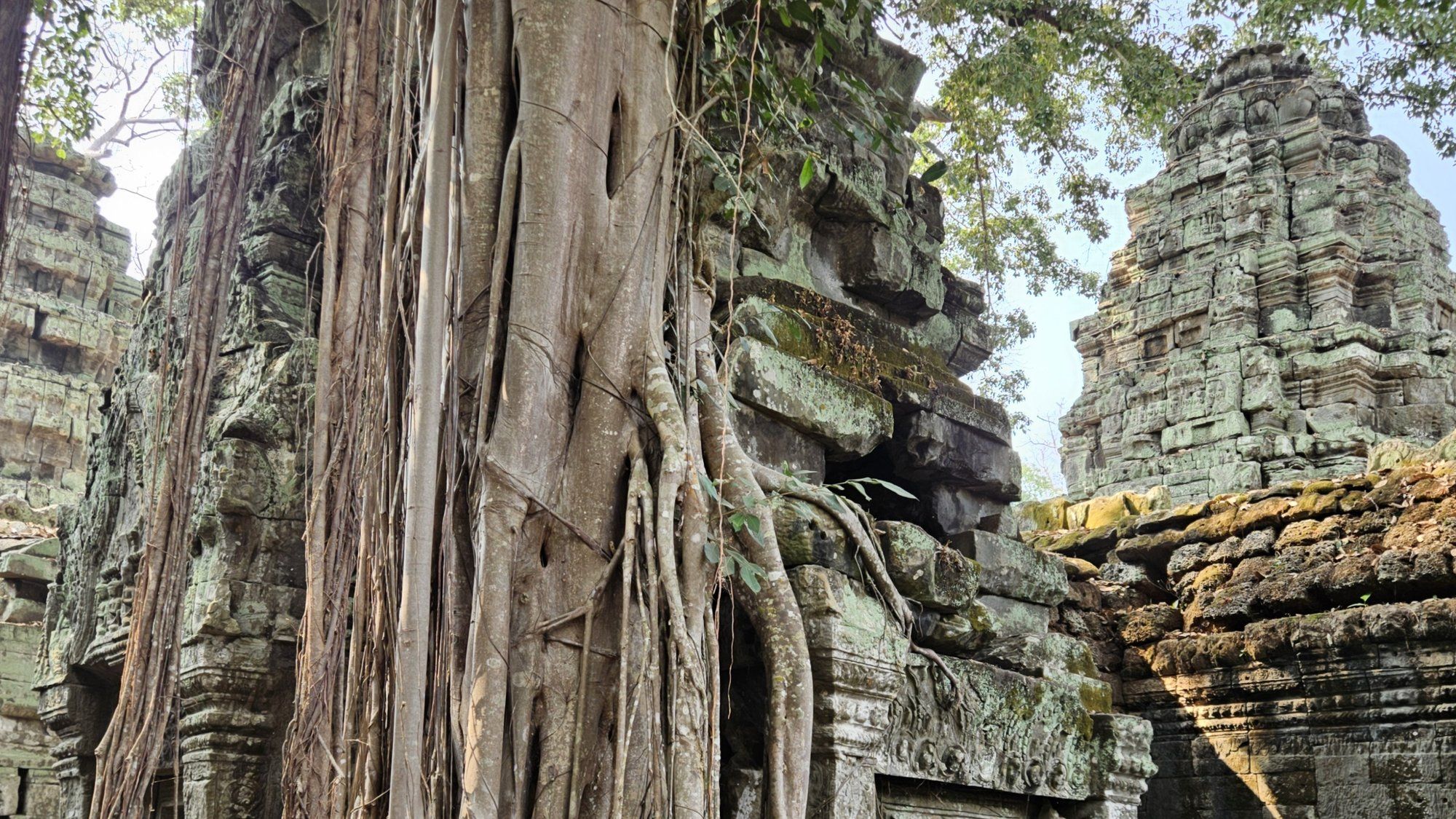
Ta Prohm is the temple everyone’s seen in photographs even if they don’t know its name. A strangler fig erupts through the roof of a stone gallery, roots wrapping the walls like fingers, as if the jungle is digesting the building. The photograph is famous. The temple itself is stranger and more interesting than any picture.
Ancestor Brahma or Lokeshvara?
Ask a local what Ta Prohm means, and you will get an answer you won’t find in the guidebooks. In Khmer, “Ta” means ancestor or grandfather. “Prohm” means Brahma. Ancestor Brahma.
The local tradition holds that the temple is dedicated to Brahma, the creator god of the Hindu trimurti. The reasoning is visual: the temple’s iconography is dominated by four faces in four directions, exactly how Brahma is traditionally depicted. The name itself, in the local understanding, confirms it.
Historians disagree. The scholarly consensus identifies the central deity of Ta Prohm as Lokeshvara (Avalokiteshvara), the bodhisattva of compassion in Mahayana Buddhism. “Lokeshvara” means “lord who looks down,” and the multiple faces looking in all directions are an expression of compassion that sees every corner of suffering. Some scholars also suggest it could represent the father of King Jayavarman VII, deified in Buddhist form.
The debate is real. Locals call it Brahma. Historians call it Lokeshvara. The temple itself does not settle the question. It sits there, wrapped in roots, four-faced towers gazing at the horizon, and lets both stories coexist.
This tension between local tradition and academic consensus is the “tadka,” the spice that makes Ta Prohm more than just another temple. It is a place with two identities living side by side. And both stories are told there, every day, by different guides to different visitors.
“Ta Prohm has an identity,” Aditya said after visiting in February 2025. “It is really beautiful. A mix of natural and man-made temple, different from Angkor Wat or Bayon style.”
The temple the ASI restored
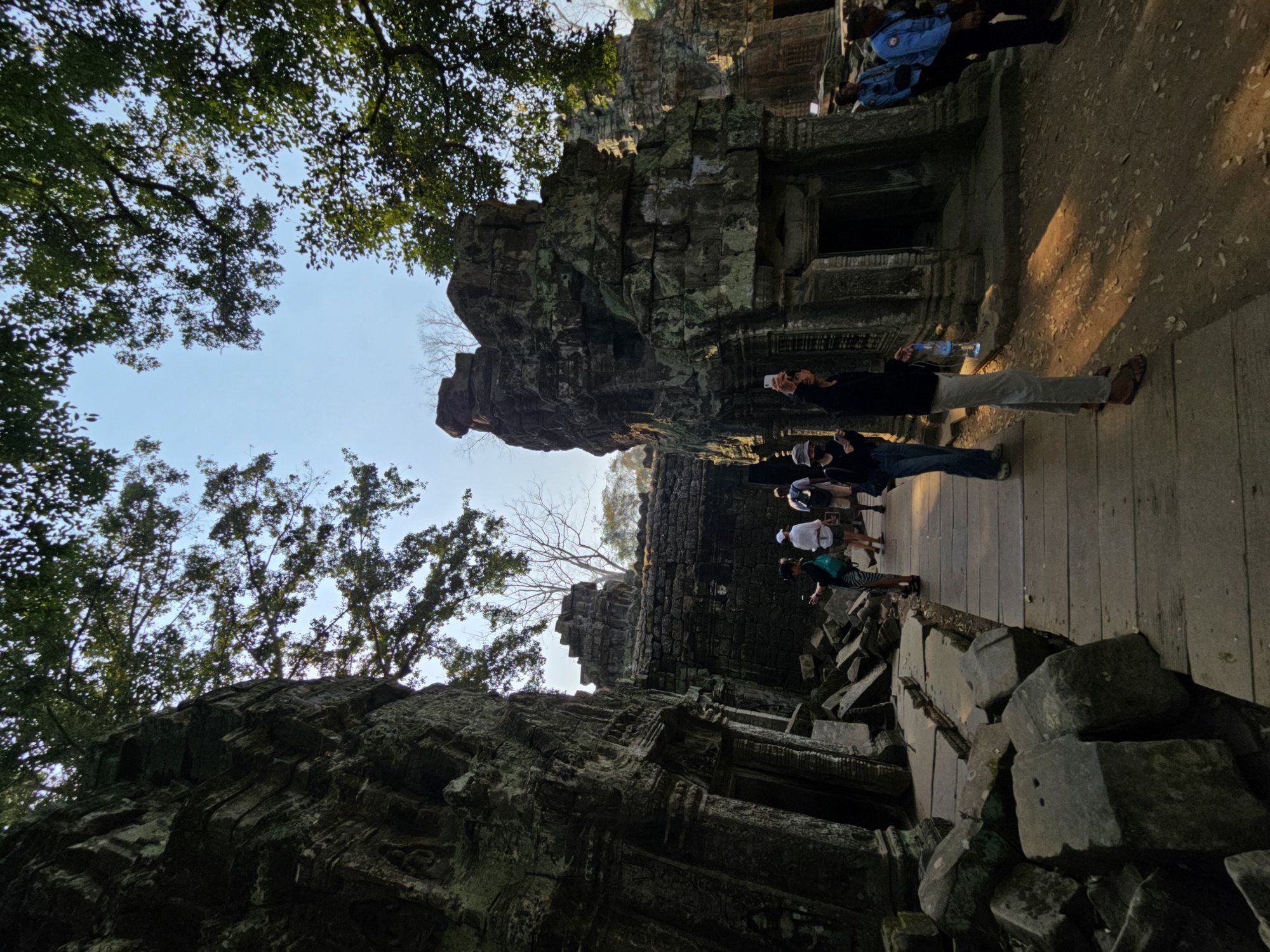
Ta Prohm was built by Jayavarman VII in the late 12th century as a Buddhist monastery and university dedicated to his mother. At its peak it was one of the largest monastic complexes in the empire, staffed by thousands of monks and priests and supported by thousands of villages.
When the French archaeological mission arrived in the early 20th century, they made a deliberate choice: leave Ta Prohm as they found it. Other temples were cleared, restored, rebuilt. Ta Prohm was kept as a demonstration of what the jungle does to stone. It became the “lost temple” of every explorer fantasy.
In recent decades the Archaeological Survey of India has undertaken significant restoration work, and their approach has drawn praise. “The ASI did some really good work in restoration,” Aditya noted, “merging the temple with the natural surroundings.” The Indian team understood that the trees are now part of the temple’s identity. You cannot remove the strangler figs without collapsing the walls they hold together. The restoration philosophy was not to fight the jungle, but to stabilise what the jungle had claimed.
The result is a temple that feels organic. The stone and the trees have grown into each other. It is impossible to tell where Khmer masonry ends and Cambodian root begins.
The trees
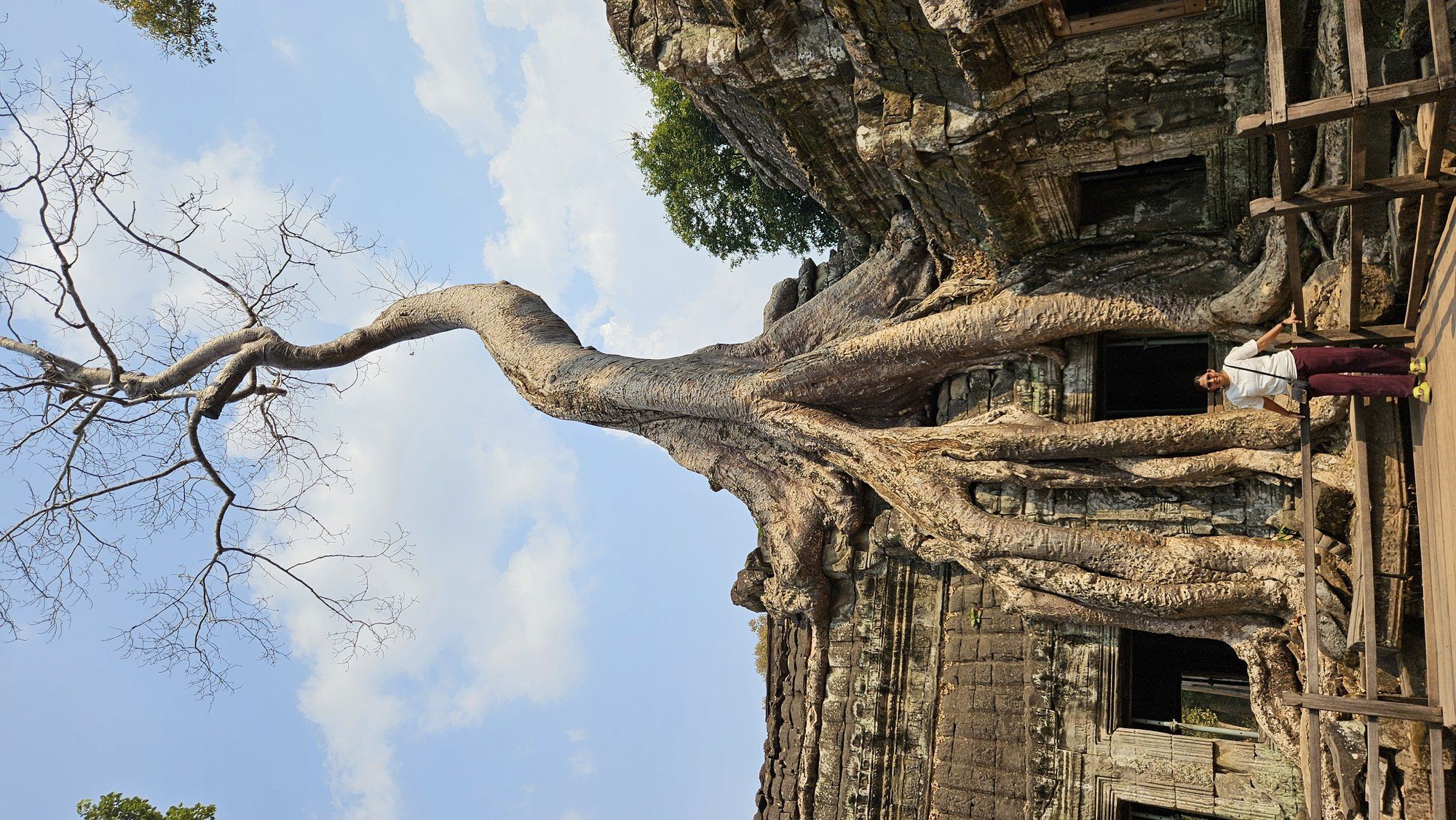
Two species dominate. The strangler fig starts its life in the canopy, sends roots down along the stone walls, and slowly encloses them like a fist. The host tree inside the fig eventually dies, leaving a hollow lattice of roots in the exact shape of the temple wall. The silk-cotton tree (Ceiba pentandra) grows massive buttress roots that spread across the stones like the base of a waterfall. Both are beautiful. Both are slowly destroying the temple. The debate over how much to intervene is ongoing.
The most photographed spot in Ta Prohm is the “Tomb Raider tree,” the giant fig that engulfs a gallery near the east entrance. Angelina Jolie’s Lara Croft ran through this doorway in the 2001 film, and the shot made Ta Prohm famous to a generation that had never heard of it. You will queue briefly for a photo here. It is worth it.
What makes Ta Prohm different
Angkor Wat is grand. The Bayon is strange. Ta Prohm is intimate. The scale is smaller, the paths are tighter, the rooms feel like rooms you could have lived in. The trees press in from every side, filtering the light into a green-gold haze. Birds call from the canopy. The sound of other visitors is absorbed by the foliage.
“Different from Angkor Wat or Bayon style,” Aditya said. He meant it as a fact, not a comparison. Angkor Wat is designed to impress you with its size. Ta Prohm is designed to let you wander through something that feels half-abandoned and half-alive.
Come early. By 9am the tour buses arrive and the narrow passages become single-file. In the first hour, with the long shadows and the low sun, you can have whole corners of Ta Prohm to yourself. Walk the outer enclosure first, where the crowds thin out, and save the central sanctuary and the famous tree for when the light is better.
How to see it
Ta Prohm is on the Small Circuit, about fifteen minutes from Angkor Thom by tuk-tuk. Most people combine it with Angkor Wat and Thom in a single day, but it rewards a longer visit.
Aditya visited Ta Prohm on his second day, after Angkor Wat sunrise and Banteay Srei. The route: Angkor Wat sunrise, back to hotel, then Banteay Srei (the pink temple), then Ta Som, East Mebon, Pre Rup, and finally Ta Prohm in the late afternoon. The timing worked: Ta Prohm in the soft late light, the roots casting long shadows, the crowds thinning.
The approach matters. Enter from the east, where the path arrives through a long avenue lined with the remains of the outer walls. The giant fig is near the east entrance, so you encounter it early. Spend time in the inner courtyard, where the smallest trees have woven through the library walls. Leave through the south for a different perspective.
Two hours minimum. Three if you want to sit and watch the light shift.
Next: Inside Angkor Thom, with the Baphuon, Phimeanakas, and the Royal Terraces.
Let Tripcuro Plan Your Angkor Journey
Tripcuro designs your Cambodia journey end to end, from flights out of your city and the Angkor temple pass to a Siem Reap stay with perks at Raffles Grand Hotel d’Angkor or Anantara Angkor. We time Ta Prohm for the quiet morning light, secure a guide who knows the local traditions, and handle every detail. Tell us your dates and we will build a bespoke itinerary around them.