
This is Part 4 of our 13-part Angkor series. Read Part 3: Inside Angkor Wat
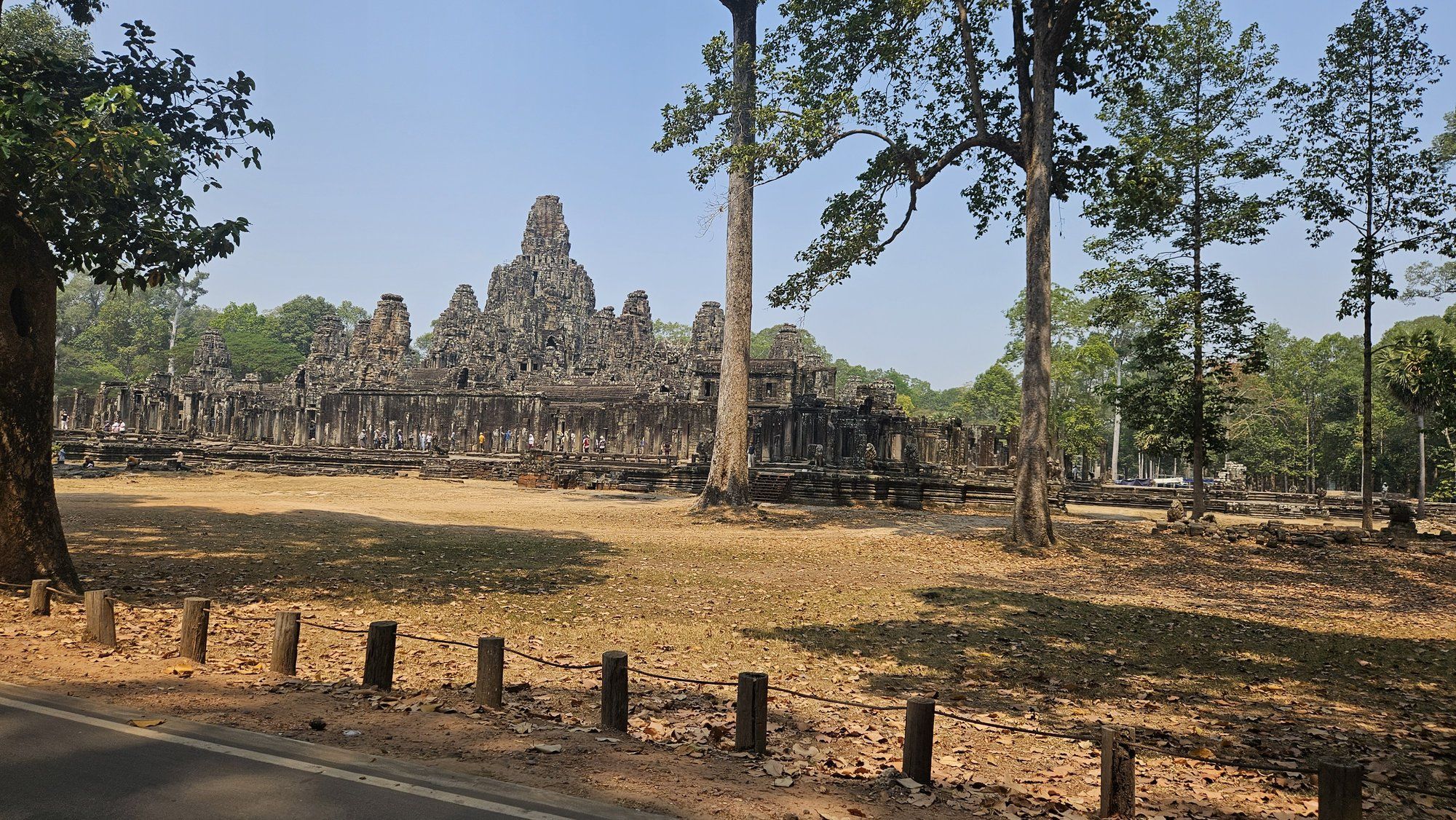
Angkor Wat is a temple. Angkor Thom is a city, a walled capital nearly ten square kilometres in area, planned and built in the late 12th century as the headquarters of the Khmer Empire. At its centre stands the Bayon, a temple so strange and personal that it feels less like architecture and more like a ruler’s self-portrait in stone.
Aditya entered Angkor Thom through the South Gate during his February 2025 visit. “I was enamoured by how well the South Gate and North Gate were,” he said. He already knew the Bayon faces from photos and from Ta Prohm. But the gates themselves, the approach, are what stayed with him.
The approach: crossing into another world
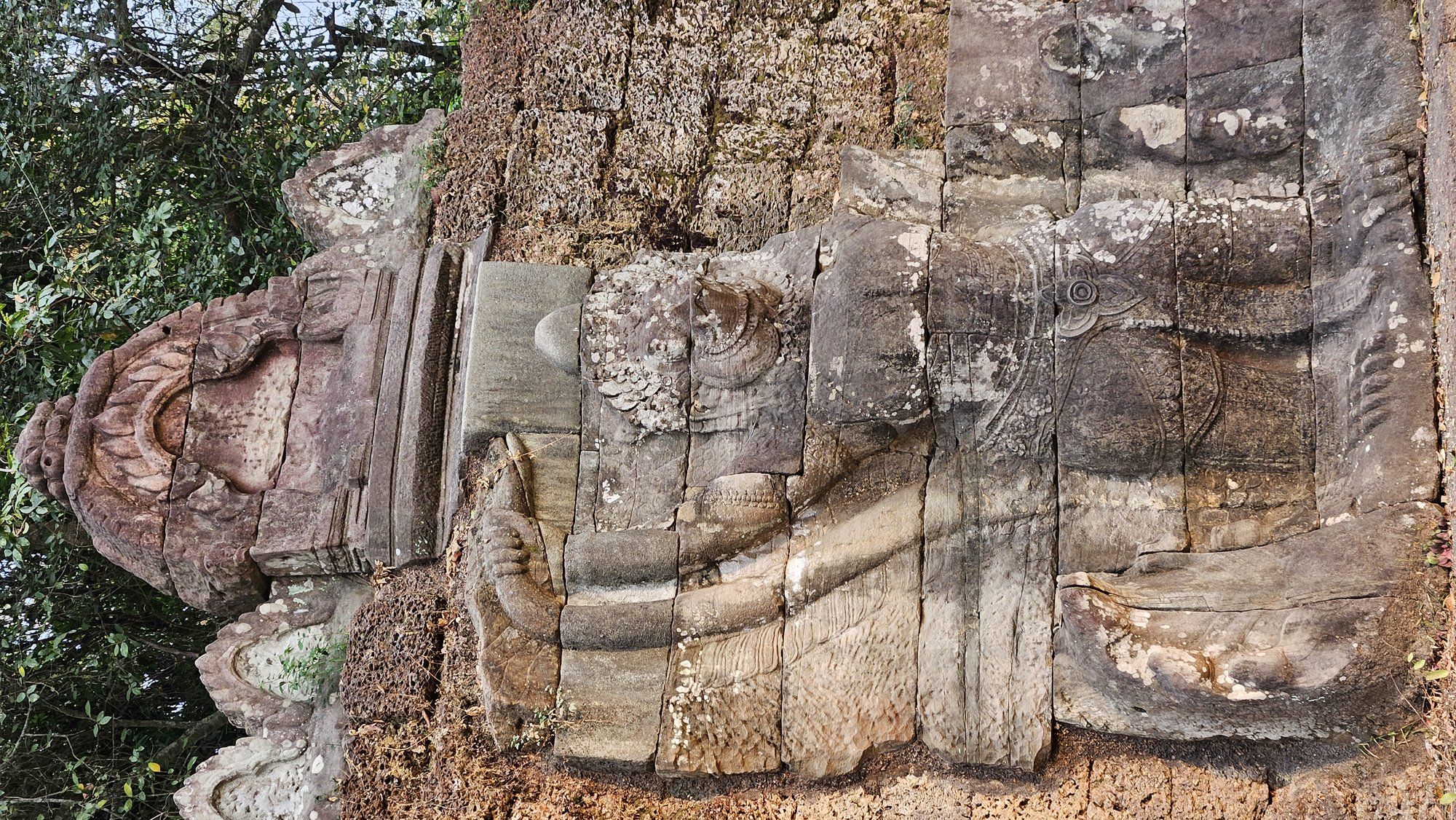
Every approach to Angkor Thom is a ceremony. The city sits inside an eight-metre-high laterite wall and a wide moat, and each of the five gates is reached by a causeway lined with fifty-four gods on one side and fifty-four demons on the other. They are not standing guard. They are pulling the naga serpent in the eternal Churning of the Ocean of Milk, the same scene carved into the walls of Angkor Wat. You arrive at the capital of the Khmer Empire by walking through the Hindu creation myth.
Each gate is crowned with three enormous faces looking outward in the cardinal directions. “The faces on the gates are the precursor to what you will see at the Bayon,” Aditya observed. They set the tone: the king’s face, or perhaps the bodhisattva’s face, watching every arrival and every departure.
The South Gate is the best preserved and the most photographed. The naga-causeway is intact, the giant statues are mostly complete, and the road approaches from the south, so the gate appears ahead of you for a full kilometre before you reach it. It is the most theatrical entrance in all of Angkor.
Jayavarman VII’s city
Angkor Thom was the creation of King Jayavarman VII, the same king who converted the state to Mahayana Buddhism and placed the Buddha in Angkor Wat’s central sanctuary. He built Angkor Thom as his capital after the Cham invasion of 1177 demonstrated that the old capital of Angkor was indefensible. The new city was fortified, planned, and built at staggering speed: the Bayon alone required the labour of tens of thousands.
At its peak, Angkor Thom probably housed well over a hundred thousand people inside the walls, with hundreds of thousands more in the surrounding urban sprawl that recent lidar surveys have revealed. This was not a ceremonial capital. It was a working megacity, the largest urban complex on the planet in the twelfth century, larger than Paris, larger than London.
The Bayon: two hundred faces
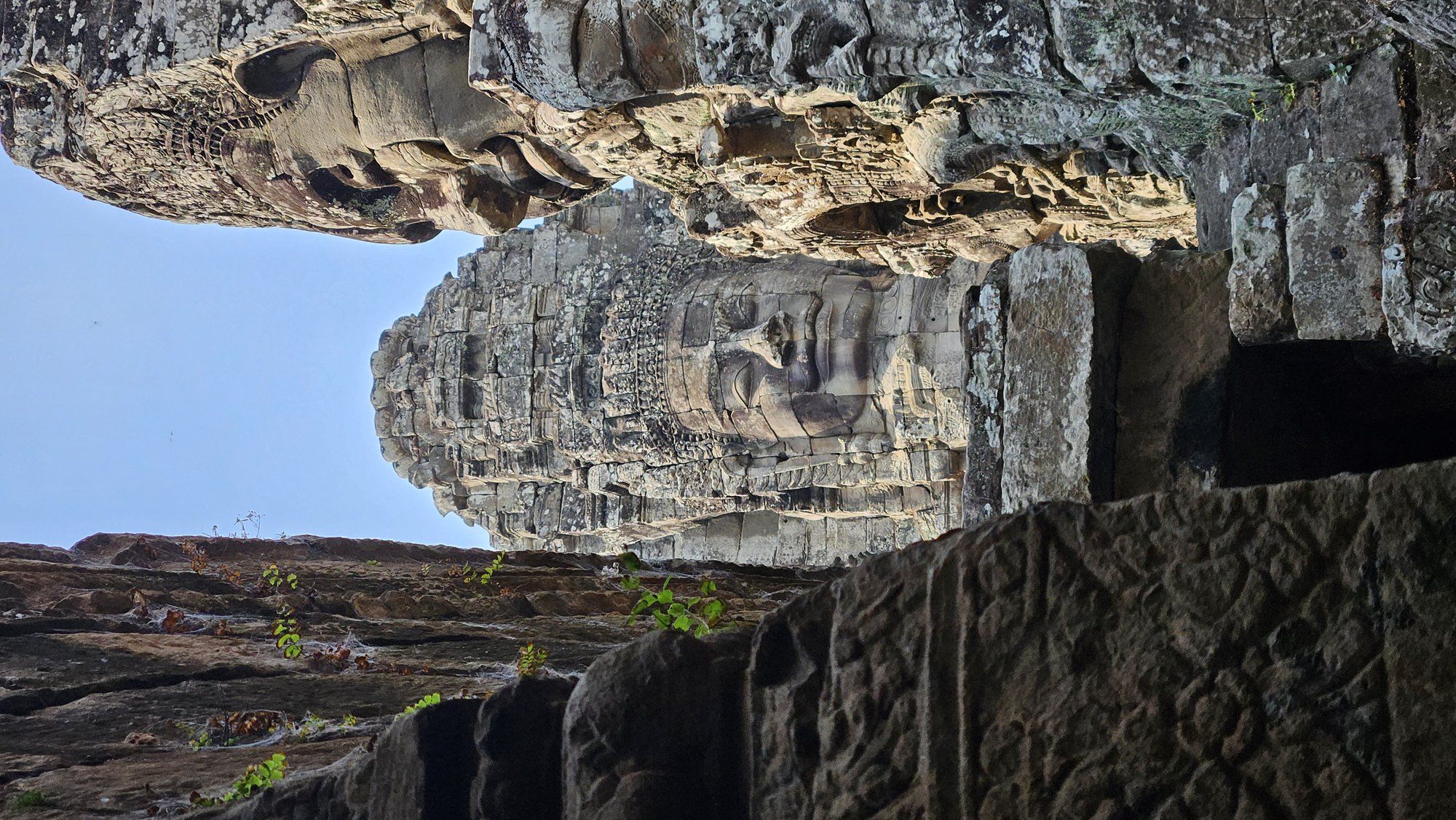
The Bayon sits at the precise centre of the walled city. From a distance it looks like a heap of rubble. Up close it resolves into a forest of 37 surviving towers, each carrying four enormous stone faces oriented to the cardinal directions. Nearly two hundred faces in all, each one wearing the same calm, half-smiling expression.
The identity of the faces is still debated. The most widely accepted reading is Jayavarman VII merged with the bodhisattva Avalokiteshvara, the king who wanted to be encountered everywhere you turned in his capital, watching over his people as a compassionate deity. A minority of scholars argue for Shiva or a syncretic Buddha-Shiva. The ambiguity is part of the spell.
Aditya had seen Bayon faces in photos before he arrived, so the shock of scale was expected. But the gates themselves were the surprise: the way the faces on the South Gate are the first announcement of what waits at the centre of the city.
The bas-reliefs of the Bayon’s outer gallery are different from anything at Angkor Wat. Angkor Wat’s carvings are myth: the Ramayana, the Mahabharata, the churning. The Bayon’s carvings are history: Khmer armies marching, naval battles on the great lake, everyday market scenes, a woman giving birth. It is one of the only places in Angkor where ordinary people appear in the stone. The king’s temple recorded daily life alongside gods and empire.
Wood for the living, stone for the dead
One of the most striking things about Angkor Thom is what has disappeared. The palaces, the royal residences, the diplomats’ quarters, the administrative buildings: all were built of wood. They have rotted away completely. Only the religious structures (the temples, the terraces, the gates) were built of stone. Aditya noticed this: “Palaces were made with wood while the temples of stone. The rulers wanted their legacy clearly.”
The Khmer kings built their worldly homes perishable and their spiritual homes permanent.
Aditya also saw where the diplomats were kept, the embassy quarters within the city. Angkor Thom was an international capital, receiving envoys from China, India, and the neighbouring kingdoms of Champa and Sukhothai. The city was built to impress, and the wooden palaces and stone temples, taken together, were designed to convey a single message: this empire is both powerful and eternal.
How to see Angkor Thom
Enter through the South Gate. Give yourself time to walk the naga-causeway. Then proceed to the Bayon for the first hour after opening, when the low sun defines the faces. After that, the Terrace of the Elephants and the Terrace of the Leper King are a short walk north and deserve a slow circuit. Save the secondary temples (Baphuon, Phimeanakas, Preah Palilay) for a return visit or the afternoon.
Angkor Thom rewards two visits. The first is for the Bayon. The second is for everything else.
In the next part: Ta Prohm, the temple in the trees, and why the locals call it Ancestor Brahma.
Let Tripcuro Plan Your Angkor Journey
Tripcuro designs your Cambodia journey end to end — from flights out of your city and the Angkor temple pass to a Siem Reap stay with perks at Raffles Grand Hotel d’Angkor or Anantara Angkor. We sequence Angkor Thom for the right light, secure a guide who knows the Bayon’s faces, and handle every detail. Tell us your dates and we will build a bespoke itinerary around them.