
This is Part 11 of our 13-part Angkor series. Read Part 10: Angkor for Indian Travellers
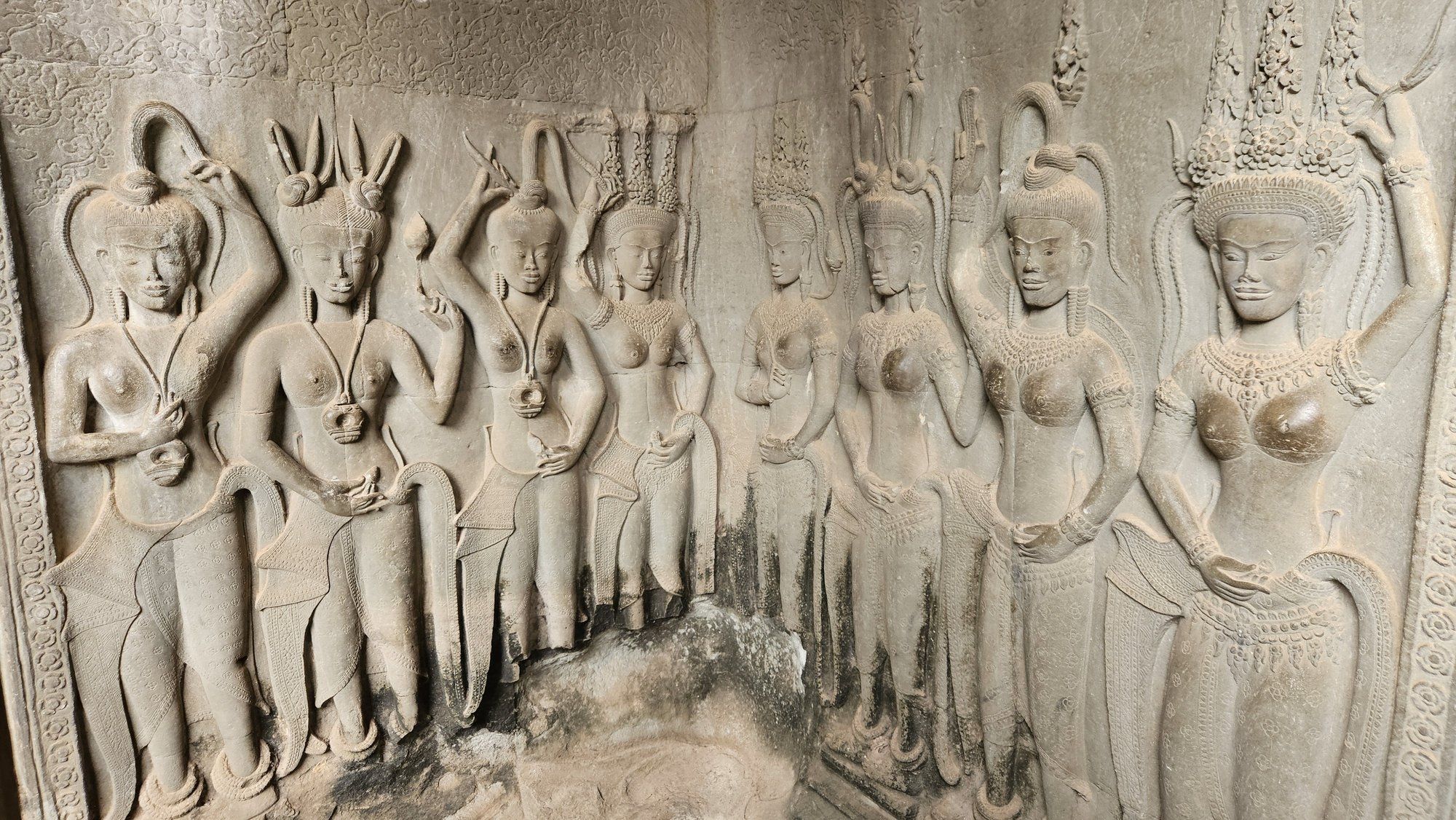
Look up at the walls of Angkor Wat. Between the battle scenes and the epic narratives, everywhere in the spaces the stone carvers left between the big stories, stand the apsaras. Celestial dancers. Nearly two thousand of them, carved into the surfaces of the temple, each one different, each one moving in a slightly different posture, wearing a different crown, holding a different flower.
They are the most personal art at Angkor. The big panels are state propaganda: the king’s victories, the gods’ battles, the creation of the universe. The apsaras are the space the artists claimed for themselves.
What is an apsara?
In Hindu and Buddhist mythology, apsaras are celestial nymphs born from the Churning of the Ocean of Milk. They are dancers, entertainers of the gods, beautiful and eternal. In the Indian tradition they are often associated with courtship and seduction. In the Khmer tradition they took on a higher role: guardians of the temple, intermediaries between the human and divine worlds.
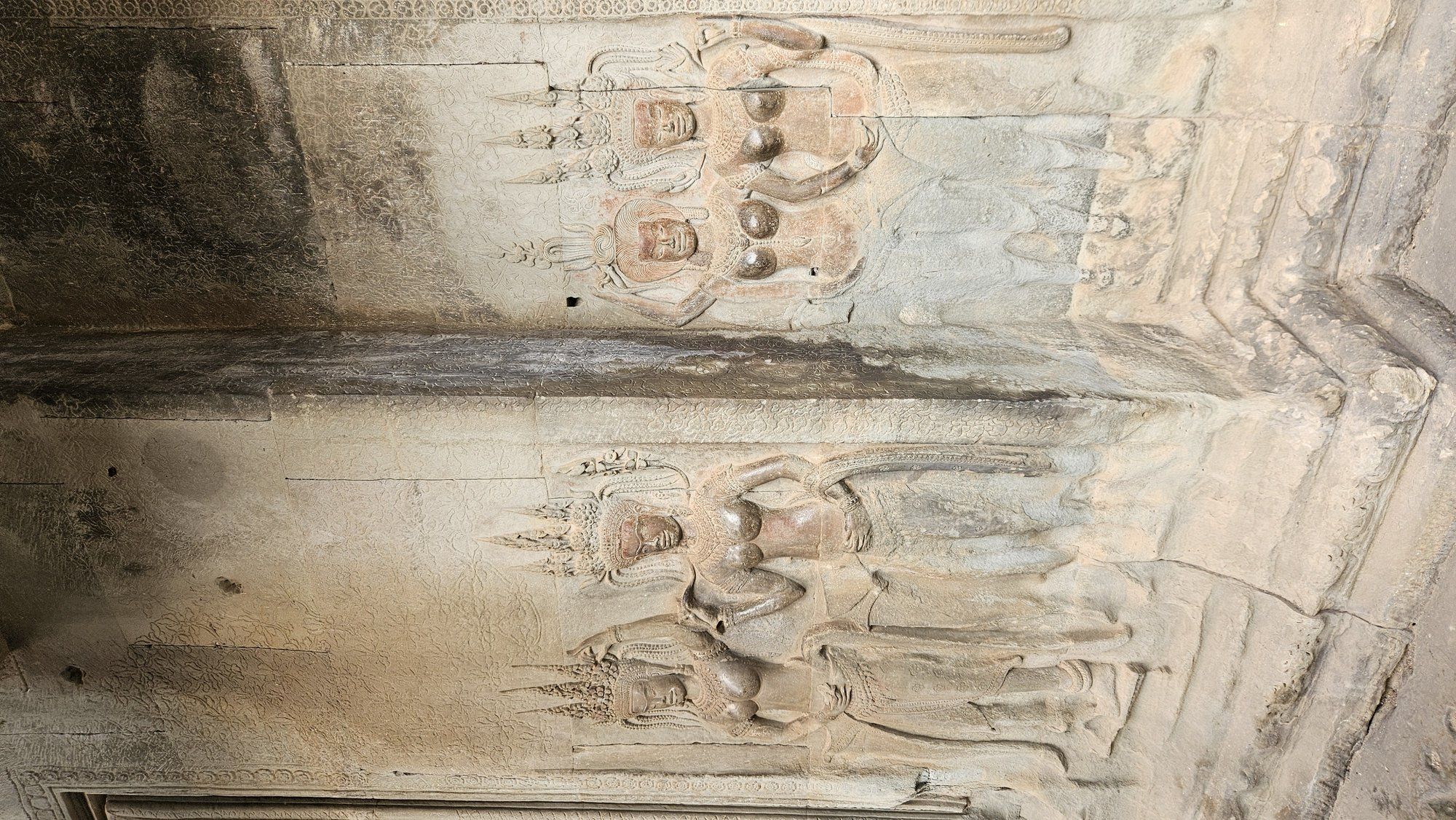
Khmer artists distinguished between two types of female figures. The apsara is a dancer, shown in a dancing pose, usually bare-breasted, wearing a long sampot (sarong) with elaborate pleats and a folded sash. The devata is a guardian figure, shown standing frontally, holding a lotus or a flower, wearing the full regalia of a Khmer princess: crown, jewellery, elaborate diadem. Both are present at Angkor Wat in overwhelming numbers. Both are distinct to the eye once you learn to see the difference.
The apsaras of Angkor Wat are the most studied. They number about 1,800, distributed across the walls, pillars, doorways, and eaves of the temple. They are carved at various scales: some are life-sized guardians beside doorways, others are palm-sized decorations on pilasters. Every single one is different. The crown, the jewellery, the pleating of the sampot, the angle of the hip — none are repeated. The artists who carved them apparently treated each apsara as an individual, a distinct personality in stone.
The dance that came from the carvings
The Apsara dance tradition of Cambodia claims a direct line to these carvings. The claim is partly myth and partly truth. Khmer classical dance was an unbroken tradition of the royal court for centuries, but it was nearly lost during the Khmer Rouge period, when dancers were executed and the tradition was suppressed.
The revival was led by Queen Sisowath Kossamak in the mid-20th century, who commissioned the reconstruction of the dance repertoire from temple carvings and living memory. The poses are the poses of the carvings. The gestures are the gestures of the stone. The connection between the carved apsaras and the living dancers is a deliberate act of cultural recovery, not a metaphor.
Aditya saw Apsara dance performances at dinner venues in Siem Reap. “Multiple such places exist,” he said. The standard format is a dinner show: a buffet of Khmer food followed by a dance performance that includes the classical Apsara dance, folk dances from different regions, and the Reamker, the Khmer version of the Ramayana. The dancers wear heavy brocade costumes inspired by the carvings, with the same pleated sampot, the same elaborate crown, the same lotus-bud hand gestures frozen in mid-motion.
These performances are tourist-oriented, but the tradition behind them is real. In 2003, UNESCO inscribed Khmer classical dance on the Representative List of the Intangible Cultural Heritage of Humanity.
A double meaning: the APSARA Authority
The word “apsara” in Cambodia carries a second, entirely practical meaning. APSARA is also the acronym of the Authority for the Protection and Management of Angkor and the Region of Siem Reap, the government body that runs the Angkor Archaeological Park.
The APSARA National Authority is responsible for conservation, security, ticket revenue, and development control across the entire park. It manages the balance between tourism and preservation. It approves restoration projects. It decides where new hotels can be built. It is the single most powerful organisation in Siem Reap, and its name was chosen deliberately — the celestial dancer, guardian of the temple, now the guardian of the temple complex itself.
The pun is probably intentional. It is certainly appropriate.
Seeing the apsaras
Once you know to look for them, the apsaras become the most absorbing detail at Angkor Wat. They are everywhere. The pillars inside the first gallery carry rows of them, each with a distinct face and expression. The lintels above the doorways carry dancing figures in mid-leap. The corners of the eaves carry small apsaras peeking out from the shadows.
The best place to see them is the inner gallery of Angkor Wat near the central sanctuary, where the carvings are deepest and the light is softest. The second-best place is the Angkor National Museum, which has a dedicated hall of apsara carvings at eye level with explanatory text.
In the next post: Beyond Angkor Thom — Banteay Srei and the holy mountain.
Let Tripcuro Plan Your Angkor Journey
Tripcuro designs your Cambodia journey end to end, from flights out of your city and the Angkor temple pass to an evening of Apsara dance and a Siem Reap stay with perks at Raffles Grand Hotel d’Angkor or Anantara Angkor. Every detail, handled. Tell us your dates and we will build a bespoke itinerary around them.