
This is Part 2 of our 13-part Angkor series. Read Part 1: Where is the Largest Hindu Temple in the World?
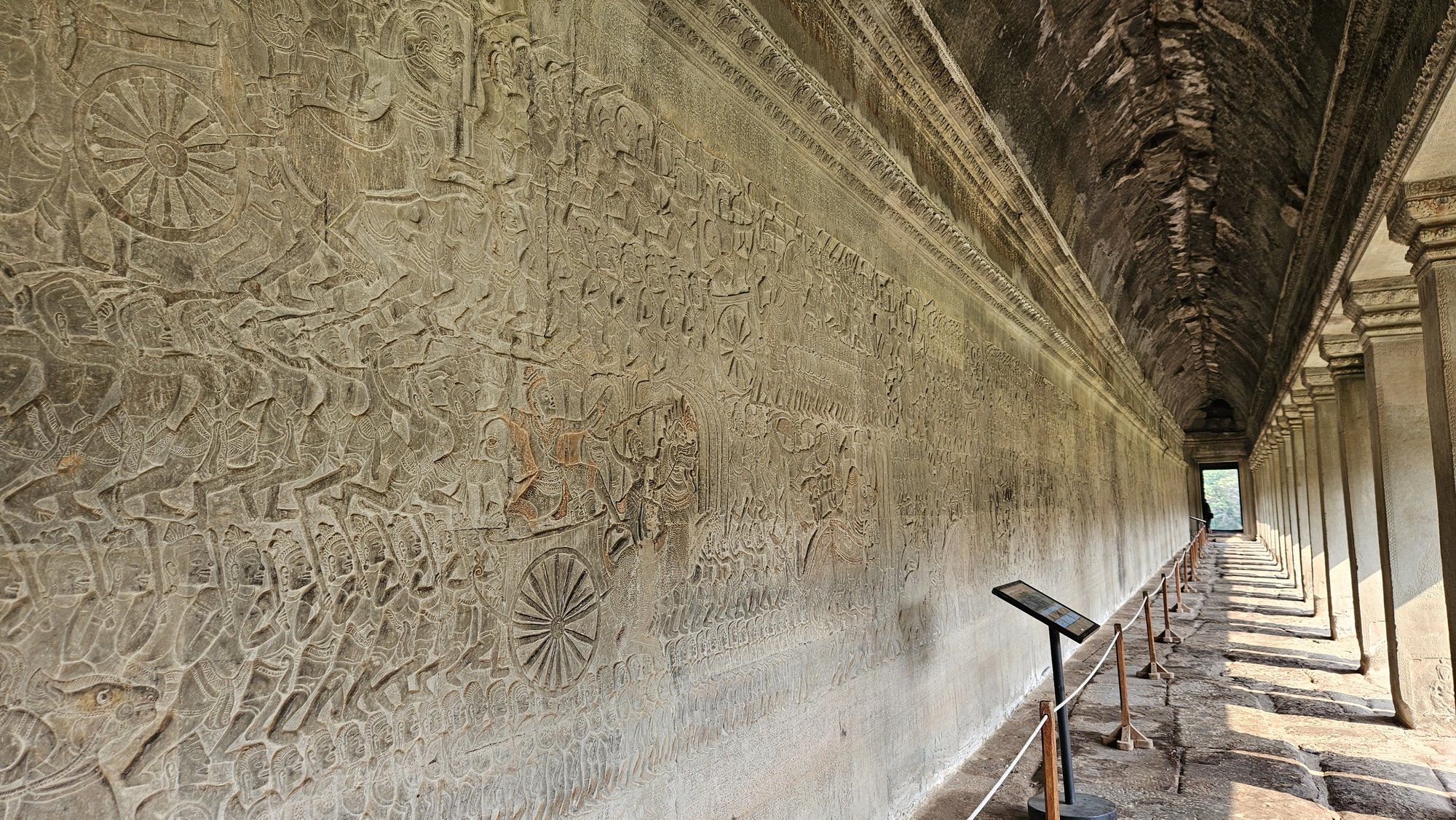
Most visitors walk past the outer walls of Angkor Wat on the way to the famous towers. That is a mistake. The walls themselves contain the longest continuous narrative stone carving in the world: hundreds of metres of sandstone that tell the Ramayana, the Mahabharata, and the history of the Khmer Empire, wrapped around the temple in a single continuous gallery. For an Indian traveller this is the quietest shock of the entire park: the stories you grew up with, carved into stone on the other side of Southeast Asia, nine hundred years old.
The gallery that wraps the world
The outer gallery of Angkor Wat is not a wall in the ordinary sense. It is a covered colonnade roughly 800 metres in perimeter, every surface covered in carved bas-reliefs. The panels are arranged to be walked clockwise, starting from the west entrance. They tell a deliberate sequence: Hindu creation myth on one side, epic battles on another, and the historical procession of the king who built it all.
The stone is grey-green sandstone quarried from the Kulen hills 50 kilometres away, brought down by river and canal. The carvers left no inch unfilled. Devas, asuras, monkeys, warriors, celestial dancers, lotus motifs, and animals crowd every panel. You could spend a full day on the walls alone and still find new detail on a second pass.
The Churning of the Ocean of Milk: Amrit Manthan
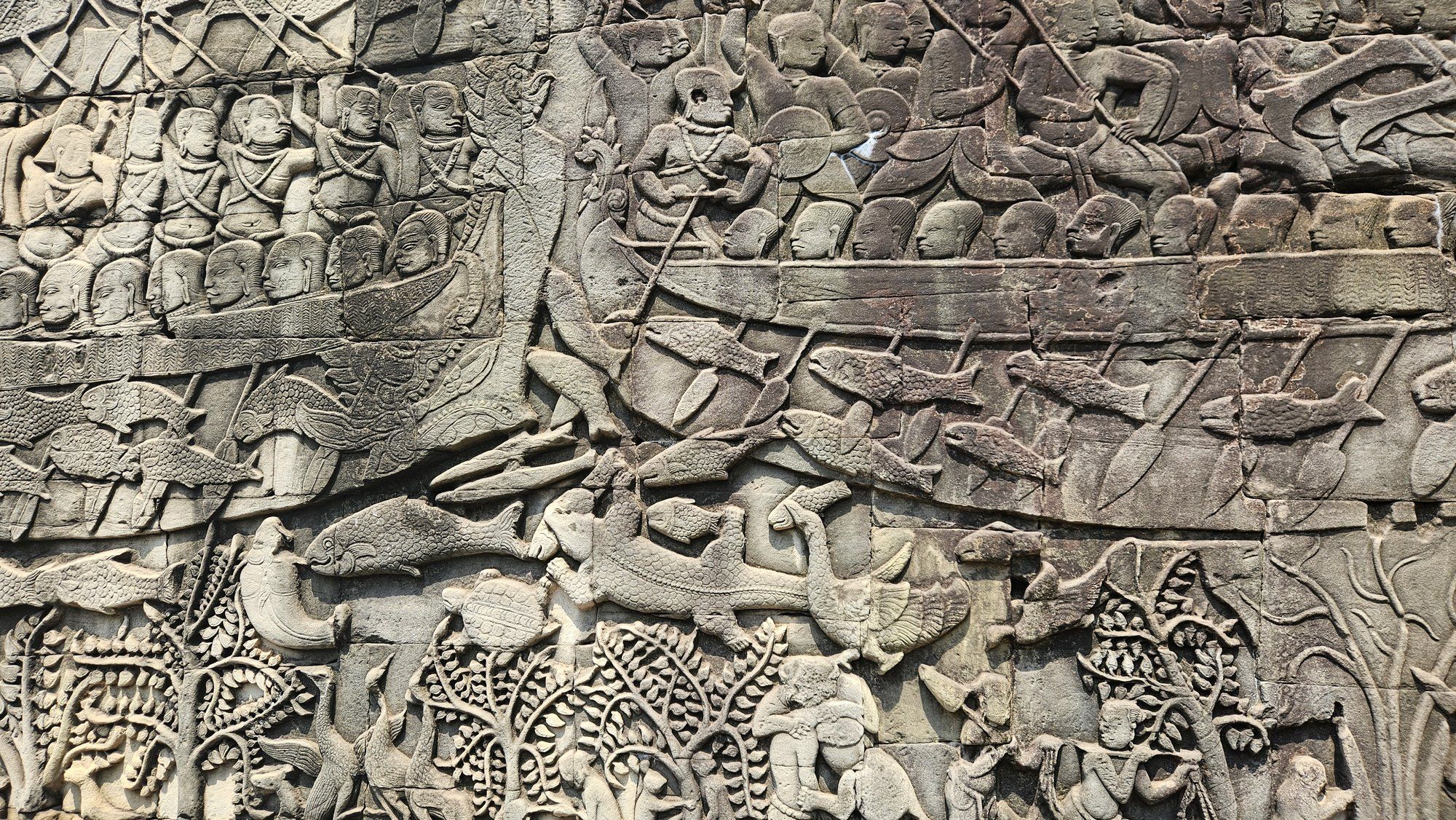
The most famous panel, and the one that stops every Indian visitor, covers the entire east wall of the south gallery. It is the Samudra Manthan, the Churning of the Ocean of Milk.
The scene is vast. Eighty-eight devas on one side and ninety-two asuras on the other pull the serpent Vasuki back and forth across Mount Mandara, which serves as the churning rod. Vishnu himself sits at the centre as Kurma, the tortoise, supporting the mountain on his back. The detail is staggering: every single figure has a distinct face and expression, and the composition follows the textual descriptions from the Puranas with remarkable fidelity.
Aditya, who visited in February 2025 and walked this gallery three days in a row, said the carving was “extremely well depicted as per the sources about the number of devas and asuras with Vasuki, Vishnu and Kurma being clearly seen.” The carvers knew the source material intimately. These were not abstract craftsmen working from second-hand descriptions. They knew the epics.
Walk the full panel slowly. The asuras are on the left, the devas on the right. Above the centre, Vishnu in his tortoise form is clearly visible. Above him, the gods and demons churn, and from the ocean emerge the treasures: the apsaras, the white elephant, the goddess Lakshmi, the pot of amrita. It is the origin myth of the Hindu universe, rendered by Khmer hands who absorbed Indian epic as their own.
The Ramayana panels
The west gallery and parts of the south gallery carry the Ramayana. The carvings follow the narrative: Rama’s exile, the abduction of Sita by Ravana, the monkey army building the bridge to Lanka, and the great battle. Hanuman is everywhere: leaping, fighting, carrying a mountain.
What makes these panels different from temple carvings in India is the Khmer interpretation. The architecture in the background is distinctively Khmer: the palaces look like Angkor, not Ayodhya. The landscape is Southeast Asian. The story is Indian, but the visual language is Cambodian. It is a fusion that makes the carvings feel like a translation rather than a copy.
For an Indian traveller in 2025, the recognition is immediate. “I could totally understand Ramayana and Mahabharata with the characters depicted,” Aditya noted.
The Mahabharata and the Kurukshetra war
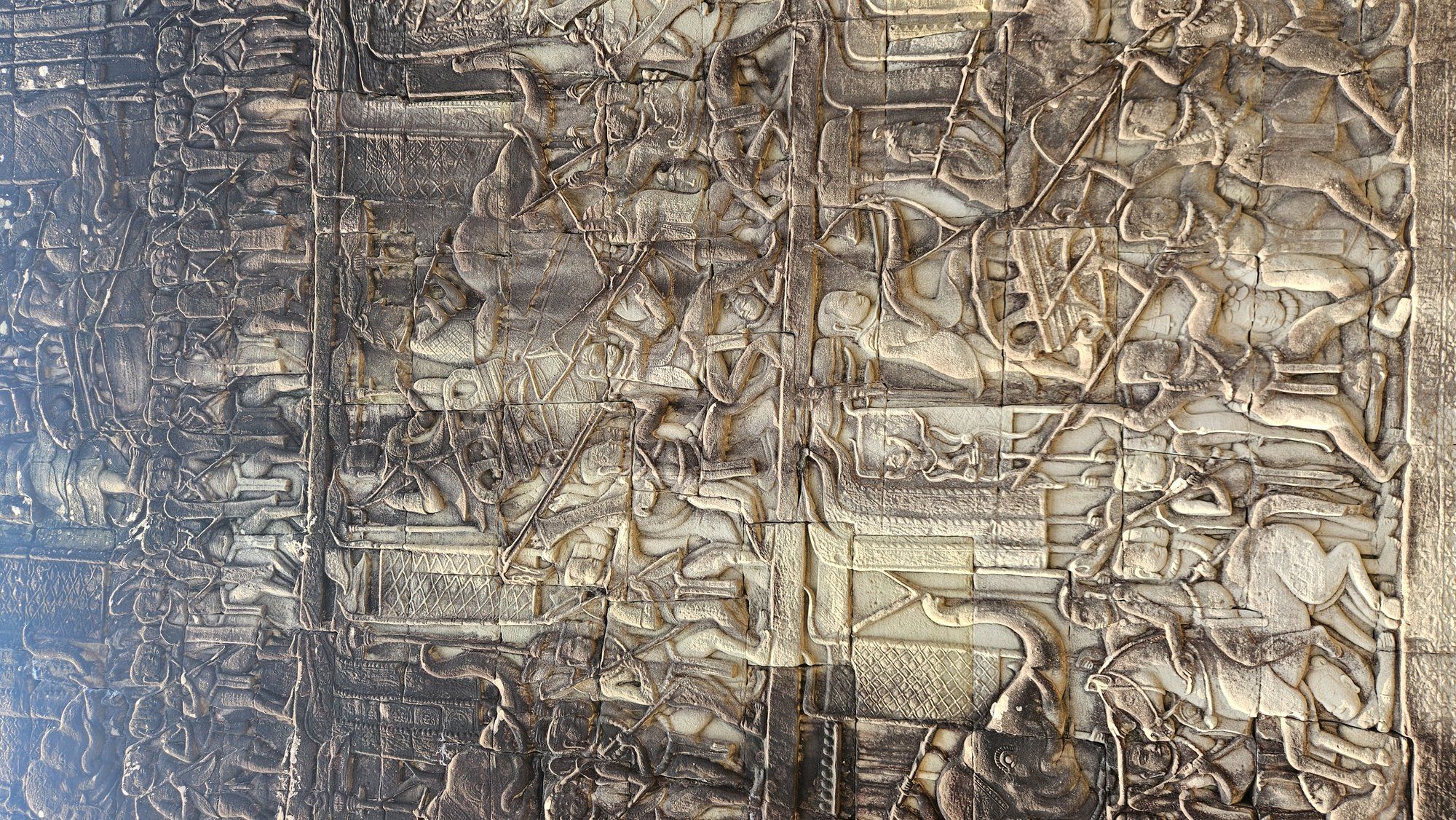
The east gallery carries the Mahabharata, specifically the battle of Kurukshetra. The carving shows armies in formation, chariots crashing into each other, archers on elephants, and the dead and wounded on a battlefield that stretches across the stone. The panels do not flinch from the carnage: this is the Gita war rendered in stone, and the carvers gave it all the violence the text describes.
Look for the identifying detail: the mace of Bhima, the chariot of Arjuna, the conch of Krishna. The carvers marked every character with a distinct attribute so the story could be read like a comic strip by an audience that knew the names.
The historical procession
The south gallery also carries something the epics don’t: a historical procession of King Suryavarman II, the builder of Angkor Wat. He is shown on a palanquin, shaded by parasols, surrounded by ministers and army commanders. This is the only known contemporary portrait of the man who built the largest religious monument on Earth. It is a reminder that these carvings were imperial propaganda as much as religious art, connecting the king to the gods whose stories his walls told.
How to see the gallery
Aditya spent three mornings at Angkor Wat and walked the outer gallery each time. His advice: go early, walk clockwise from the west entrance, and give the Amrit Manthan panel at least twenty minutes. “The best one for me was Amrit Manthan,” he said. “Extremely well depicted.”
The light matters. Early morning light from the east falls across the south and east galleries, picking out the deeper cuts in the stone. The carvings show sharpest in the first two hours after sunrise. By midday the contrast flattens and the details blur.
A guide makes a real difference here. The carvings reward explanation. A good Khmer guide who knows the epics will point out characters and episodes that a self-guided eye would walk past. When Aditya returned for a guided tour on his third day, he caught details he had missed on two previous solo walks.
Let Tripcuro Plan Your Angkor Journey
Tripcuro designs your Cambodia journey end to end — from flights out of your city and the Angkor temple pass to a Siem Reap stay with perks at Raffles Grand Hotel d’Angkor or Anantara Angkor. We pair every temple with a guide who can read the carvings, and handle the vegetarian dining so you eat well without the guesswork. Tell us your dates and we will build a bespoke itinerary around them.