
This is Part 6 of our 13-part Angkor series. Read Part 5: Ta Prohm: The Temple in the Trees
Angkor Thom is a city. The Bayon is its heart, but the rest of the walled enclosure holds temples, terraces, and hidden corners that most visitors walk past on the way to the next big name. This is where you find the temples that test your guide’s knowledge and reward your patience.
Aditya spent his third day inside Angkor Thom with a guide. “Bayon, Preah Khan, Phimeanakas, the Pithu Group, Baphuon, Terrace of Elephants,” he listed. The order matters: he started with the famous Bayon, then worked his way through the city’s supporting structures. Here is what he saw.
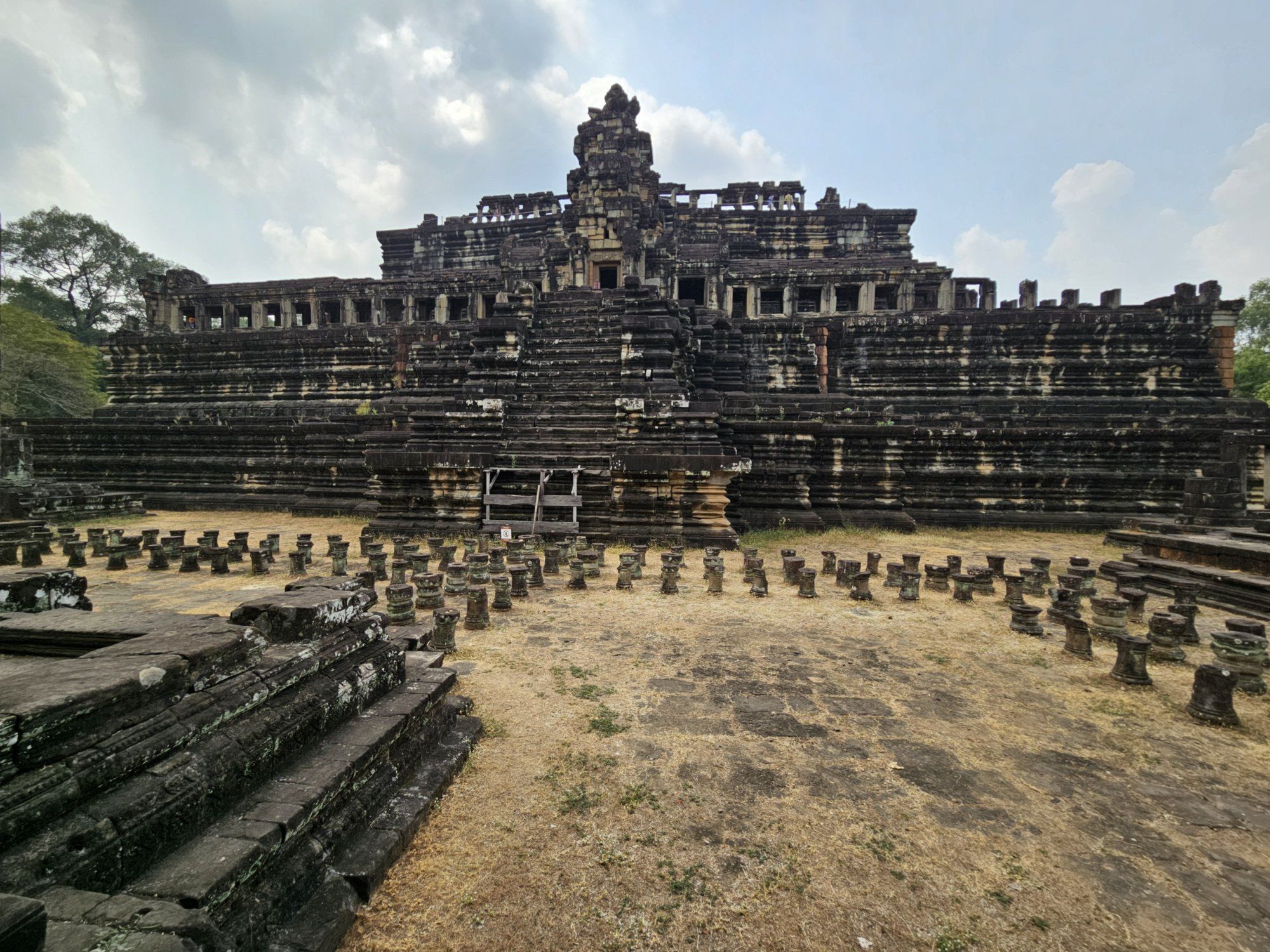
Baphuon: the pyramid of Yashodharapura
Baphuon is the oldest of Angkor Thom’s temples, built in the mid-11th century, more than a century before Jayavarman VII founded the city. It is a three-tiered temple-mountain dedicated to Shiva, originally the centre of the city of Yashodharapura, which occupied the same site before Angkor Thom was built over it.
“This was the earlier of the temples of Yashodharapura,” Aditya noted. Yashodharapura was the capital established by King Yasovarman I around 900 CE, predating Angkor Thom by three centuries. When Jayavarman VII built his walled city, he absorbed the earlier structures into its boundaries. Baphuon, Phimeanakas, and several of the other “inside Thom” temples are survivors from a previous age.
Baphuon’s restoration was one of the longest and most difficult archaeological projects in Southeast Asian history. The temple was dismantled for restoration in the 1960s, and then the Khmer Rouge took power. The records were destroyed. The stones sat in labelled piles in the jungle for thirty years. An archaeologist named Pascal Royère spent his entire career rebuilding what was lost. When the temple finally reopened in 2011, nearly fifty years after work began, Royère had transformed what looked like a permanent ruin into a standing pyramid where visitors could climb to the top.
The west side of Baphuon carries something unexpected: a 60-metre-long reclining Buddha, added in the 16th century when the temple was converted to Buddhist use. It is made of laterite blocks laid over the original stonework, and it is visible from the ground as a long, geometric shape running along the western flank of the pyramid. The Buddha was added four hundred years after the temple was built, when the temple was already seven hundred years old.
Phimeanakas: the celestial palace
Phimeanakas means “celestial palace.” It was the state temple of the royal enclosure and, according to legend, the nightly dwelling of a serpent queen (naga) who would become a woman to make love to the Khmer king. The king had to spend a certain number of hours with her every night or the kingdom would fall. The story is carved into the temple’s history like the naga balustrades that guard every entrance.
The temple itself is a three-tiered sandstone pyramid, smaller than Baphuon but more elegant. The climb to the top is steep and the central sanctuary is empty. The wooden palace buildings that once surrounded it have long since disappeared. From the top you can see the Terrace of Elephants running along the eastern edge of the former royal enclosure. It is a good spot to orient yourself: the Bayon to the south, the royal palace to the north, the forest pushing in from every side.
The Terrace of Elephants
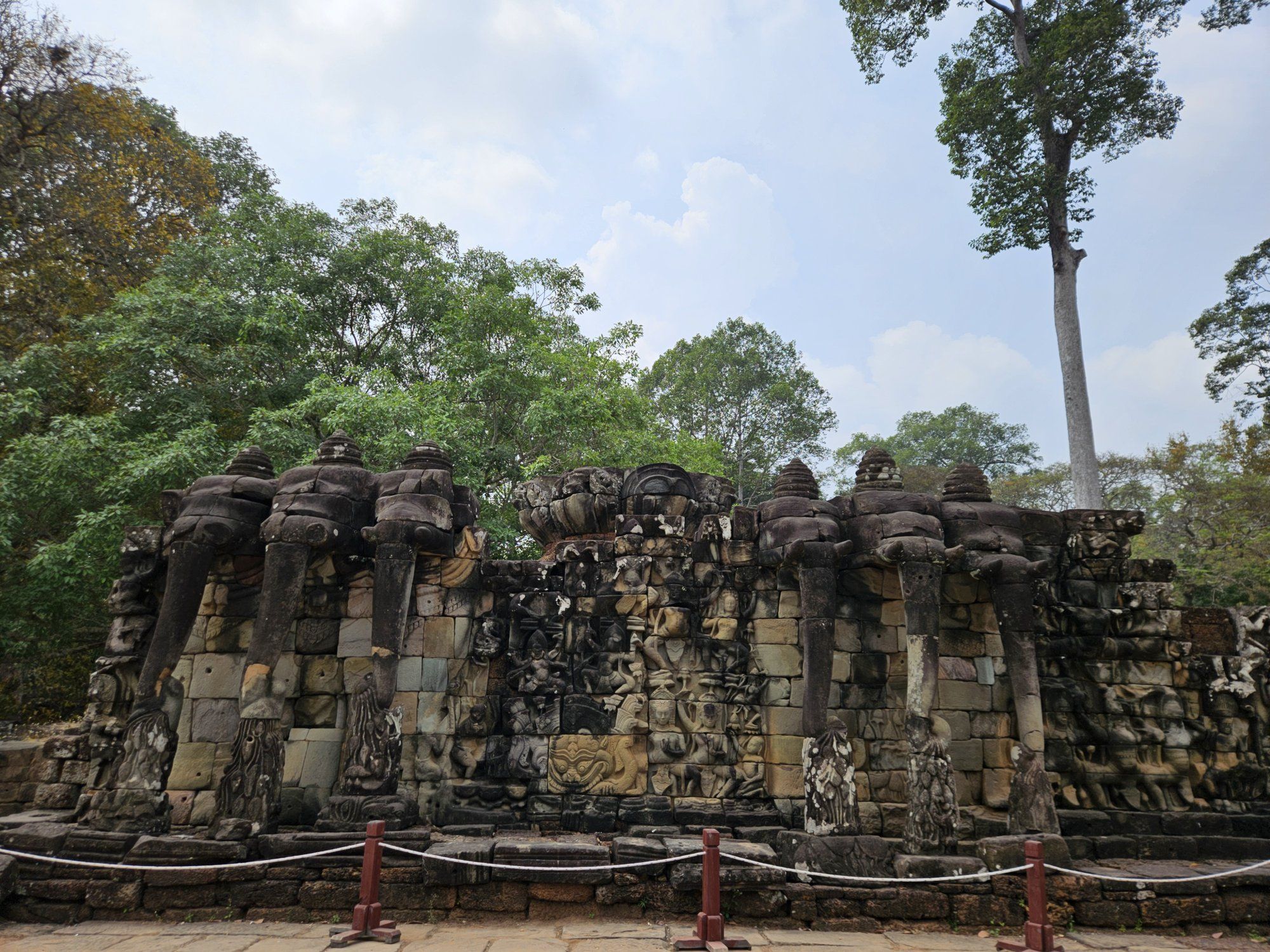
The Terrace of Elephants is not a temple. It is a grandstand, a 350-metre-long platform carved with life-sized elephants where the king would watch military parades, royal ceremonies, and public audiences. The elephants are carved in three dimensions, emerging from the wall like they are walking toward you. It is one of the most photographed, and one of the most crowded, spots in Angkor Thom.
Aditya walked the full length of the terrace. The detail of the elephant carvings (the mahouts, the lotus flowers, the five-headed horses) rewards a slow pass. The best section is the central stairway, flanked by lions and garuda and guarded by elephants with their trunks touching the ground.
The Terrace of the Leper King
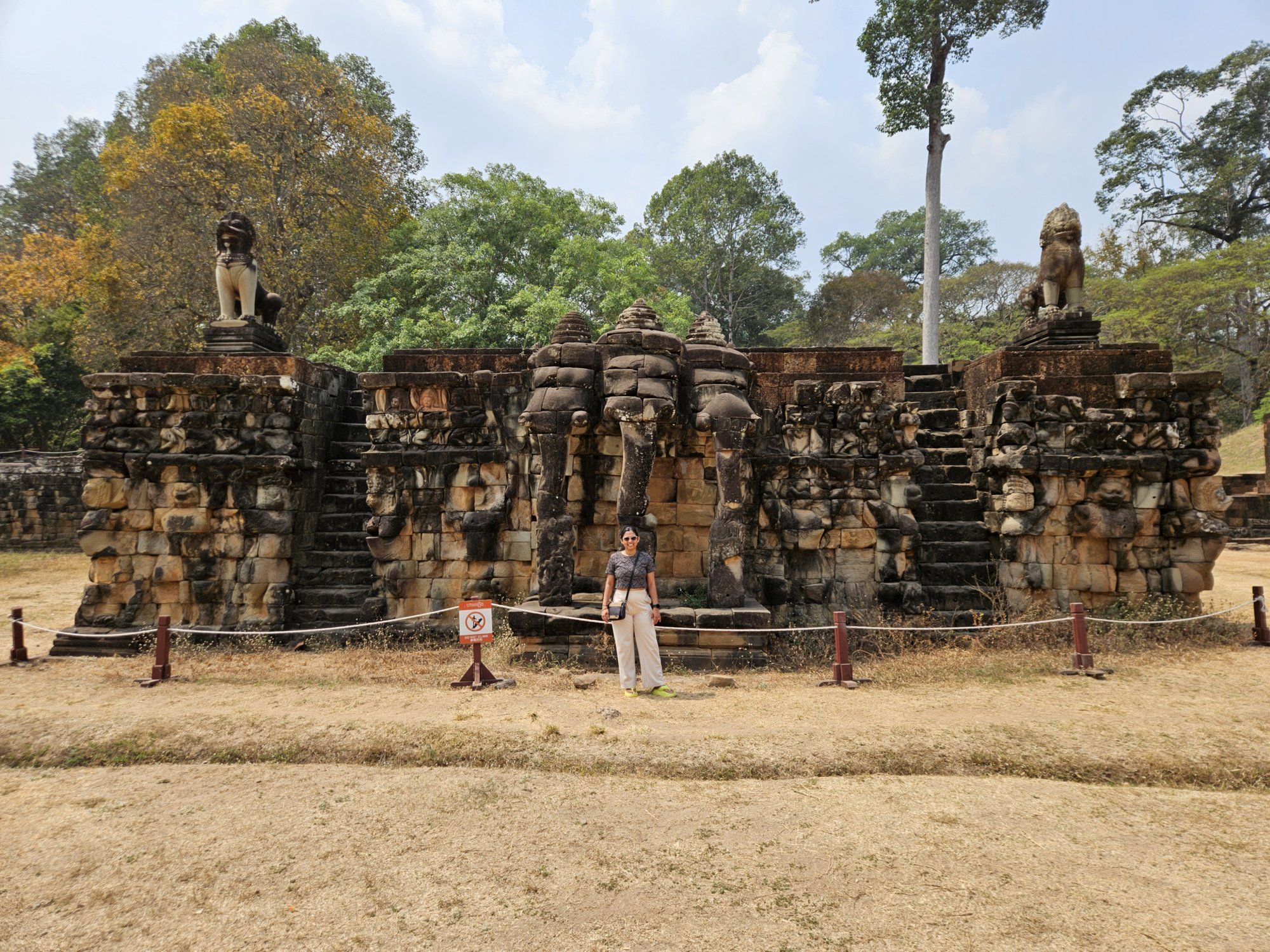
A few steps north of the Elephant Terrace sits a smaller but stranger platform: the Terrace of the Leper King. The name comes from a statue found there, a naked, seated figure with a missing toe, thought by early archaeologists to show symptoms of leprosy. The statue is now in the National Museum in Phnom Penh. The one on site is a replica.
The real treasure of the Leper King Terrace is invisible from the front. Aditya noted the “hidden carvings at the Terrace of the Leper King.” When the terrace was excavated in the 1990s, archaeologists discovered that the outer wall was actually a later addition. Behind it, perfectly preserved, was an earlier wall covered in detailed carvings: the “hidden gallery.” The figures include gods, demons, hunters, ascetics, and forest creatures, arranged in tiers. The quality of the carving is exceptional. The fact that it was hidden for centuries, sealed behind a new wall, only adds to the mystery.
Walk around the back. The entrance to the hidden gallery is on the northern side. The narrow passage between the inner and outer walls is dark and damp, and the carvings emerge from the shadows.
The Pithu Group and the quiet corners
The Pithu Group consists of three small shrines hidden in the forest south of the Terrace of Elephants. They are rarely visited. The carvings are unrestored. The trees grow through the roofs. If you want one corner of Angkor Thom to yourself, this is it.
Aditya also visited Preah Khan on the same day, a huge monastic complex outside the city walls, which we will cover separately. Inside the city, the quiet temples (Preah Palilay, Tep Pranam, the old palace foundations) are the ones that make you feel what Angkor Thom was like when it was alive. A city of wooden houses, royal processions, foreign diplomats, and the constant presence of the king’s face watching from every gate.
How to see them
The interior temples of Angkor Thom work best as a morning circuit after the Bayon. A suggested route: Bayon at opening, walk north to Baphuon (climb the pyramid), continue to Phimeanakas (the view from the top), then walk the full length of the Terrace of Elephants and the Terrace of the Leper King (including the hidden gallery). The Pithu Group and Preah Palilay are optional but rewarding if you have the energy.
Aditya did this on day three, with a guide. The total time inside the walls was about four to five hours, including the Bayon. “More than 35,000 steps each day,” he said. This was a walking trip.
Next: How to visit Angkor, with routes, circuits, and the itineraries that actually work.
Let Tripcuro Plan Your Angkor Journey
Tripcuro designs your Cambodia journey end to end — from flights out of your city and the Angkor temple pass to a Siem Reap stay with perks at Raffles Grand Hotel d’Angkor or Anantara Angkor. We sequence your days so you see the quiet corners too, and handle every detail. Tell us your dates and we will build a bespoke itinerary around them.