
This is Part 7 of our 13-part Angkor series. Read Part 6: Inside Angkor Thom
Every Angkor trip starts with the same question: how many days, which temples, and what order? This post answers it with a real itinerary: the exact route our founder Aditya followed in February 2025, with what worked, what he changed mid-trip, and what he would do next time.
The quick answers
- 3 days for the main temples is the sweet spot. You can cover the Small Circuit, the Grand Circuit, and Banteay Srei.
- Add a fourth day for Phnom Kulen, Kbal Spean, and the outer temples if you have it.
- Rent a scooter if you are travelling as a couple ($7/day). For groups, hire a taxi or minivan.
- Sunrise at Angkor Wat at least once. Aditya did it three days in a row and never regretted it.
- 35,000+ steps per day is normal. Good shoes are not optional.
- $7/day for a scooter was the best value of the entire trip.
The four-day itinerary (what Aditya actually did)
Day 1: Arrive and settle in
Aditya flew in from Kuala Lumpur (Jaipur to KL with a stopover, then KL to Siem Reap). He took the airport bus to CDF Duty Free (note that the bus drop-off location has changed recently), then a tuk-tuk to the hotel for $1 (the price is now $2, still cheap).
Where he stayed: Apsara Centrepole Hotel, near Pub Street. A comfortable 3-star, $25–$50 per night room-only. Similar options: Ta Prohm Hotel, Ibis Styles. For something better: Borei Angkor. For luxury: Sofitel and Raffles.
After checking in, he walked to a scooter rental and rented one for $7 per day. “Scooter works best for a couple,” he says. “For more people, a taxi or minivan works best.”
Recommended driver/taxi: S Vuthorng from siemreaptaxidrivertour. Pre-book for groups.
Evening: walked Pub Street and the Night Market.
Day 2: Small Circuit + Banteay Srei
- 5:00 AM: Angkor Wat sunrise (the pool west of the temple, five towers reflected in the water)
- Back to hotel for breakfast and rest
- Banteay Srei (the pink sandstone temple, 40 minutes northeast)
- Ta Som (the quiet tree-through-the-gate temple)
- East Mebon (the brick temple-mountain on the dry East Baray)
- Pre Rup (sunset-ready pyramid)
- Ta Prohm (late afternoon, softer light, fewer crowds)
- Evening: Pub Street and massage near Old Market
Total: ~35,000 steps.
Day 3: Guided tour of Angkor Wat + Angkor Thom interior
- Morning: Angkor Wat with a guided tour (the bas-reliefs, the central sanctuary, the libraries)
- Bayon (the two hundred faces)
- Preah Khan (the huge monastic complex, north of Thom)
- Phimeanakas (the celestial palace inside the royal enclosure)
- The Pithu Group (three forgotten shrines in the forest)
- Baphuon (the pyramid that took fifty years to rebuild)
- Terrace of Elephants (350 metres of life-sized elephants)
- Terrace of the Leper King (with the hidden gallery)
- Evening: Pub Street and massage
Day 4: Sunrise finals + the east side
- 5:00 AM: Angkor Wat sunrise (yes, a third time; “the crowd was there, but not heavy. I could get a great place every day.”)
- Phnom Bakheng (the hilltop temple, first capital of the area)
- Neak Pean (“a really beautiful temple,” the island temple in the artificial lake)
- Banteay Kdei (the quiet monastic temple)
- Angkor National Museum (air-conditioned, excellent collection, good end to a temple-heavy trip)
- Evening: Pub Street and massage
Next morning: fly out.
What he would do differently
“Give more days. Go to outlying temples like Phnom Kulen and Kbal Spean. Go deeper into the temples and get a feel. Siem Reap is an awesome place and I would probably spend 15–30 days there next. Also I would have more coconut water.”
The clear regret was too little time for the outer day trip to Phnom Kulen (the holy mountain, the river of a thousand linga) and Kbal Spean (the carved riverbed). These need a full day and are best added as Day 5.
The pass tiers
- 1-day pass ($37): Tight but doable. Angkor Wat sunrise, then Angkor Thom, then Ta Prohm. Skip everything else.
- 3-day pass ($62): The sweet spot. Day 1: Small Circuit. Day 2: Angkor Thom interior + Preah Khan. Day 3: Banteay Srei + east side temples. This is what Aditya used.
- 7-day pass ($72): Worth it if you want to go slow, revisit temples in different light, and add outer day trips.
Buy the pass at the official ticket centre (not at the temples). The centre opens at 5 AM for next-day sunrise passes. Bring your passport. Keep the pass on you at every temple. It is checked at the entrance.
Getting around
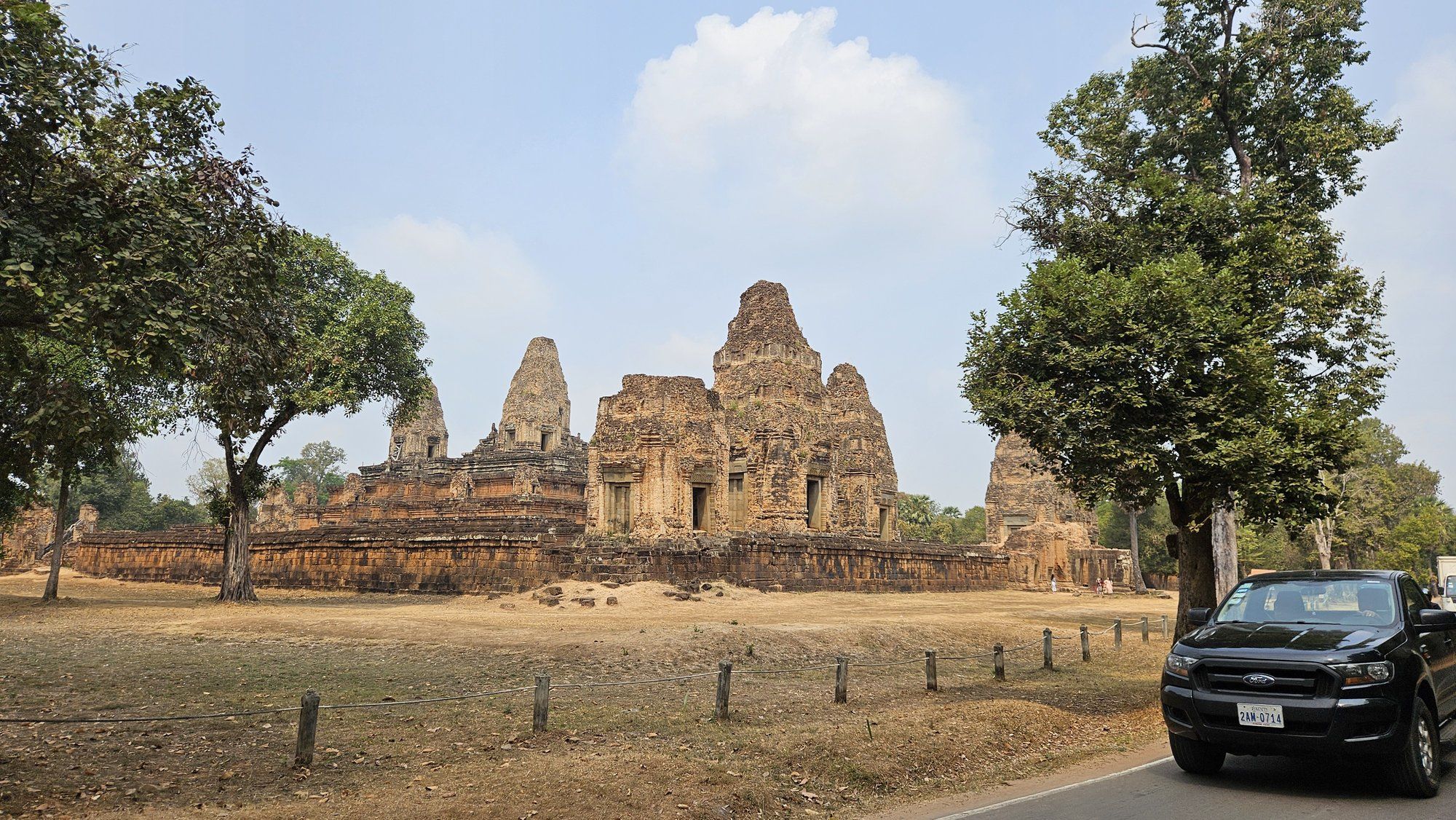
Scooter ($7/day): Best for a couple. Angkor’s roads are flat, the distances between temples are short (1–5 km), and a scooter lets you stop whenever you want. Aditya rented one for all three days and said it was the best money he spent.
Tuk-tuk ($15–$25/day): The standard option. Your driver waits while you explore. Good for two people, fine for three if you like each other.
Car with driver ($35–$50/day): Essential for the Banteay Srei loop (30–40 minutes each way from the main park) and for groups. Recommended driver: S Vuthorng from siemreaptaxidrivertour.
Licensed guide ($40–$60/day): Worth it for at least one day. The carvings repay explanation, and a good guide catches details you would miss on your own. Aditya hired a guide for Day 3 and saw Angkor Wat differently.
Sunrise and sunset strategy
- Angkor Wat sunrise: The classic spot is the reflecting pool west of the temple. Arrive by 5:00 AM. In February, the crowd was moderate and manageable. Aditya found a good spot every day.
- Phnom Bakheng sunset: The hilltop temple limits visitors to 300 at a time. Go early or accept the queue.
- Pre Rup sunset: Less crowded than Phnom Bakheng and equally dramatic. The brick-and-laterite pyramid glows orange in the evening light.
- Srah Srang sunset: The royal bathing pool east of Angkor Thom. Almost empty at sunset. This is the secret alternative.
Money and practical tips
- Entrance fee: 3-day pass $62 (2025 prices, verify before you go).
- Scooter rental: $7/day. You will need an International Driving Permit or a Cambodian driving licence. Check the latest rules.
- Guide: $40–$60/day for a licensed English-speaking guide.
- Tips: A small tip for the guide and driver is standard at the end of each day.
- Water: Bring 2 litres per person per day. The temples are exposed and the heat is real.
- Dress: Shoulders and knees covered. This is an active religious site. A scarf for the shoulders and long shorts or loose trousers are the standard uniform.
- Best time: November to March. February is ideal: dry, warm days, cool mornings, manageable crowds.
Let Tripcuro Plan Your Angkor Journey
Tripcuro designs your Cambodia journey end to end — from flights out of your city and the Angkor temple pass to a Siem Reap stay with perks at Raffles Grand Hotel d’Angkor or Anantara Angkor. We build your itinerary day by day, based on how you like to travel and how many days you have. Tell us your dates and we will build a bespoke itinerary around them.