
Khustain Nuruu National Park
Töv, Mongolia
Why visit Khustain Nuruu National Park?
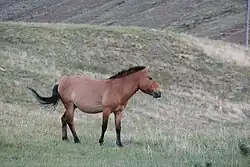
Khustain Nuruu National Park (Хустайн нуруу), also known as Hustai National Park, is a mountain-steppe nature reserve in Töv province, roughly 100 km west of Ulaanbaatar. Its fame rests on a single remarkable animal: the takhi, or Przewalski's horse — the last truly wild horse species on Earth. Once extinct in the wild, the takhi was reintroduced to Khustain from zoo populations in Europe beginning in 1992, and the park's free-ranging herds today number in the hundreds, making it the easiest place in the world to see these stocky, dun-coloured horses living wild on the steppe where their ancestors roamed.
The park protects a transition zone of birch-clad hills, open grassland and shallow river valleys, designated a national park in 1993 and recognised as part of a UNESCO biosphere reserve. Beyond the takhi, it shelters red deer, marmots, gazelle, wolves and a rich birdlife, while the valleys hold ancient features including Turkic-era stone monuments and burial mounds. The visitor centre near the park gate has displays on the takhi reintroduction story and the park's ecology, and ranger-guided drives improve the odds of close sightings.
The reserve's terrain is gentle mountain steppe, and almost the whole approach road is paved. The best time to visit is May through October, when the weather is pleasant; the most rewarding wildlife viewing is at dawn and dusk in late spring and summer, when the takhi come down to graze and water. Winters are severe, with temperatures around −30°C, and most facilities scale back. An entry fee of around US$10 per person is charged at the gate.
Planning Khustain Nuruu National Park? Tell us your dates and we’ll tailor the trip.
Ask on WhatsAppHow do you get there?
By Plane
The nearest airport is Chinggis Khaan International Airport (UBN), near Khöshig Valley south of Ulaanbaatar. From the airport it is roughly 100–120 km to the park; there is no direct transport, so arrange a car or transfer, typically via Ulaanbaatar.
By Car / Road
The park lies about 100 km west of Ulaanbaatar, and the road is paved for nearly the whole route — comfortable for an ordinary car and suitable, with care, even for a cycling trip. The drive takes roughly two to two and a half hours. Most visitors come on an organised tour or hire a car, microbus or jeep with driver; arranging transport through a tour operator or your accommodation in Ulaanbaatar is the simplest approach. There is no scheduled public bus to the park gate.
Inside the park, getting around is by vehicle or on foot. Ranger-guided drives in a jeep are the standard way to find the takhi herds — the rangers know the valleys the horses favour and the times they are most active — while short hikes from the visitor centre and along the valleys let you explore on foot. Wildlife is best watched at dawn and dusk, so plan to overnight at or near the park rather than rushing a day trip. There is no public transport within the reserve; keep the car and driver who brought you, or join the park's guided drives.
What are the things to do?
Takhi (Przewalski's horse) herds — The park's headline sight: free-ranging herds of the world's last wild horse, best seen grazing in the valleys at dawn and dusk; guided drives improve your chances.
Other steppe wildlife — Red deer, Mongolian marmots, gazelle, wolves and abundant birds, including raptors, all visible across the grassland and hills.
Visitor centre and museum — Near the park gate, with exhibits on the takhi reintroduction programme, the park's ecology and conservation work.
Turkic stone monuments — Ancient stone monuments and burial mounds in the park's valleys, relics of the early medieval steppe cultures.
Mountain-steppe scenery — The birch-covered hills, open grassland and the Tuul River along the park's southern edge.
Wildlife watching — The core activity: tracking takhi and other animals, ideally on dawn and dusk drives with a ranger.
Hiking — Walking trails and valley routes from the visitor centre and ger camps offer a closer look at the steppe and its smaller wildlife.
Birdwatching — The mix of steppe, hills and river supports a varied birdlife that rewards patient observers.
Photography — The takhi against the open steppe, the marmots and the rolling birch hills make for memorable images.
Conservation talks — The visitor centre and park staff explain the takhi reintroduction story, one of the world's notable conservation successes.
Planning Khustain Nuruu National Park? Want these on a customised itinerary?
Ask on WhatsAppWhere to eat?
Eating in the park centres on the ger camps and the dining hall near the visitor centre, which serve standard Mongolian fare: mutton soups, buuz (steamed dumplings), khuushuur (fried meat pasties) and rice or noodle dishes. There are no independent restaurants, so arrange meals through your accommodation or the dining hall. Vegetarians should make their needs known well in advance, as the local diet is meat-centred and substitutes are limited.
- Park dining hall (budget to mid-range) — The communal dining facility near the visitor centre and ger camp, serving Mongolian meals to visitors.
Where to drink?
The drink to know is airag, fermented mare's milk, a summer staple of herder families and culturally fitting in horse country; süütei tsai, salty milk tea, is the everyday hot drink. The dining hall and ger camps sell soft drinks, tea, coffee and bottled water; Mongolian beer and vodka may also be available. Bring or buy bottled water — do not drink untreated water from the rivers or streams without boiling or filtering it first. There is no bar or café scene in the park.
Planning Khustain Nuruu National Park? We’ll book the stays and dining for you.
Ask on WhatsAppWhere to stay?
Budget — Camping is the cheapest option. Camping is generally not permitted within the core park, but you can camp almost anywhere on the steppe outside its boundary, including near the Tuul River along the southern edge.
Mid-range — The park operates a ger camp near the visitor centre, renting traditional gers (yurts) with shared facilities and a dining hall; this is the most convenient base for dawn and dusk wildlife drives.
Upscale — There is no upscale lodging at the park; for comfortable hotels, base yourself in Ulaanbaatar and visit on a tour, or look for higher-standard ger camps in the wider region.
What should you buy?
There are no shops to speak of inside the park beyond a small selection of souvenirs and basic supplies at or near the visitor centre. Buy food, water and anything else you need in Ulaanbaatar before you set out. The capital is also the place for souvenirs — cashmere, felt crafts and Mongol artwork — at far better value. Bargaining is normal at open markets in the city but not at fixed-price shops or the park visitor centre.
Where to go next?
- Ulaanbaatar (~100 km east, ~2–2.5 hours) — Mongolia's capital, with Gandan Monastery, Sükhbaatar Square and the National Museum.
- Genghis Khan Equestrian Statue (~150 km east via Ulaanbaatar, ~2.5–3 hours) — The colossal Chinggis Khaan statue at Tsonjin Boldog.
- Gorkhi-Terelj National Park (~170–190 km east via Ulaanbaatar, ~3 hours) — Granite tors, forest and ger camps northeast of the capital.
- Kharkhorin (Karakorum) (~200 km west, ~3.5–4 hours) — The site of the ancient Mongol imperial capital and Erdene Zuu Monastery.
- Zuunmod (~90 km southeast) — The Töv provincial capital, near Manzushir Monastery and Bogd Khan Uul.
Nearby in Töv
More places to explore around Khustain Nuruu National Park.
Guide content as of May 2026. Portions adapted from Wikivoyage, CC BY-SA 4.0.

Contact Us
Get in touch with us.
Get in touch
Contact Us
Tell us where you'd like to go and how you like to travel. A real Tripcuro planner — not a bot — will craft an itinerary around you.
- Personalised, hassle-free planning end-to-end
- Transparent pricing, no hidden costs
- 24/7 support for complete peace of mind