
Prague
Praha, Hlavní město, Czechia
Why visit Prague?
Prague (Praha) is the capital and largest city of Czechia, a city of golden spires, medieval streets, and Baroque grandeur spread across both banks of the meandering Vltava River. With a population of 1.3 million, it is the cultural, economic, and political heart of the country. The historic centre — a UNESCO World Heritage Site — is one of the best-preserved medieval urban ensembles in Europe, having survived World War II largely unscathed. Prague was founded in the 9th century and grew to prominence under the Holy Roman Emperor Charles IV in the 14th century, who made it his imperial capital and built Charles Bridge, St. Vitus Cathedral, and founded the Charles University — the oldest university in Central Europe. The city later flourished under Habsburg rule, producing some of Europe's greatest Baroque architecture and a German-speaking literary tradition that included Franz Kafka and Rainer Maria Rilke. Today, Prague is Czechia's most visited destination, drawing millions of visitors to its castle district, Old Town Square, Jewish Quarter, and vibrant contemporary arts scene.
The best time to visit is May–September for warm weather (20–28°C) and full cultural programmes. July and August are peak tourist season. December brings atmospheric Christmas markets. The city is divided into several distinct districts: Staré Město (Old Town), Malá Strana (Lesser Town) beneath the castle, Hradčany (Castle District), Josefov (Jewish Quarter), and Nové Město (New Town) radiating from Wenceslas Square. Beyond the historic core, Vinohrady and Žižkov offer authentic local life with excellent bars and restaurants.
Planning Prague? Tell us your dates and we’ll tailor the trip.
Ask on WhatsAppHow do you get there?
By Plane
Václav Havel Airport Prague (PRG) is 20 km west of the city centre. Bus 119 connects to Nádraží Veleslavín metro station (Line A) in 20 minutes; the Airport Express bus (AE) goes directly to Praha hlavní nádraží (main train station) in 40 minutes. A taxi to the centre costs 500–700 CZK.
By Train
Praha hlavní nádraží (main station) serves international connections from Berlin (4.5 hours), Vienna (4 hours), Budapest (6.5 hours), Munich (6 hours), and Warsaw (6 hours). The station is on metro Line C. Praha Holešovice station handles some international services.
By Car / Road
Prague is at the centre of the Czech motorway network. The D1 from Brno enters from the southeast, D5 from Plzeň and Germany, D8 from Dresden and Germany, and D11 from Hradec Králové. Parking in the historic centre is very limited and expensive; use P+R lots on the outskirts and take the metro in. The main bus station at Florenc serves domestic and international destinations.
Prague has an excellent integrated transport system (PID) covering metro (three lines — A, B, C), trams (24-hour service on key routes), buses, and a funicular to Petřín Hill. A single ticket (30 minutes, 32 CZK) or day pass (120 CZK) is valid on all modes. Walking is the best way to explore the historic centre — all the main sights are within a 4 km walk. Taxis are available but use Uber or Bolt for fair prices. Bicycle-sharing (Rekola, Nextbike) is widely available.
What are the things to do?
Prague Castle (Pražský hrad) — The largest ancient castle in the world (Guinness World Record), covering 70,000 m². Highlights include the Gothic St. Vitus Cathedral, the Old Royal Palace with Vladislav Hall, the Basilica of St. George, and Golden Lane with its tiny colourful houses.
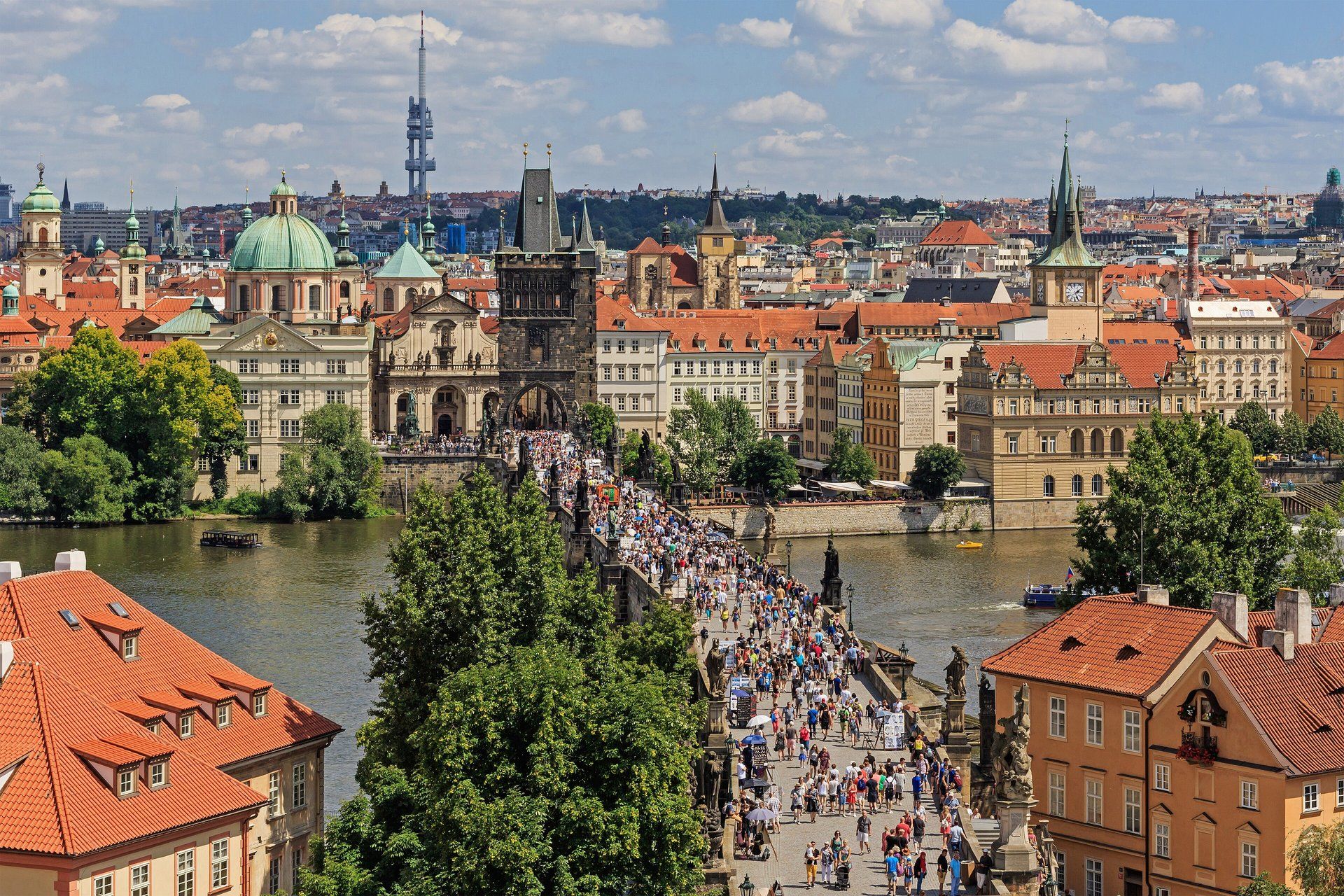
Charles Bridge (Karlův most) — The 14th-century stone bridge lined with 30 Baroque statues, connecting Old Town with Malá Strana. Visit at dawn to avoid crowds.
Old Town Square (Staroměstské náměstí) — The historic heart of Prague, surrounded by Gothic, Baroque, and Rococo buildings. The Astronomical Clock (Orloj) performs a show at the top of every hour.
Jewish Quarter (Josefov) — Six synagogues, the Old Jewish Cemetery with layered 12,000-tombstone burial ground, and the Pinkas Synagogue Holocaust memorial.
Petřín Hill — A green refuge overlooking the city, with a 60-metre Eiffel Tower-imitating lookout, rose gardens, and the Hunger Wall.
Vyšehrad — The historic fort south of the centre, the oldest seat of Czech rulers, with a Gothic basilica and the Slavín Cemetery where Dvořák, Smetana, and Mucha are buried.
Vltava River cruise — 1-hour sightseeing cruises (300–400 CZK) or longer dinner cruises with live music.
Beer spa — Soak in a beer-filled wooden tub at Original Beer Spa in the Old Town (around 2,000 CZK per person).
Classical concert — Attend a performance in the Church of St. Nicholas, the Rudolfinum, or the Estates Theatre.
Prague Zoo — Consistently ranked among the world's best zoos, with a magnificent hilltop setting.
Planning Prague? Want these on a customised itinerary?
Ask on WhatsAppWhere to eat?
Prague's restaurant scene ranges from traditional Czech hospody to Michelin-starred fine dining. Lokál (multiple locations) serves exceptionally executed Czech classics — svíčková, vepřo knedlo zelo, and fresh Pilsner from tanks. U Zlaté Studně offers fine dining with a castle-view terrace. Lehká Hlava (Old Town) and Pastva (Vinohrady) are excellent vegetarian/vegan options. For cheap eats, try chlebíčky from Sisters Bistro or smažený sýr from a traditional pub. Culinary highlights: svíčková na smetaně (beef sirloin in cream sauce), bramboráky (potato pancakes), and for dessert, větrník (cream-filled choux pastry).
Where to drink?
Beer (pivo) is the drink of choice. Pilsner Urquell, Budvar, and Kozel are ubiquitous on tap; the craft beer scene thrives at pubs like Dva Kohouti, BeerGeek, and Pivovarský Dům. Absinthe bars cater to tourists around Old Town Square. The traditional hot drink is svařák (mulled wine) in winter. Becherovka served as Beton (with tonic and lemon) is a Czech cocktail staple.
Planning Prague? We’ll book the stays and dining for you.
Ask on WhatsAppWhere to stay?
- Budget: Hostel One Home (300–600 CZK dorm bed), Plus Prague (200–500 CZK dorm bed) — both in the centre
- Mid-range: Hotel Julian (2,000–3,500 CZK double), Cosmopolitan Hotel (2,500–4,000 CZK double) — both well-located
- Upscale: Hotel Imperial (4,000–7,000 CZK double) — stunning Art Nouveau building, or the Four Seasons Prague (10,000+ CZK) for luxury The best-value neighbourhoods are Vinohrady and Karlín, both a short tram ride from the centre.
What should you buy?
Prague offers excellent shopping for Bohemian crystal, garnet jewellery, Czech amber, and wood crafts. Pařížská Street is the luxury shopping strip. For souvenirs, head to Havelské tržiště (Havel's Market) in the Old Town. Manufaktura stores sell high-quality Czech crafts, including wooden toys and traditional linen. Palladium and Kotva department stores offer mainstream shopping.
Where to go next?
- Kutná Hora — 1 hour by train, the UNESCO-listed medieval silver-mining town with St. Barbara's Church and the Sedlec Ossuary (bone church)
- Karlštejn Castle — 45 minutes by train, the iconic Gothic castle built by Charles IV
- Český Krumlov — 3 hours by bus/train, the UNESCO-listed fairy-tale town
- Plzeň — 1.5 hours by train, the home of Pilsner Urquell brewery and Czechia's fourth city
- Krkonoše Mountains — 2 hours by bus, Czechia's highest mountains for hiking and skiing
Sample itinerary
Prague features in a real Tripcuro trip — see the full day-by-day plan.
Guide content as of June 2026. Portions adapted from Wikivoyage, CC BY-SA 4.0.

Contact Us
Get in touch with us.
Get in touch
Contact Us
Tell us where you'd like to go and how you like to travel. A real Tripcuro planner — not a bot — will craft an itinerary around you.
- Personalised, hassle-free planning end-to-end
- Transparent pricing, no hidden costs
- 24/7 support for complete peace of mind