
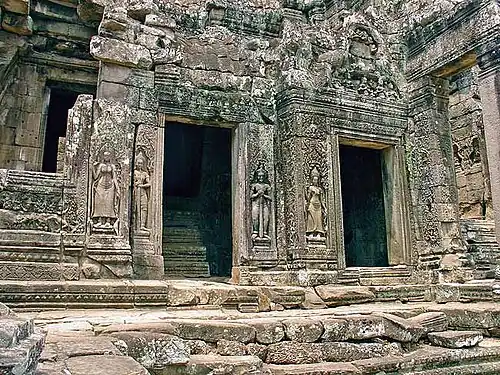
Angkor Archaeological Park
Siem Reab, Cambodia
Why visit Angkor Archaeological Park?
Angkor Archaeological Park is the spiritual and cultural heart of Cambodia — a 400-square-kilometre forested expanse north of Siem Reap that holds the ruins of successive capitals of the Khmer Empire, which ruled much of mainland Southeast Asia from the 9th to the 15th centuries. At its peak, Angkor was the largest pre-industrial city in the world, with a population estimated to have approached one million when London held perhaps 50,000. The park's hundreds of monuments range from the iconic five-towered silhouette of Angkor Wat — the largest religious monument on earth — to the enigmatic face-towers of the Bayon, the strangler-fig embrace of Ta Prohm, and dozens of smaller jungle-shrouded shrines that most visitors never reach. UNESCO inscribed the park as a World Heritage Site in 1992, simultaneously placing it on the List of World Heritage in Danger because of looting, a falling water table, and unsustainable tourism.
The temples were built across roughly six centuries by a succession of god-kings, and the park's character shifts depending on which era you're walking through. Early Angkor was emphatically Hindu, oriented around the temple-mountain — a stone representation of Mount Meru, surrounded by a moat, pyramidal in form, topped by five towers. Jayavarman VII converted to Mahayana Buddhism around 1200 CE and built a new capital, Angkor Thom, with Bayon at its centre and Ta Prohm and Preah Khan as monastic complexes. His Hindu successor Jayavarman VIII reversed course and systematically defaced Buddhist images. Recurring motifs — the bare-breasted apsara (celestial nymph), the jawless guardian face of the kala, and the many-headed naga lining causeways — repeat across temples and centuries.
The park has no accommodation and few facilities; the tourist hub is Siem Reap, 6 km south. Climate dictates almost everything about the visit. The dry, cool peak season runs November to February (25–30°C), but the temples are crowded and hotel rates spike around Christmas and New Year. March to May is brutally hot, often hitting 40°C. June to October is the rainy season — outlying temples become quagmires, but the main monuments are blissfully empty and a half-day round of sightseeing is usually possible before the afternoon downpour. Dress codes are enforced: shoulders and knees must be covered, particularly to access the upper tier of Angkor Wat, and a thin scarf may not be accepted as cover.
Planning Angkor Archaeological Park? Tell us your dates and we’ll tailor the trip.
Ask on WhatsAppHow do you get there?
By Plane
Siem Reap–Angkor International Airport (SAI) opened in October 2023 and replaced the old in-town airport. It sits about 50 km east of Siem Reap near Sotr Nikum, roughly a 45–60 minute drive from the town centre. A licensed airport taxi to a Siem Reap hotel costs around US$30–35; shared minivan shuttles run for US$8–10 per person. Some hotels offer free or discounted transfers — worth confirming when booking. From central Siem Reap, the south entrance of Angkor is a further 15–20 minutes by tuk-tuk or car.
The old in-town airport (formerly REP) is closed to commercial passenger traffic, though Helistar Cambodia operates scenic flights from the Military Apron of the former airfield.
By Car / Road
Siem Reap is the staging point for all road access to Angkor. Common approaches:
- From Phnom Penh: ~315 km via NH6, 5–6 hours by car. Express minivans (Giant Ibis, Mekong Express, Virak Buntham) cost US$15–20 and take 6–7 hours; sleeper buses run overnight.
- From Bangkok (Thailand): ~410 km via the Poipet/Aranyaprathom border crossing, 8–10 hours total including border formalities. Direct bus and train+bus combinations are available; the Bangkok–Aranyaprathom train followed by a tuk-tuk to the border and an onward minivan to Siem Reap is the budget option.
- From Battambang: ~170 km, 3–4 hours by minivan (US$8–10).
- From Sihanoukville: ~480 km via Phnom Penh, 9–11 hours; flying or splitting the trip is recommended.
Once in Siem Reap, the southern park entrance and APSARA ticket office are about 6 km north of town, roughly a 20-minute drive.
You cannot tour Angkor on foot — distances between temples are too great. Choose your wheels based on time, budget, and stamina.
- Tuk-tuk — the default. Around US$15/day for the Small Circuit (Angkor Wat, Angkor Thom, Ta Prohm), US$20–30 for the Big Circuit or further-flung temples like Banteay Srei. A US$3 supplement is common for a 05:00 sunrise start at Angkor Wat. Drivers must be licensed and wear a numbered grey vest inside the park.
- Car with driver — US$45–50/day with an English-speaking licensed guide; US$30–40/day for driver only. Add US$5–10 for outlying sites; more for remote ones like Beng Mealea.
- Motorbike with driver — US$6–8/day, plus extras for distant temples. Same vest requirement applies.
- Bicycle — US$3–4/day from Siem Reap rental shops. Excellent for the Small Circuit and Angkor Thom, manageable for the Big Circuit if you start at dawn. Roads inside the park are paved, traffic is light, and shaded trees make the riding pleasant. Bring at least 2 litres of water; bottled water inside the park costs ~US$2.
- Electric cars — short-hop shuttle service for US$2 round trip, found at Angkor Wat and the Terrace of the Elephants.
- Tour buses — US$25–70/day with guide. Convenient but visit only the marquee sights and arrive at peak crowd hours.
- Helicopter — Helistar Cambodia from US$90/person for a 14-minute loop over Angkor Wat, Pre Rup, and Eastern Mebon. Departs from the Military Apron at the old Siem Reap airport. Bookings via hotels or +855 12 449 555.
Self-drive motorbike rental to foreigners is officially discouraged in Siem Reap; rental shops do exist, but always wear a helmet (legally required) and expect to be stopped if you don't. Cycling on the island of Angkor Wat itself is not permitted — expect to walk a fair distance once inside.
Angkor Pass (mandatory, photo taken on purchase, carry at all times):
- 1-day: US$37
- 3-day (any 3 days within a week): US$62
- 7-day (any 7 days within a month): US$72
Buy only at the official APSARA ticket office off the highway from Siem Reap, or online via the Angkor Enterprise website. Sales close at 17:30; passes issued after 17:00 do not count toward your day allowance and are valid from the next day. Cambodian citizens, K-visa holders, and children under 12 (with passport) enter free.
Scams to watch: unofficial "ticket sellers" near the park entrance — always buy at the APSARA office or online; "guides" who approach you at temples without credentials; and tuk-tuk drivers who promise the Big Circuit but cut it short. Agree on the route and price in writing or on a sketch map before setting off.
What are the things to do?
Most visitors structure their trip around the Small Circuit (17 km loop covering Angkor Wat, Angkor Thom, and Ta Prohm) and the Big Circuit (26 km, adding Preah Khan, Neak Pean, Ta Som, Eastern Mebon, and Pre Rup). Temples generally open 05:00 to 17:30; Angkor Wat and Pre Rup open earlier for sunrise, Phnom Bakheng stays open later for sunset. All sites require an Angkor Pass — no separate ticket cost.
The Essentials
- Angkor Wat — The largest religious monument on earth and the symbol on Cambodia's flag. Built by Suryavarman II in the early 12th century as a Hindu temple to Vishnu, later converted to Buddhist use. The 800-metre bas-relief gallery (Churning of the Sea of Milk, Battle of Kurukshetra) and the steep climb to the upper sanctuary are the highlights. Sunrise from the western causeway is iconic but extremely crowded.
- Bayon — At the geographic centre of Angkor Thom. Jayavarman VII's state temple, famous for 200+ enigmatically smiling stone faces carved on 54 towers. Best visited mid-morning when light catches the faces. Don't miss the outer-gallery bas-reliefs depicting daily life and the Khmer–Cham naval battles.
- Ta Prohm — Left in semi-ruined state by conservators; massive silk-cotton and strangler-fig roots fuse with the stones. Made famous by Tomb Raider (2001). Goes early or late to avoid the worst crowds.
- Angkor Thom — The 9-km² walled city of Jayavarman VII. Enter via the South Gate (the most photogenic, with intact naga-bearing devas and asuras lining the causeway). Other highlights: the Terrace of the Elephants, the Terrace of the Leper King, and the Baphuon.
The Big Circuit
- Preah Khan — Sprawling 12th-century monastic complex, atmospheric and lightly visited. Highlights include the unique two-storey columned building (purpose unknown) and a striking vaulted hall.
- Neak Pean — A small island temple in the centre of the now-restored Jayatataka baray. Reached via a wooden boardwalk through flooded forest — beautiful in the wet season.
- Ta Som — Compact but rewarding, with a famous strangler-fig-covered eastern gopura.
- Pre Rup — Tiered laterite pyramid, popular for sunset.
- Eastern Mebon — 10th-century temple built on what was an island in the now-dry East Baray; flanked by life-size stone elephants at its corners.
Sunrise & Sunset Spots
- Phnom Bakheng — Hilltop temple, classic sunset view over Angkor Wat. Visitor numbers are capped to 300 at the summit; arrive 90 minutes early.
- Pre Rup — Less crowded sunset alternative on the Big Circuit.
- Sras Srang — A serene royal bathing reservoir, good for both dawn and dusk light.
Further Afield
- Banteay Srei — 25 km northeast of Angkor Wat (35–45 min by tuk-tuk; expect a US$10 supplement). The "Citadel of the Women" is carved from rose-pink sandstone and famed for the finest, most delicate bas-reliefs in all of Khmer art.
- Roluos Group (Bakong, Preah Ko, Lolei) — 13 km east of Siem Reap. The pre-Angkorian capital of Hariharalaya (late 9th century); Bakong is the prototype temple-mountain.
- Beng Mealea — 65 km east, partially cleared 12th-century temple in jungle ruin. Half-day excursion; covered by the Angkor Pass.
- Banteay Samre — Often-overlooked 12th-century temple east of the Big Circuit; quiet and well preserved.
Museums
Angkor National Museum — On Charles de Gaulle Blvd in Siem Reap. Eight thematic galleries and a Hall of 1,000 Buddhas. Useful primer before visiting the temples. Daily 08:30–18:30; admission US$12 (US$5 supplement for audio guide). About 30–45 minutes is enough; serious enthusiasts may want longer.
Preah Norodom Sihanouk-Angkor Museum — Smaller, focused on artefacts recovered from the Koh Ker site. Daily 08:00–17:00; admission US$3.
Sunrise at Angkor Wat — The classic experience. Arrive at the western causeway by 05:00–05:15 in dry season for a 06:00 sunrise. The reflecting pool to the left of the causeway gives the postcard shot.
Hire a licensed guide for at least one day — Around US$20/day for English; other major languages available. The carvings only make sense with someone reading them for you. Book through your hotel or the Khmer Angkor Tour Guides Association.
Multi-day temple itineraries — Three days lets you see the major and most secondary temples without rush. Seven days is the right length if you're an enthusiast and want Banteay Srei, the Roluos Group, and Beng Mealea included.
Cycling tour — Self-guided or with operators like Grasshopper Adventures (half- and full-day rides through the temples and surrounding villages, ~US$45–95).
Cooking classes in Siem Reap — Several reputable schools (Cooks in Tuk Tuks, Lily's Secret Garden, Le Tigre de Papier) run half-day classes for US$25–35 including market visit.
Phare, the Cambodian Circus — In Siem Reap, not Angkor, but a must: contemporary circus performed by graduates of a Battambang arts NGO. Tickets US$18–38; nightly at 20:00.
Quad-bike or buggy tours through the rice paddies and villages outside the park (operators in Siem Reap, ~US$45 for a sunset ride).
Apsara dance performance — Several dinner shows in Siem Reap; the Apsara Theatre at Angkor Village (US$28 with dinner) and Rosana Broadway are well-regarded.
Hot-air balloon ride — Tethered balloon near Angkor Wat for an aerial view (~US$20, 10 minutes).
Floating villages on Tonlé Sap — Day trips to Kompong Phluk (stilted village) or Kompong Khleang (more authentic, less touristy). Around US$20–30 by tuk-tuk + boat combo.
Volunteer / responsible visits — APOPO's HeroRAT visitor centre near Angkor (mine-detection rats; US$10) and the Cambodia Landmine Museum near Banteay Srei (US$5) give context to the country's recent history.
Planning Angkor Archaeological Park? Want these on a customised itinerary?
Ask on WhatsAppWhere to eat?
Khmer food sits alongside Thai and Vietnamese in the regional pantheon but is gentler in spice, with an emphasis on freshwater fish, palm sugar, kroeung (lemongrass-galangal-turmeric paste), and the funky fermented fish paste prahok. The signature dish is fish amok — a coconut-cream curry of fish steamed in banana leaf. Other standards include lok lak (peppered stir-fried beef), bai sach chrouk (grilled pork on broken rice, the classic breakfast), nom banh chok (rice noodles with green fish curry), and kuy teav (pork-bone noodle soup).
Inside the park, food is mostly from rest stops and stalls clustered around Angkor Wat's north entrance and near Bayon — fried rice, noodle soup, baguettes, and cold drinks for US$3–6. You'll eat better, and not much more expensively, in Siem Reap. Dietary needs are well-handled: most tourist-area menus mark vegetarian options and many places do gluten-free and halal on request.
- Sister Srey Café (budget–mid; Pokambor Avenue, riverside) — All-day brunch, smoothie bowls, and Khmer staples. Mains US$5–8. Trains and employs at-risk Cambodian youth.
- Khmer Kitchen Restaurant (budget; The Lane, off Pub Street) — Long-running local favourite for amok, lok lak, and Khmer curries. Mains US$3–6.
- Marum (mid; Wat Polanka area) — TREE Alliance training restaurant; creative Khmer tapas (red tree-ant beef salad, crispy frog legs) in a leafy garden. Plates US$5–9.
- Cuisine Wat Damnak (upscale; on the south river) — Two tasting menus rotating fortnightly by chef Joannès Rivière. US$36 (5 courses) / US$42 (6 courses). Reservations essential, closed Sun–Mon.
- Mahob Khmer (mid–upscale; Sok San Road) — Refined contemporary Khmer in a wooden villa. Mains US$10–15; tasting menu around US$28.
- Pou Restaurant (upscale; behind Wat Damnak) — Modern Khmer fine dining; sharing menus from US$45.
- Bugs Café (mid; Angkor Night Market Street) — for the curious: tarantula doughnuts, scorpion skewers, ant tempura. Mains US$5–10.
Where to drink?
The water from the tap is not safe to drink — stick to bottled or filtered water, widely available for ~US$0.50 in town and US$1–2 inside the park. Most reputable hotels and restaurants use filtered ice; cheaper ones may not.
Cambodia's national lager is Angkor Beer; Cambodia, Anchor, and Ganzberg are the other big domestic brands, all around US$0.50–1 a draught at happy hour. The local rice wine sraa is potent and an acquired taste; palm wine (sraa thnaot) is fresher and better. The country's emerging craft scene is led by Cerevisia Craft Brewhouse and Fuzzy Logic, both available across Siem Reap.
- Pub Street — the loud, neon-lit centre of Siem Reap nightlife. Cheap drinks, mostly cover bands, fun for an evening; not where you'll find your most memorable cocktail.
- Miss Wong (The Lane) — 1930s-Shanghai-themed cocktail bar, the standout for craft drinks.
- Asana Old Wooden House (Street 7) — cocktails in a traditional stilted Khmer house; rice-spirit infusions.
- Sombai (Wat Damnak area) — flavoured rice-liqueur tasting room; tours and tastings around US$8.
- The Embassy (King's Road Angkor) — wine bar attached to the Embassy fine-dining restaurant.
- Little Red Fox Espresso (Hup Guan St, Kandal Village) — excellent third-wave coffee from Cambodian beans. Open from 07:00.
- Brown Coffee — local chain, reliable for iced coffee with condensed milk in a cool, working-friendly space.
For coconut water, fresh coconuts are sold from carts inside and around the park for around US$1–2.
Planning Angkor Archaeological Park? We’ll book the stays and dining for you.
Ask on WhatsAppWhere to stay?
There is no accommodation inside the park. All sleep options are in Siem Reap; transport to the south entrance is 15–20 minutes by tuk-tuk.
Budget
- Onederz Siem Reap (Sivatha Road) — Capsule and dorm beds with a rooftop pool. Dorms from US$8, privates from US$25.
- Mad Monkey Siem Reap (off Sivatha) — Reliable backpacker stalwart; pool, bar, social events. Dorms from US$7, privates from US$22.
Mid-range
- Lub d Cambodia Siem Reap (Sok San Road) — Polished Thai-owned hostel-hotel hybrid with co-working, pool, and a strong food scene. Doubles from US$55.
- Tara Angkor Hotel (Charles de Gaulle Blvd) — On the road to Angkor; dependable mid-range with two pools. Doubles from US$70.
- Golden Temple Hotel — Long-running boutique with strong service reputation. Doubles from US$80.
Upscale / Heritage
- Raffles Grand Hotel d'Angkor (1 Vithei Charles de Gaulle) — The grande dame, opened 1932 in colonial-era splendour. Apsara fountain pool, the Elephant Bar (a Siem Reap institution). Doubles from US$320.
- Belmond La Résidence d'Angkor (River Road) — Riverside compound of timber-and-stone villas. Doubles from US$300.
- Park Hyatt Siem Reap (Sivatha Road) — Contemporary luxury in the centre of town; spa, two pools. Doubles from US$280.
- Amansara (former royal villa of King Sihanouk, off Charles de Gaulle Blvd) — All-inclusive, 24-suite, fly-or-sell-your-house-for-it luxury. Suites from US$1,400.
- Phum Baitang (south of town, by Bakong area) — 45 villas on 8 hectares of rice paddies. Doubles from US$450.
What should you buy?
The park itself has only stalls of postcards, scarves, and pirated guidebooks at the major temples — buy here only what you forgot to pack. The serious shopping is in Siem Reap.
- Angkor Night Market (off Sivatha Road) and Made in Cambodia Market (next to King's Road) — vetted, locally produced goods at the latter, mass-market souvenirs at the former.
- Old Market (Psar Chas) — central Siem Reap, the place for spices, kramas (the all-purpose checked Khmer scarf), silver, and silk.
- Artisans Angkor — fair-trade workshop and showroom on Stung Thmey Street; stone carvings, lacquerware, and silk products made by trained Cambodian artisans. Free workshop tours.
- Theam's Gallery — refined silk scarves, lacquer panels, and homewares from designer Lim Muy Theam.
- Senteurs d'Angkor — locally sourced spices, soaps, candles, and teas; multiple branches.
Bargaining is expected at markets but not in fixed-price boutiques like Artisans Angkor or Theam's. Open with around 50–60% of the asked price and settle around 70%. Always check that "antiques" are reproductions — the export of genuine Khmer artefacts is illegal and you risk prosecution at both ends.
Where to go next?
- Siem Reap town (6 km / 15 min) — Your base, but worth a day in its own right for the Old Market, Pub Street, Phare circus, and the Angkor National Museum.
- Tonlé Sap Lake & floating villages — Kompong Phluk (~30 km / 45 min) or Kompong Khleang (~55 km / 90 min). Stilted villages and seasonally flooded forest; best in wet season (Aug–Nov).
- Banteay Srei & Cambodia Landmine Museum (~32 km / 45 min) — Pink-sandstone temple combined with a sobering museum on the country's mine-clearance work.
- Beng Mealea (~65 km / 90 min) — Jungle-swallowed 12th-century temple; covered by the Angkor Pass. Combine with Koh Ker for a long day.
- Koh Ker (~120 km / 2.5 hr) — Brief 10th-century capital of Jayavarman IV; seven-tiered pyramid Prasat Thom. UNESCO-listed in 2023.
- Battambang (~170 km / 3–4 hr by bus) — Cambodia's second city, French-colonial architecture, the Bamboo Train, Phare Ponleu Selpak circus school, and surrounding hill temples.
- Preah Vihear (~210 km / 4 hr) — Dramatic cliff-top Hindu temple on the Thai border, also UNESCO-listed; fewer crowds than Angkor.
Nearby in Siem Reab
More places to explore around Angkor Archaeological Park.
Guide content as of May 2026. Portions adapted from Wikivoyage, CC BY-SA 4.0.

Contact Us
Get in touch with us.
Get in touch
Contact Us
Tell us where you'd like to go and how you like to travel. A real Tripcuro planner — not a bot — will craft an itinerary around you.
- Personalised, hassle-free planning end-to-end
- Transparent pricing, no hidden costs
- 24/7 support for complete peace of mind