
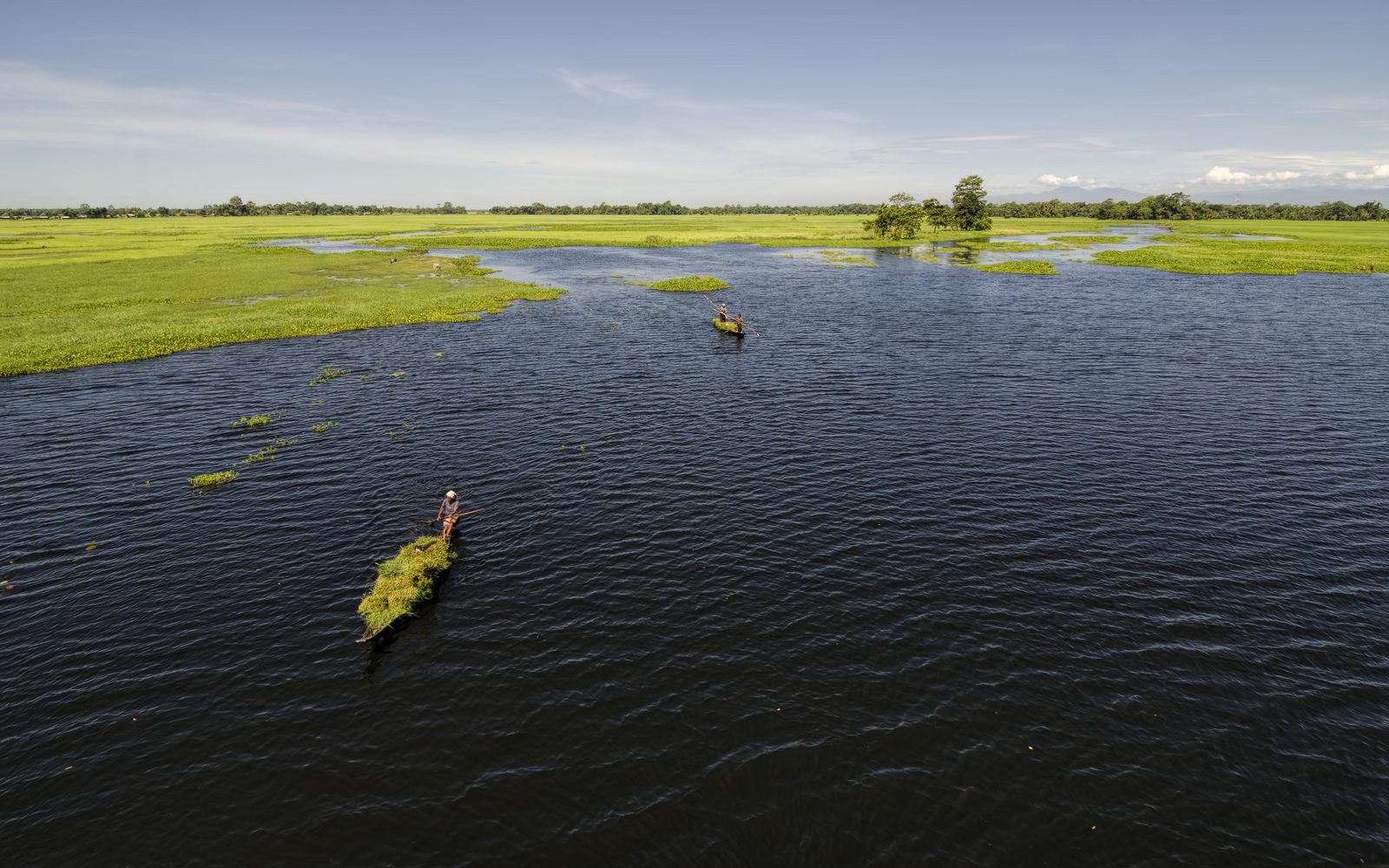
There is a place in the middle of the Brahmaputra where the land is quietly disappearing and, somehow, the culture keeps getting louder. Majuli, the world’s largest river island, sits a short ferry ride from Jorhat in upper Assam, and in 2026 it is having its moment. If you want the real Northeast India before it changes, this is the year to go.
Why Majuli is trending in 2026
For years Majuli was a whispered tip passed between slow travellers and culture nerds. That is changing fast, for a few concrete reasons.
- A UNESCO push is gathering pace. Majuli has sat on UNESCO’s Tentative List since 2004, and the nomination dossier for its river-island landscape and living satra (monastery) culture has been actively worked on. A formal World Heritage bid keeps the island in the national conversation.
- Two GI tags landed on its crafts. Majuli’s mask-making (Mukha Xilpo) and its manuscript painting on tree-bark sanchi pat both received Geographical Indication status, giving the island’s artisans official recognition and a fresh wave of visitors curious about the crafts.
- A bridge is being built. The roughly 6.8 km Jorhat-Majuli bridge over the Brahmaputra is under construction. It has hit delays and will not be finished this year, but its progress is exactly why 2026 matters: for now, the only way across is still the ferry, and that dreamlike river crossing is part of the magic that a bridge will eventually make ordinary.
- It markets itself as a carbon-neutral island. Assam has positioned Majuli as a low-impact, eco-conscious destination, which fits the way discerning travellers now want to travel.
Put simply: the recognition has arrived, but the crowds and the concrete have not. That window is 2026.

The satras: living monasteries, not museums
Majuli is the beating heart of Assam’s neo-Vaishnavite culture, a devotional tradition founded by the 15th-century saint-reformer Srimanta Sankardeva. Its expression is the satra — part monastery, part arts academy, part village — and the island still has more than twenty of them. This is what makes Majuli unlike anywhere else in India.
A few stand out:
- Samaguri Satra is world-famous for mask-making. Watch artisans build expressive masks of gods, demons and mythical birds from bamboo, clay and cloth — a single elaborate mask can take up to two weeks. Many workshops let you try your hand at it.
- Auniati Satra is known for classical satra dance, borgeet devotional music and a small museum of Assamese royal and ritual artefacts.
- Kamalabari Satra is a centre for art, culture and literature, and a hub for performances.
- Dakhinpat Satra is a principal seat of Vaishnavite learning, closely tied to the island’s grand Raas tradition.
These are working religious communities, so dress modestly and ask before photographing. The reward is watching a 500-year-old art form performed by the people who never stopped performing it.
Beyond the monasteries: the island itself
Majuli is roughly 20 km from Jorhat but feels like another century. Spend time simply moving through it slowly.
- Cycle the causeways. Flat lanes run between emerald paddy fields, ponds and clusters of stilted bamboo homes belonging to the Mising tribal community. A rented bicycle or scooter is the ideal pace.
- Meet the Mising and other tribal communities. Homestays here are the real experience — hand-woven textiles, rice beer, and food cooked over a fire in a raised bamboo house.
- Watch the birds. In winter the wetlands fill with migratory birds, and the light over the Brahmaputra at dawn and dusk is extraordinary.
- Buy the crafts at the source. Pottery made without a wheel, hand-loomed cloth, and those GI-tagged masks and manuscript paintings make souvenirs with genuine provenance.
If you can time it, the Raas Mahotsav in mid-November turns the whole island into a stage, with satras enacting the life of Krishna across nights of dance and drama. The 2026 edition is expected around 15 to 17 November.

A suggested rhythm: ~3 to 4 days
Majuli rewards slowness, so resist the urge to day-trip it.
- Day 1 — Arrive. Fly into Jorhat, drive ~30 to 45 minutes to Nimati Ghat, and take the ferry across (~1 to 1.5 hours). Settle into a Mising homestay or eco-cottage and watch your first island sunset.
- Day 2 — The satras. Samaguri for masks, Auniati or Kamalabari for performance and history. Try a mask workshop in the afternoon.
- Day 3 — The island’s other life. Cycle the paddy lanes, meet weavers and potters, birdwatch at dawn, and eat where you sleep.
- Day 4 — Slow exit. A final riverside morning before the ferry back to Jorhat.
Add a night in Jorhat itself for its tea-estate bungalows and colonial-era Gymkhana Club if you want to bookend the trip with old-Assam tea country.
For travellers from India
Visa and entry. Majuli is domestic travel — no visa, no permit. Unlike some Northeastern states, Assam does not require an Inner Line Permit, so Indian nationals just carry a government photo ID. Foreign visitors no longer need special area permits for Assam but should carry a passport.
Flights. The gateway is Jorhat (JRH), about 20 km from the ferry point. As of 2026, IndiGo is the main carrier here. Delhi to Jorhat is roughly a ~4-hour direct flight, with connecting options via Kolkata or Guwahati. From Bengaluru or Mumbai, expect a connection, usually through Kolkata. Alternatively, fly into Guwahati (GAU) — far better connected nationally — and take a ~50-minute hop to Jorhat or the scenic ~6-hour road journey.
Getting onto the island. From Jorhat, drive to Nimati Ghat, then cross by government ferry to Kamalabari or Aphutia Ghat. Public ferries typically run through the day for a nominal fare; a larger Ro-Pax vehicle ferry also operates. Sailings thin out by mid-afternoon, so cross early.
Best time to go. October to March. Winter brings clear skies, comfortable days, migratory birds and the big cultural festivals. Avoid the monsoon (roughly June to September), when the Brahmaputra floods and ferry schedules turn unreliable.
Food and connectivity. Eat Assamese — light, herb-forward, fish-and-rice cooking, plus Mising specialities in the homestays. Mobile signal is patchy and the island runs on a gentler electricity supply than the mainland, so download offline maps, carry a power bank, and treat the disconnection as part of the point. Carry enough cash; ATMs are few.
Planning it well
Majuli is not hard to reach, but it is easy to get wrong — arriving on the last ferry, missing the festival by a week, or booking a soulless guesthouse when the whole appeal is the homestays. The satras keep their own rhythms, the ferries keep theirs, and the flights into Jorhat are limited enough that timing genuinely matters. Get the sequence right and Majuli becomes one of the most quietly moving trips in India; get it wrong and you spend the visit chasing logistics. This is exactly the kind of destination where a little groundwork pays for itself many times over.
Let Tripcuro Plan Your Majuli, Assam Trip
Tripcuro designs your Majuli journey end to end, from the right Jorhat flight and a well-timed ferry crossing to hand-picked Mising homestays and private satra visits. We build the itinerary around the festivals, the light and the crafts you actually care about, so every day flows. Tell us your dates and we will shape a bespoke trip that feels effortless from the first ferry to the last sunset.