

Say “Dominica” and half your friends will picture the wrong country. This is not the Dominican Republic with its all-inclusive beach resorts; it is the Commonwealth of Dominica, a small, ferociously green volcanic island in the eastern Caribbean that the tourism board simply calls the Nature Island. There are 365 rivers, a lake that boils, a rainforest interior protected as a UNESCO World Heritage Site, and almost no crowds. In 2026 it is finally getting the attention it has always deserved.
Two things tipped it over. In late 2025 Dominica’s parliament passed the world’s first law creating a marine reserve for sperm whales, roughly 800 square miles of protected water off the west coast where a resident population lives year-round. Then National Geographic put the island on its Best of the World 2026 list. Add a new geothermal plant, a nearly-finished international airport and the Caribbean’s longest hiking trail, and the case for going now, before the rest of the world catches up, more or less writes itself.
Why Dominica is having its moment in 2026
The numbers back the buzz. Dominica’s total visitor arrivals rose about 15 per cent in 2025, climbing from 432,989 in 2024 to 496,635, driven by growth in both stayover and cruise guests. The 2025-26 cruise season brought 409,761 passengers between October and April, a 23 per cent jump and the island’s strongest performance since 2010-11. For a country of roughly 70,000 people, that is a genuine renaissance, and it is being handled with unusual care.
The reason to care, though, is the whales. Dominica is the only place on earth where sperm whales can be reliably seen all year, because the females and juveniles never leave. Its resident pod of nearly 200 animals is the best-studied in the world. The Sperm Whale Reserve, given legal effect in October 2025, protects around 1,231 square kilometres of their habitat and regulates diving, research and whale-watching so the encounters stay low-impact and high-value. Underpinning it all is the island’s low-carbon ambition: a 10-megawatt geothermal plant, tapping the same volcanic heat that boils the lake, is designed to supply up to half of Dominica’s peak electricity demand.
The signature experiences worth building a trip around
Dominica rewards travellers who come to move, swim and hike rather than to lie still. A handful of experiences consistently define the trip:
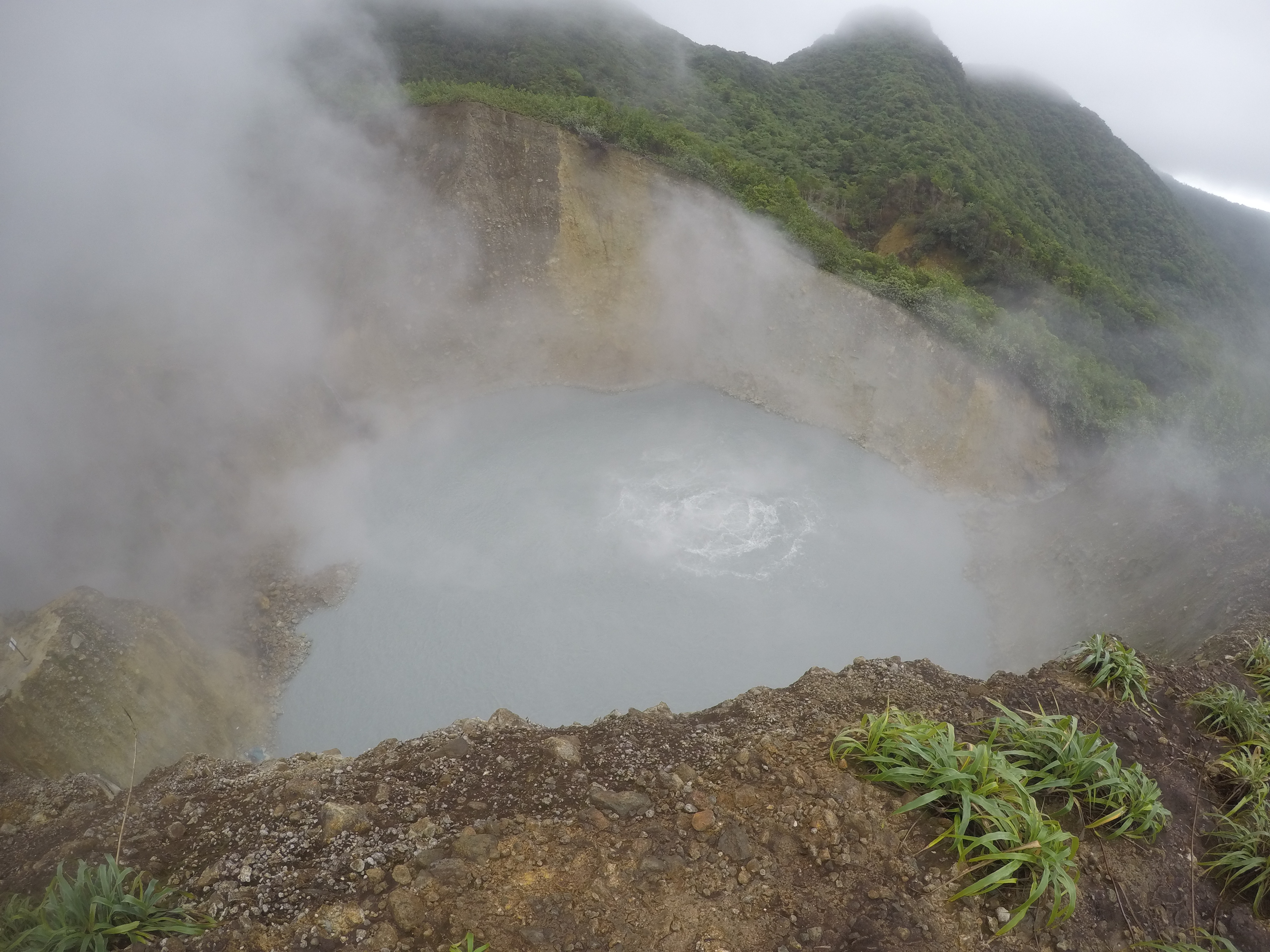
- The Boiling Lake, the world’s second-largest, is a mist-shrouded, grey-blue cauldron at the heart of Morne Trois Pitons National Park. The classic route is a demanding six-hour return hike through the aptly named Valley of Desolation, past steaming fumaroles and sulphur vents. It is the island’s rite of passage.
- Trafalgar Falls, the most accessible of the great waterfalls, is really two side by side: locals call them Papa and Mama, twin cascades tumbling into pools fed by hot-spring vents. You can reach the viewing platform in fifteen minutes and soak nearby.
- Champagne Reef is snorkelling and diving over a shallow reef where volcanic gas bubbles up from the seabed, so you drift through warm streams of effervescence with turtles and seahorses. There is nowhere else in the Caribbean quite like it.
- The Waitukubuli National Trail runs 115 miles across 14 segments from Scotts Head in the south to Cabrits in the north, making it the longest hiking trail in the Caribbean. Waitukubuli, “tall is her body”, is the Kalinago name for the island; you can walk a single segment in a day or the whole thing over a fortnight.
- Swimming with the whales, run under permit inside the new reserve, is the once-in-a-lifetime splurge, best from November to March when calm seas bring the family groups close to shore.

Woven through all of it is the Kalinago Territory on the east coast, home to the Caribbean’s largest surviving Indigenous community, where the island’s older story of canoe-building, cassava and craft is still very much alive.
A rhythm for a first trip: about 8 to 10 days
The mistake first-timers make is treating Dominica like a beach holiday. It is a nature trip, and it wants a little stamina and an unhurried pace. About eight to ten days is the sweet spot.
- Days 1 to 3, ease into the south and the capital. Base near Roseau, warm up on the shorter waterfall and hot-spring hikes, and dive or snorkel Champagne Reef and Scotts Head at the island’s tip.
- Days 4 to 6, the wild interior. Give the Boiling Lake its own day, and keep the next one gentle: gorge pools, the Emerald Pool, and a soak in a natural hot spring afterwards. Add a Waitukubuli trail segment if your legs are willing.
- Days 7 onward, the whale coast and the north. Move up towards Portsmouth and Cabrits National Park for the boat trips, the calmer beaches and, in season, the whales.
If you only have a long weekend bolted onto another Caribbean trip, do the south: Roseau, Trafalgar Falls and Champagne Reef alone make a memorable three days.
For Travellers From India
Visa. This is the easy part. Indian passport holders do not need a visa to visit Dominica; entry is visa-free for tourism, and immigration will expect a valid passport (keep at least six months’ validity), a return or onward ticket and proof of where you are staying. There is no sticker to arrange and no VFS queue, which is rare and welcome for a destination this far away.
Getting there. There are no direct flights from India, and Dominica’s current airport cannot take long-haul jets, so every routing connects. The practical shape is two hops: fly a Gulf or European carrier such as Emirates, Qatar Airways or British Airways to a Caribbean gateway, then take a short regional flight in. The usual gateways are Barbados (Bridgetown), Antigua, San Juan in Puerto Rico or Guadeloupe, from where interCaribbean, Winair and the revived LIAT fly on to Douglas-Charles. From Antigua the final leg is barely 45 minutes. Expect a long travel day and round-trip fares from the metros starting around ₹1.7 lakh. The good news on the horizon: a new international airport at Wesley, the largest project in the island’s history, is on track to open in 2027 with a runway long enough for direct wide-body flights, which will change the maths considerably.
When to go. The dry, breezy season from December to April is the sweet spot, and it lines up perfectly with the prime sperm-whale window of November to March, when calm seas bring the pods close. Steer clear of the official Atlantic hurricane season, June to November, when the heaviest rain and storm risk sit; most whale operators pause from late June through October for exactly this reason. If you want the greenest rainforest and the fewest visitors, the shoulder weeks of late November and early December are hard to beat.
Money, food and connectivity. The currency is the Eastern Caribbean dollar (XCD), pegged to the US dollar, and US dollars are widely accepted; cards work in Roseau, hotels and dive shops, but carry cash for village markets, guides and roadside stalls. Vegetarians eat well: the Creole kitchen leans on root vegetables, plantain, callaloo, breadfruit and the national dish of “mountain chicken” aside, plenty of fresh produce, so flag your preferences and you will be looked after. Buy a local SIM or an eSIM on arrival, because signal thins out fast in the mountains and river valleys where you will spend most of your days.
Exclusive Hotel Deals
Through our partnerships with luxury hotel programs, we can offer exclusive perks at 2+ properties in Dominica:
Secret Bay (5-star, Portsmouth)
- Upgrade on arrival, subject to availability
- Early Check-In / Late Check-Out, subject to availability
- Complimentary wifi
- Resort Credit of US$100
Intercontinental Dominica Cabrits Resort & Spa by IHG (IHG, 5-star, Portsmouth)
- $100 USD (or local currency equivalent) hotel credit per stay
- Daily complimentary breakfast for 2 guests (full or continental, depending on the hotel)
- Complimentary room upgrade (subject to availability)
- Local welcome amenity
Planning it well
Dominica is deceptively easy to love and genuinely fiddly to organise. The joins are the whole game: matching your dates to the whale season and away from the hurricane months, threading two flights so you do not lose a day to a missed connection, and booking the small, brilliant lodges early because they hold only a handful of rooms. Get those decisions right and the island unfolds effortlessly.
That is where a planner who knows the island earns their keep. At Tripcuro we build the routing from your city, time the trip to the whales and the weather, line up the permitted operators inside the new reserve, and secure the perks at the luxury properties, from Secret Bay to the InterContinental at Cabrits, that turn a wild adventure into a comfortable one. You get every waterfall and no logistics.
Let Tripcuro Plan Your Dominica Trip
Tripcuro designs your Dominica journey end to end, from the connecting flights out of your city to a route that pairs the Boiling Lake and the Waitukubuli Trail with the whales offshore. We match your dates to the season, secure the island’s best lodges with exclusive perks, and handle every join so the trip simply flows. Tell us how you like to travel, and we will build it around you.